

11 Affordable High-Horsepower Cars You Can Buy For Under $35,000
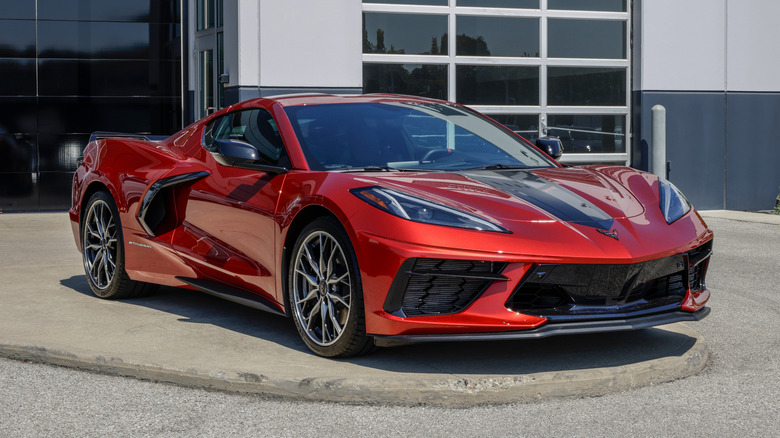
There's an incredibly strong correlation between engine output and sales price, with higher-performing vehicles tending to sell for more than the average model. This phenomenon is perhaps most easily described by looking at the exorbitant price leap horsepower can have within the same model. Take, for instance, the 2026 Corvette Stingray, which has a starting price of $72,495 for its baseline 1LT Coupe trim with an impressive 490-horsepower engine, per Car and Driver. While that's undeniably expensive already, the breathtaking 1,064 horsepower of the 2026 Corvette ZR1 jacks the price up to $187,495.
Naturally, this industry-wide trend keeps many thrill seekers from considering a high-powered vehicle, with the automatic assumption that the price tag is out of range. While roaring engines tend to come with additional costs compared to the standard vehicle, there are some inexpensive diamonds in the rough if you know where to look. Lucky for you, Money Digest has already done the digging. We've compiled a list of affordable high-powered cars you can buy for under $35,000. Of course, you'll be looking at the pre-owned side of the market, but these performance machines pack a quality punch in addition to their raw power.
To establish a benchmark, let's review the cost and engine specs of a run-of-the-mill model. In 2025, the Environmental Protection Agency estimated that the average car carried around 264 horsepower. All included models exceed this turbocharged yardstick. Additionally, the typical new model sells for around $49,220, according to Kelley Blue Book. Thus, the $35,000 price ceiling easily comes in under what the average consumer spends. The following tire-shredders are listed from lowest to highest horsepower, not by cost.
11. 2023 Dodge Hornet GT
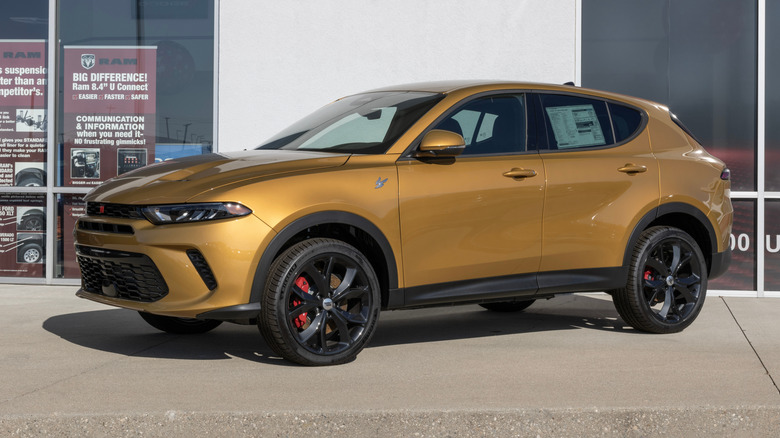
The 2023 Dodge Hornet GT kicks off the list of the most affordable high-horsepower cars you can buy for under $35,000 with a stellar output of 268 horsepower and 295 pound-feet of torque. For clarification, horsepower measures an engine's raw output potential over time, and torque tracks the twisting force of the drivetrain and wheels. Put more succinctly, torque is what gets a vehicle going, and horsepower provides the oomph. The entry-level four-cylinder turbocharged engine achieves 60 miles per hour in 5.5 seconds. What's more, the Hornet GT's standard all-wheel drive offers improved handling, better traction, and quicker acceleration. According to J.D. Power, the 2023 Dodge Hornet GT typically costs around $20,550, with a broader price range of $18,226 to $22,973.
CarEdge estimates that owners of the Dodge Hornet usually spend an additional $56,331 across various categories within the first five years of routine driving. Depreciation accounts for 43% of these long-term expenses, totaling $24,030. Unsurprisingly, the Hornet is not one of the cheapest cars to insure, with a coverage cost of $13,210. Fuel reaches $9,625 over half a decade. Per FuelEconomy.gov, the federal government's official database for automotive fuel efficiency, this model gets around 24 miles per gallon combined. Interest, for those taking out a loan, is another $6,068. Maintenance and repairs represent the lowest expense at $3,397. The Insurance Institute for Highway Safety (IIHS), the gold standard for independent vehicle safety ratings, often fails to test high-performance models. However, the Hornet comes standard with automatic emergency braking, pedestrian and cycling detection, lane-keep assist, and lane-departure warning.
10. 2020 Subaru WRX STI
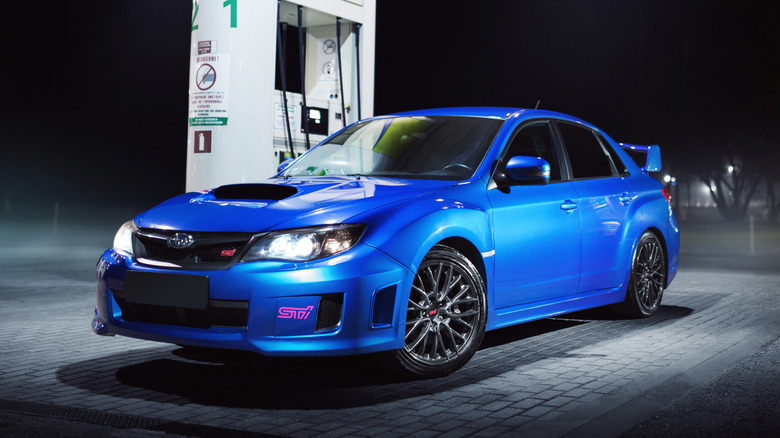
Subarus are widely known for their mass appeal. In fact, Money Digest has highlighted some of the best Subaru models for retirees, but this Japanese marque sneaks in some affordable road rockets into its lineup. For instance, the 2020 Subaru WRX STI boasts 310 horsepower and 290 pound-feet of torque generated from its 2.5-liter, flat-four engine. Also known as a boxer engine, the flat-four places its pistons in a square formation, with two on either side of the crankshaft, generating a smoother ride than a traditional inline-four design. J.D. Power reports that the average person pays about $25,850 for the 2020 Subaru WRX STI, placing it a solid $10,000 less than the price cap. The larger price range for this potent Subaru is $24,583 to $27,305.
CarEdge predicts that the typical owner of this model will spend an additional $47,357 over the first half decade of driving on various add-on costs. The Subaru WRX is not the best example for showing how quickly a car's value can depreciate after you buy it, due to its impressive residual value. After five years, this model only sheds around $14,264 of its original value. Insurance costs follow closely, stretching to $13,670. With an average gas mileage of 19 miles per gallon combined, as reported by FuelEconomy.gov, this nameplate's five-year fuel costs reach $10,500. Interest on a loan tack on an additional $6,768, while general upkeep is $2,155. The 2020 Subaru WRX, the baseline trim of the STI version, achieved a Top Safety Pick classification from the IIHS, the second-highest accolade from the independent testing organization.
9. 2020 Lexus IS 350
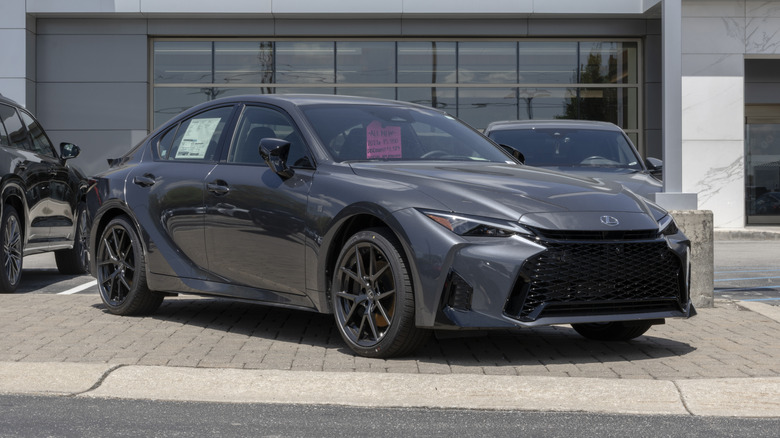
The 2020 Lexus IS 350 serves as proof that a punchy engine doesn't have to sacrifice dependability. In fact, Money Digest has pinpointed this popular, power-packed sedan as one of the vehicles more reliable than the best-selling Toyota Camry, which is no small feat. The 2020 IS 350 may be classified as a luxury sedan, but it surges into sports-car territory with 311 horsepower and 277 pound-feet of torque. The built-in V6, 3.5-liter engine sends this solid output directly to the rear wheels. J.D. Power reports that the average buyer of this nameplate spends around $27,741. The slightly expanded price range of the 2020 IS 350 only goes from $26,417 to $29,227.
According to CarEdge, drivers of the IS 350 should budget about $54,978 over the initial five years of ownership. These prolonged expenses are primarily eaten up by depreciation and insurance, which run about $19,311 and $16,265, respectively. These combined costs account for 65% of long-term expenses. With a decent fuel economy of 23 miles per gallon combined, as calculated by FuelEconomy.gov, the IS 350's half-decade gas costs are $10,045. There is an all-wheel drive option, but that tanks the fuel efficiency to 21 miles per gallon. If you're taking out a loan to afford this nameplate, you'll see another $7,413 of interest. Finally, maintenance and repairs are a modest $1,944, only 4% of these ownership expenditures. The IIHS gave the 2020 Lexus IS lineup perfect scores across crashworthiness tests and solid front crash prevention ratings.
8. 2020 Kia Stinger GT
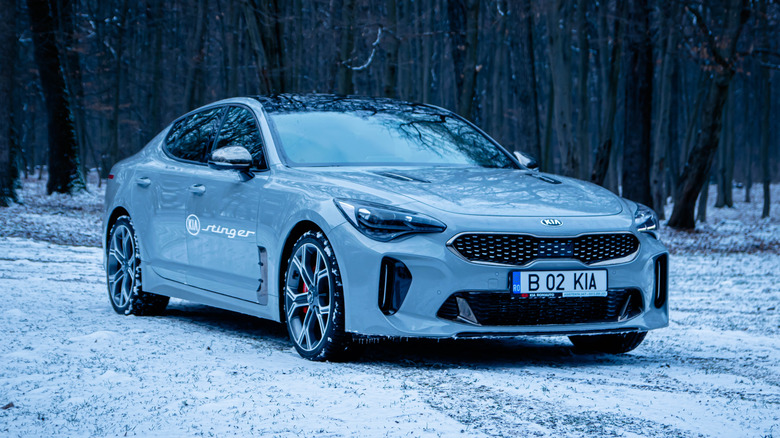
Money Digest has championed the Kia Stinger GT as a luxurious Audi A7 car alternative that's $40,000 cheaper. What's more, this sports-focused model muscles its way into direct competition with the Audi's most powerful models, with a 365 horsepower maximum output. 376 pound-feet of torque ensures the Stinger GT can make use of every single horsepower available. The 3.3-liter, twin-turbo V6 engine propels this model into the race for the most affordable high-horsepower cars you can buy for under $35,000. J.D. Power suggests that 80% of consumers spend between $21,515 and $23,785 on the 2020 Kia Stinger GT. The average cost settles at a reasonable $22,588.
CarEdge doesn't track ownership costs for the Kia Stinger GT, but Edmunds provides some location-specific costs, as opposed to national averages. To demonstrate the range of costs, we looked at long-term expenses in Sioux Falls, South Dakota, and Miami, Florida. In the former region, owners are looking at a five-year cost of $53,384. This figure is remarkably consistent when moving to the latter location, only adjusting to $51,752. It's worth noting that Edmunds includes taxes and fees in addition to the depreciation, financing, insurance, fuel, and upkeep costs included in CarEdge calculations. FuelEconomy.gov reports that the 2020 Kia Stinger GT achieves about 20 miles per gallon combined. The 2020 Kia Stinger model range was classified as an IIHS Top Safety Pick, with exceptional crashworthiness, although its headlights varied greatly.
7. 2020 BMW 3-Series M340i
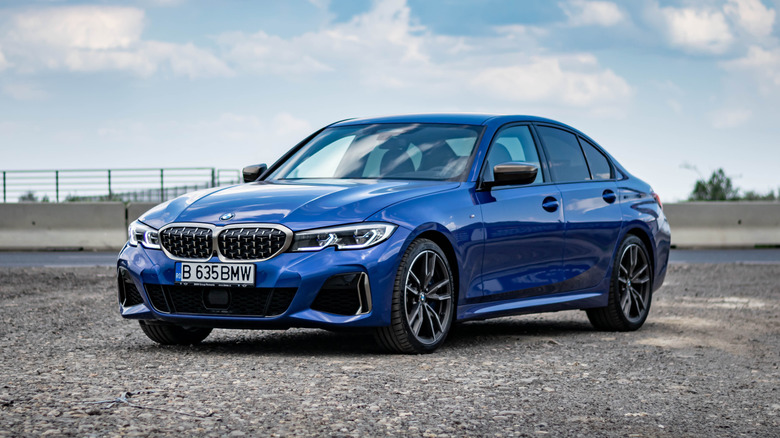
The 2020 BMW 3-Series M340i stands as another example of a full-throttle vehicle with robust engine power that still sports an accessible price tag. This sedan is equipped with a 3-liter, inline-six engine that spits out 382 maximum horsepower and 369 pound-feet of maximum torque. Similar to many sports-oriented vehicles, the M340i is powered by the rear wheels. According to J.D. Power, this 2020 release typically sells for $34,538, placing it just below the $35,000 threshold. It's worth noting that some models fall outside this limit, with 80% of drivers paying between $32,742 and $36,531 for this model.
During the initial five years of ownership, the BMW 3-Series demands about $67,622 of additional investment, according to CarEdge. The gradual loss of value is the largest single expense, accounting for 45% of these add-on costs. While depreciation runs $30,497 over half a decade, insurance coverage isn't too far behind at $16,125 over the same period. Unless you're buying this model outright, you'll see another $9,048 of interest. FuelEconomy.com references a fuel efficiency of 25 miles per gallon for the 2020 M340i. CarEdge places the five-year gas costs at $7,450. Maintenance and repairs are slightly higher than those of some more affordable models, reaching $4,501. This sedan doesn't sacrifice dependability, but there are many cars more reliable than the BMW 3-Series for buyers prioritizing this characteristic. The entire BMW 3-Series range received a Top Safety Pick recognition from the IIHS, sporting pristine crashworthiness and front crash prevention ratings, yet its headlight performance was mixed.
6. 2023 Nissan Z Sport
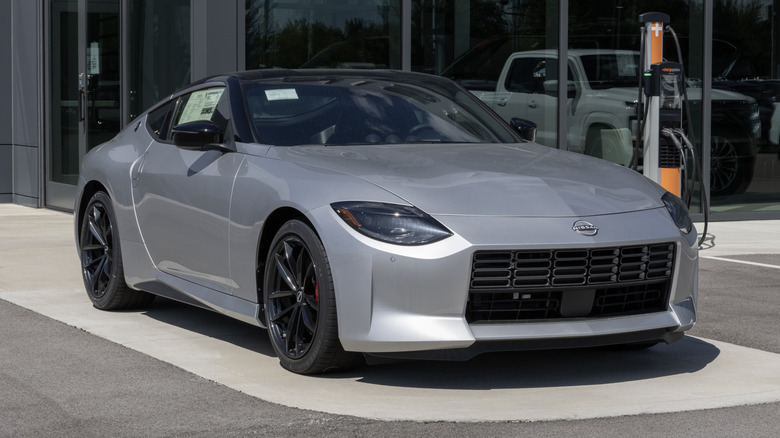
The 2023 Nissan Z is one of the newest models on this list of affordable high-horsepower vehicles, cheaper than $35,000. This two-door Nissan coupe is built for speed with a twin-turbo V6, 3-liter engine. Remarkably, this engine screams with a maximum of 400 horsepower and 350 pound-feet of maximum torque. In the vein of many sports models, the 2023 Nissan Z is rear-wheel drive. Despite exhibiting a higher horsepower capacity than many aforementioned models, the 2023 Nissan Z offers a stellar price tag. J.D. Power estimates that eight out of 10 buyers pay between $27,589 and $32,559. More pointedly, the average price for this model is $30,030.
In the first five years of driving the Nissan Z, most owners commit around $61,212 to long-term ownership expenses, beyond the model's upfront cost. According to CarEdge, depreciation is the priciest of these categories, with this sporty model losing $23,731 of its original value over half a decade. Insurance coverage tends to cost $14,905 over this period. At the fuel pump, owners usually experience a total bill of $11,550. FuelEconomy.gov adds further insight, detailing that the 2023 Nissan Z gets about 22 miles per gallon combined. Interest, for consumers financing their purchase, costs an additional $8,777. General upkeep is the least burdensome expense at $2,248. While the Nissan Z is an undeniably attractive coupe, it's among the worst of the Nissan cars for retirees. The 2023 Nissan Z Sport didn't get an IIHS assessment, but this model comes standard with a slew of safety features, such as adaptive cruise control, lane-departure warning, and automatic emergency braking.
5. 2017 Chevrolet Corvette Stingray
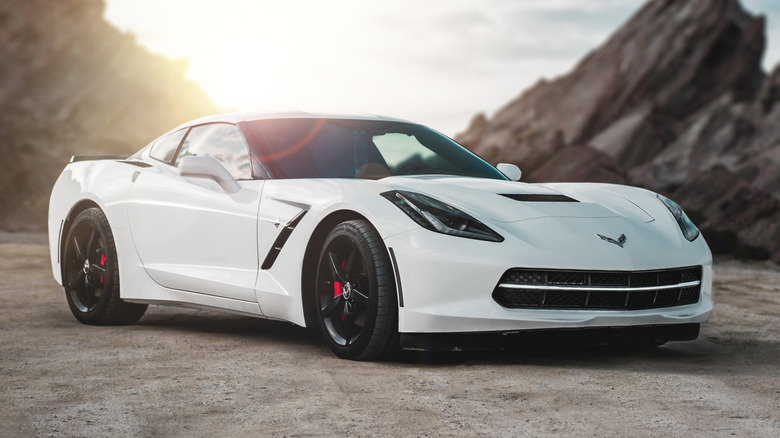
The 2017 Chevrolet Corvette is the earliest horsepower-rich model included in this list, which testifies to the sheer demand and popularity of America's favorite sports car. The Stingray exhibits 455 horsepower, roaring out of a powerful 6.2-liter V8 engine. An accompanying 460 pound-feet of torque allows this sports model to make the most of its remarkable maximum horsepower. If you have an opportunity to safely test the 2017 Stingray's zero-to-60 sprint, you may do it in under four seconds. In fact, road tests show this nameplate can achieve the milestone in a neck-breaking 3.7 seconds. J.D. Power reports that 80% of 2017 Corvette buyers spend around $32,439 to $36,584, placing some outside of the $35,000 cap. However, the average price is closer to $34,400.
While the Corvette Stingray exhibits the highest upfront costs on this list of affordable high-horsepower cars, it also displays the heftiest long-term ownership expenses. According to CarEdge, Stingray owners usually put up $80,071 over five years across various categories. In line with most models, depreciation accounts for the overwhelming majority of this expenditure, comprising $36,201 of these costs. Insurance coverage racks up another $16,075, or about one-fifth of these half-decade investments. Unless you can afford the Stingray outright, you're looking at an additional $12,836. Fuel costs bite at the heels of interest costs, totaling $12,160. Per FuelEconomy.gov, the 2017 Corvette Stingray gets 19 miles per gallon combined. Maintenance and repair costs are modest at $2,799. Crucially, this iconic car is also one of the deadliest in terms of crash fatalities.
4. 2020 Chevrolet Camaro (SS & LT1)
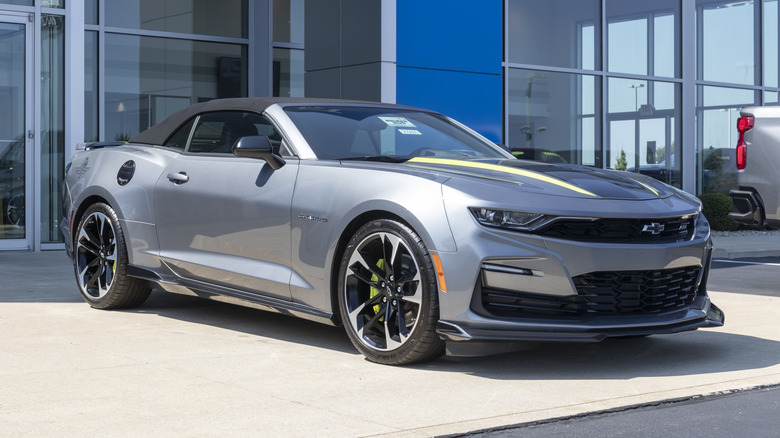
The 2020 Chevrolet Camaro offers two different high-horsepower trims to consumers that fall under the $35,000 limit. Both the Camaro SS and LT1 feature a screaming 6.2-liter V8 engine. Furthermore, these Camaros exhibit 455 maximum horsepower backed up by 455 pound-feet of torque, allowing these punchy engines to reach their optimal muscularity. Even the entry-level trims of the 2020 Camaro, which only sport 275 horsepower, achieve the zero-to-60 test in 5.1 seconds, displaying stellar acceleration and remarkable speed. J.D. Power reports that the 2020 Camaro SS has an average price of $31,025, with 80% of buyers landing in the $29,505 to $32,700 range. The LT1 comes in slightly cheaper with a typical sales price of $23,200 and a broader cost spectrum of $22,063 to $24,453.
The Chevrolet Camaro drives up a five-year ownership expense of $52,592, as calculated by CarEdge. The Camaro's gradual loss of value is moderate, only making up 35% of these overall costs, at a total of $18,150. Additionally, insurance requires $13,005 of expenditure, roughly one-quarter of these half-decade investments. Drivers tend to spend about $11,550 at the gas station during this period. More specifically, the 2020 Camaro SS struggles in the fuel efficiency department, getting around 16 miles per gallon combined, per FuelEconomy.gov. The LT1 trim is much more fuel efficient, achieving 20 miles per gallon combined. It's vital to note that the Camaro has been recognized as one of the worst cars for retirees due to its poor reliability. The IIHS report on the 2020 Chevrolet Camaro lineup indicates superior crashworthiness but below-par front crash prevention.
3. 2020 Ford Mustang GT
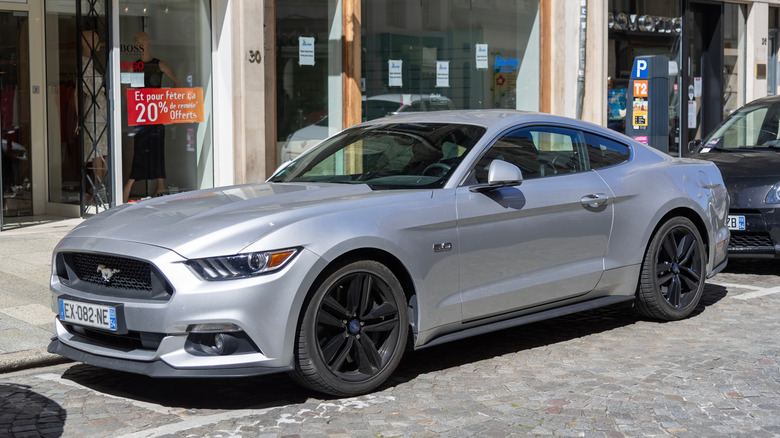
While there are several reasons retirees regret buying a Ford Mustang, those looking for a mighty engine, competent handling, and mind-blowing horsepower will feel right at home with this relatively affordable purchase. The 2020 Ford Mustang GT exerts a maximum horsepower of 460 and a maximum torque of 420. The throaty five-liter V8 engine gives this sports vehicle excellent acceleration. The 2020 Ford Mustang GT has an average sales price of $29,200, per J.D. Power, giving buyers plenty of breathing room below the $35,000 target. Furthermore, even the upper end of the broader price range, which is $27,924 to $30,888, falls under this ceiling.
According to CarEdge, owners of this nameplate usually see an additional expenditure of $62,776 over the initial half decade of routine driving. The landscape of costs reflects that of most other high-powered models, with depreciation swallowing 47% of these expenses. Over five years, the Mustang powers through $29,541 of its initial value. Insurance coverage on this uber-successful model averages $13,330. Fuel costs rise to $9,240. FuelEconomy.gov indicates that the 2020 Mustang GT gets an average of 19 miles per gallon combined. Interest on a loan for this nameplate will cost the typical owner $8,125. Maintenance and repairs round out the total costs at $2,539. The Ford Mustang lineup in 2020 exhibited solid crashworthiness scores from the IIHS, all falling above the market trend line.
2. 2020 Dodge Charger Scat Pack
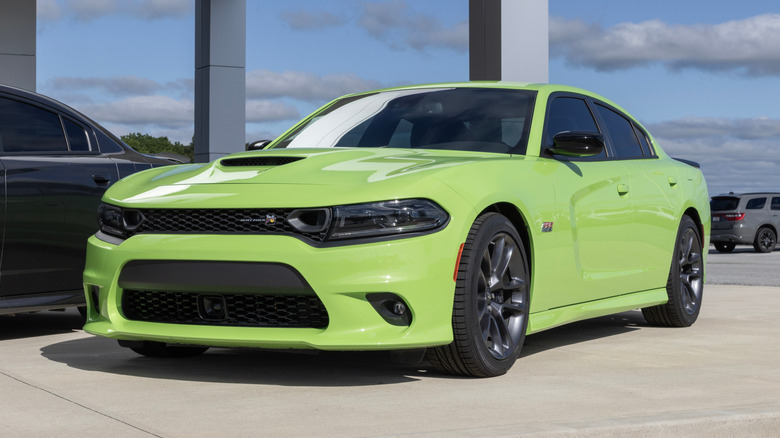
The 2020 Dodge Charger Scat Pack pushes closer to the 500-horsepower territory with a staggering 485 horsepower. The thundering V8 engine displays a lightning-quick 4.1 second surge from zero to 60 miles per hour. A maximum torque of 475 pound-feet assists the 2020 Charger in achieving its full force of output on the road. J.D. Power indicates that consumers interested in this model would only have to contend with an average sales price of $30,343. For additional context, eight out of 10 buyers spent around $28,965 to $31,978, meaning nearly all transactions fell far below the $35,000 price barrier. This stunning model doesn't come without some risk, as many Charger trims were among the most likely cars to be stolen. It's a fate that the upcoming Challenger doesn't escape, either.
Since CarEdge doesn't offer prolonged ownership costs for the Charger, the Edmunds spread will offer the data. For reference, in the city of Sioux Falls, owners typically spend $61,815 on this model, across insurance, maintenance and repairs, financing, depreciation, fuel, and, in contrast to CarEdge's calculations, taxes and fees. Demonstrating the potential range in costs, these long-term ownership costs are $59,303 in Miami. Unfortunately, the 2020 Dodge Charger Scat Pack's stunning horsepower capacity places a serious burden on fuel efficiency, with FuelEconomy.gov reporting an average of 18 miles per gallon combined, helping to explain these high fuel prices. The 2020 Dodge Charger earned decent IIHS results, although it fell short of the industry benchmark on the small overlap front crash test. Its headlights were deemed poor.
1. 2020 Dodge Challenger R/T Scat Pack
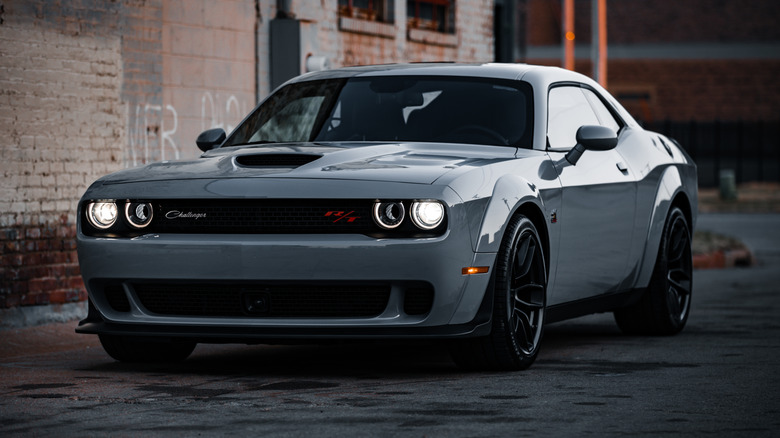
The 2020 Dodge Challenger R/T Scat Pack completes our list of affordable high-horsepower cars you can buy for under $35,000, but it ties its Dodge Charger counterpart in engine output. This powerhouse is stocked with a 6.4-liter V8 engine with a top horsepower of 485 and a max torque of 475 pound-feet. The two-door speedster usually sells for $33,411, as reported by J.D. Power, although some models extend beyond our price cap. For instance, 80% of consumers pay between $31,890 and $35,215 for this model.
We run up against the same lack of CarEdge information, requiring the intervention of Edmunds' ownership costs, using our same location-based range in place of a national average. In Sioux Falls, South Dakota, drivers should expect to spend an average of $61,969 on top of their upfront costs for the 2020 Dodge Challenger R/T Scat Pack. In contrast, those in Miami, Florida, are looking at a five-year bill of $60,005, spread across insurance, depreciation, financing, fuel, maintenance and repairs, and taxes and fees. Notice that these prolonged ownership expenses don't vary much between locations, suggesting a rather predictable cost. FuelEconomy.gov reports that the 2020 Dodge Challenger R/T Scat Pack model displays a fuel efficiency of 18 miles per gallon combined. The 2020 Dodge Challenger received a checkered IIHS report, struggling on crashworthiness and front crash prevention.