

13 Reasons Retirees Regret Moving To The East Coast

Many Americans stay in the workforce for around 40 years or more before they retire. Once those decades of work are complete, it's common for retired seniors to move to optimize their sunset years elsewhere. According to Hire A Helper's analysis of PGM data, over 2.1 million U.S. seniors aged 65 and older moved in 2025, and the East Coast received much of that traffic: Five states located in this portion of the country ranked among the top 10 recipients of interstate senior movers. While this popular area has a lot to offer, retirees may be surprised by some financial realities they could encounter should they settle there.
The National Oceanic and Atmospheric Administration defines this part of the country as the 14 states with frontage on the Atlantic Coast. More plainly, the East Coast includes Maine, New Hampshire, Massachusetts, Rhode Island, Connecticut, New York, New Jersey, Delaware, Maryland, Virginia, North Carolina, South Carolina, Georgia, and Florida. To help seniors understand why this area may be a tough match for their financial goals, we've pulled together 13 reasons retirees regret moving to the East Coast. Due to the geographic extent and economic diversity of the region, not every single financial consideration discussed applies evenly to all 14 states. However, you may be surprised to find how many eastern states share common ground when it comes to the financial challenges they impose.
1. Home prices can eat into retirement savings
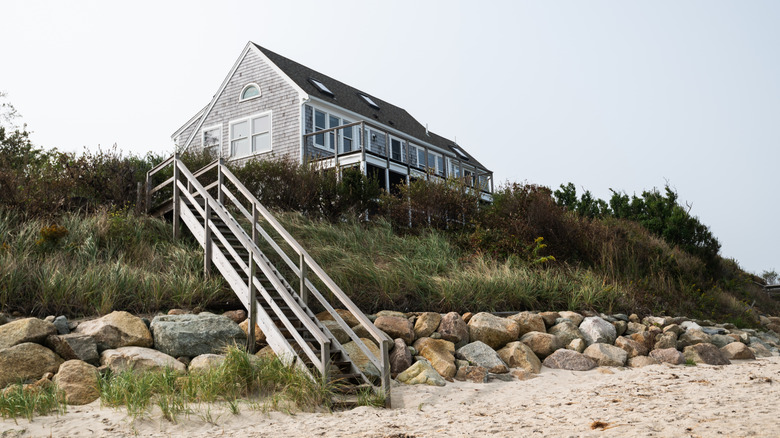
When relocating for retirement, buying a home is likely one of the largest purchases you'll encounter. Unfortunately, the East Coast includes many states with home prices exceeding the national average, with the Northeast displaying exceptionally high real estate costs. According to the National Association of Realtors (NAR), the median single-family home in the Northeast cost $561,500 in Q3 2026, considerably more than the nationwide median of $432,900. In addition to having higher housing prices, the Northeast showed a greater year-over-year increase in real estate costs. While nationwide home prices rose 1.7% from the same period the prior year, the Northeast's housing prices rose by 4%. Additionally, these higher costs aren't exclusive to the northernmost East Coast states: The median home price in Maryland, per Maryland Realtors, was $445,000 in August 2026.
For perspective, the average value of an owned home for Americans aged 65 to 74 was $378,492 in 2025, per the Federal Reserve, suggesting many retirees with homes to sell may still need to dip into their savings to afford a new place on the East Coast. This cost discrepancy can severely affect a retiree's housing options and financial flexibility, especially for those coming from areas with less valuable real estate. The Midwest, for example, had a median home price around $342,500 in Q3 2026.
2. Property taxes remain expensive after the mortgage is paid off
Moving to a state with higher property taxes when relocating for retirement is one of the state tax traps you should know about. Of the 14 states that comprise the East Coast, nine ranked in the top half of states the Tax Foundation ranked from highest effective property tax to lowest in 2024, with New Jersey, Connecticut, and New Hampshire all sitting in the top five. New Jersey topped the list with an effective property tax rate of 1.88%, while Connecticut and New Hampshire clocked in at 1.54% and 1.5%, respectively. Georgia also ranked in the top half of states for property tax rates, charging residents .79%. Meanwhile, the 10 lowest effective state property tax rates all sat at .52% or lower, and South Carolina was the only East Coast state to fall into this grouping at .49%.
Assuming you purchase a home worth $400,000, that would suggest New Jersey would require annual payments of roughly $7,520. Meanwhile, the yearly costs in Connecticut and New Hampshire would reach $6,160 and $6,000, respectively. The Federal Reserve Bank of St. Louis reported that housing made up over 36% of total annual expenses for U.S. citizens aged 65 and older in 2025. While mortgage payments and rent make up the most of this expense category, living in a place with higher-than-average property taxes could balloon spending on this subcategory of housing costs considerably.
3. Natural disasters can spike insurance coverage

Living in an area with a higher prevalence of natural disasters is a sneaky reason your property insurance rates can go up. After Hurricane Katrina's devastation cost insurers $64 billion in losses, companies started implementing storm deductibles at a greater rate than in the past, which places more financial risk on policyholders in the event of home destruction due to a natural disaster. According to the National Association of Insurance Commissioners (NAIC), 13 of the 14 states on the East Coast have storm deductibles. This could mean East Coast transplants are taking on a high concentration of financial risk, given that only 19 states in total had these policies in 2025.
The NAIC explains that storm deductibles are often applied as a percentage of a policyholder's home value, with most policies ranging between 1% and 15%. If a retiree purchases a home for $400,000, even a mid-range storm deductible of 5% would require an out-of-pocket expense of $20,000. New Hampshire, the only East Coast state without storm deductibles, still poses flood risks along its waterfront. However, the National Flood Insurance Program caps insurance coverage at $250,000, well below the average price of a home in the Northeast.
4. Condo and HOA fees can rival a second mortgage

Homeowners association (HOA) fees represent another reason retirees may regret moving to the East Coast. The U.S. Census Bureau shows that the median homeowner pays about $137 monthly in HOA or condominium fees. Furthermore, nationwide data indicates that eight of the 14 states making up the East Coast have HOA fees that exceed that figure. New York leads the pack with a median monthly fee of $809. That translates into an annual cost of $9,708, which can quickly add up for retirees on a fixed income. Massachusetts, Connecticut, New Hampshire, Rhode Island, and New Jersey round out the next five highest median HOA costs for the East Coast, costing homeowners more than $300 monthly, or $3,600 yearly.
Maine and Florida are the final two states from this region with rates higher than the U.S. median, with monthly dues reaching $248 and $234, respectively, resulting in annual fees of $2,976 and $2,808. HOA and condominium fees can often be even higher in senior-focused communities and neighborhoods, which gives retirees considering a move to the East Coast more to think about. It's much better to avoid moving to a place with high hidden housing costs if you can swing it, especially if you don't want to find out what happens if you don't pay your HOA fees.
5. Electricity costs can be much higher than expected

Even if you're comfortable with the above-average housing costs and lofty HOA expenses present throughout much of the East Coast, you may still want to factor electricity costs into your retirement relocation equation. The U.S. Energy Information Administration (EIA) shows that eight of the 14 states in this region have electricity costs higher than the national average, hitting seniors with comparatively pricey monthly utility costs. In 2025, the average price of electricity for residential customers was 17.23 cents per kilowatt-hour (kWh).
Massachusetts ranks as the most expensive state on the East Coast for electricity, with an average of 30.41 cents per kWh. Rhode Island and Connecticut aren't far behind, with costs of 29.48 and 29.31 cents per kWh, while Maine and New York charge around 27.69 and 26.39 cents per kWh, respectively. The EIA reported that the average household used 10,791 kWh of electricity in 2022. Using this national average figure, the typical home in the U.S. would have an estimated electricity bill of $1,869. For retirees living in Massachusetts, Rhode Island, or Connecticut, this yearly expense jumps to over $3,000. Even in Maine and New York, residents would face an estimated annual costs around $2,988 and $2,848, respectively. While smart home devices can slash your utility bills, these above-average expenses can still chip away at a senior's budget in a meaningful way.
6. Retirement income isn't always exempt from state taxes

Whether you're earning the average retirement income in the U.S. or more, preserving your nest egg is a must in your golden years. Most states levy taxes on traditional individual retirement accounts like IRAs and 401(k)s, with only 13 exempting retirement distributions from these plans. Unfortunately for retirees relocating to the East Coast, only two states in the region offer these exemptions: Florida and New Hampshire. The remaining 12 levy some sort of tax on at least certain forms of retirement income.
Massachusetts applies a flat tax rate of 5% across various types of retirement income, including pensions, IRAs, and 401(k)s. Meanwhile, seniors in North Carolina face a flat 3.99% tax impacting pensions, IRAs, and 401(k)s at all income levels. However, it is worth noting that some states on the East Coast set a minimum amount of annual retirement income before taxes take effect. For example, Virginia offers a tax deduction on retirement income up to $12,000 for residents 65 and older, although higher earners may see a reduction in this tax break. Depending on your income level, the state's tax rate ranges between 2% and 5.75%. This deduction is raised to $20,000 in New York and kicks in when retirees reach the age of 59 ½. However, the Empire State's income-dependent retirement tax rate range is slightly higher, at 4% to 10.9%.
7. Estate taxes can reduce what retirees leave behind

Many people don't consider the tax implications of estate sales or inheritance costs before relocating for retirement. Yet, surprise costs like estate taxes can end up costing their descendants more than they anticipate. According to the Tax Foundation, 12 states in the U.S. impose an estate tax, several of which lie on the East Coast.
Rhode Island and Massachusetts stand out for their comparatively low exemption rates, which represent the dollar amount at which estate taxes are triggered. In Rhode Island, any estate valued over roughly $1.84 million is taxed between .8% and 16%. The estate tax range is the same in Massachusetts, but the exemption amount is slightly higher at $2 million. A NetWorthCalculator review of government data reports that around 20% of seniors 65 and older have a net worth of $2 million or more, meaning a sizable portion of retirees in these areas could have their estates taxed after their passing.
Maryland, the only state in the country to impose both estate and inheritance tax, carries on with the same estate tax range after a $5 million deduction. Meanwhile, Maine's minimum estate tax is the highest on the East Coast, at 8%, but Maine decedents' estates won't be taxed unless they're valued above $7.16 million.
8. Sales taxes can make everyday spending more expensive

Some retirees seek out retirement destinations to lower their effective tax rate, but 12 of the 14 states on the East Coast apply a general statewide sales tax. New Hampshire and Delaware are the only states without a base sales tax on the East Coast, and residents in the others may also have to contend with local and municipal sales taxes to boot.
Retirees in Rhode Island see the highest rate of 7%, while seniors living in New Jersey, Connecticut, or Massachusetts are all subject to rates above 6%. South Carolina, Maryland, and Florida all levy a flat 6% sales tax. These rates are above 5% in Maine and Virginia, and at least 4% in North Carolina, New York, and Georgia.
However, even states with lower statewide sales tax rates like New York and Georgia have average local tax rates of 4.54% and 3.49%, respectively. Seeing as the Federal Reserve reports that Americans aged 65 and older spent an average of $64,445 in 2025, it's possible the average East Coast retiree could wind up losing upwards of $5,500 to sales tax annually, depending on their location.
9. Medicare supplement premiums can vary dramatically by location

Assuming standard plans cover everything is one of the Medicare mistakes retirees should avoid at all costs. Medigap, also referred to as Medicare Supplement Insurance, is private coverage that can help cover out-of-pocket expenses policyholders with only Original Medicare plans would need to pay. On top of Part B Medicare, Medigap usually comes with monthly premiums. Although these rates vary based on coverage types, seniors can also see different financial costs based on where they live. KFF reports that the national average monthly premium for Medigap was $244 in 2025. Nearly half of the states comprising the East Coast exceed this nationwide average, adding more healthcare costs to the budgets of relocating seniors.
New York actually represents the most expensive Medigap costs in the U.S., with a monthly average of $306. Florida is the second-most expensive East Coast state, displaying an average monthly rate of $262. Maryland follows closely behind at $260 per month. New Jersey, Connecticut, and Maine complete the list of East Coast states with Medigap costs higher than the national average, with premiums around $258, $255, and $250, respectively. KFF suggests that 50% of Medicare enrollees 65 and older sign up for Medigap, so retirees who don't factor these costs into their moving calculations could end up spending more than they bargained for on healthcare.
10. Long-term care can quickly drain retirement assets

Many healthcare costs can sneak up on you in retirement, but moving to a state with expensive long-term care is among the more financially cumbersome. Milliman's Long-Term Care Index projects that 60% of women and 53% of men aged 65 and older will need to pay for long-term care at some point in their lives, and these costs can be disproportionately high in some East Coast states.
According to CareScout, 11 states on the East Coast outrank the national median for a private room in a nursing home. North Carolina is the closest, with an annual estimated cost of $129,575, while Connecticut and New York tie as the No. 2 priciest states nationwide for long-term care: Each cost seniors a median of $200,750 per year for a private room. Massachusetts and Delaware have annual median prices of $189,800 and $181,588, respectively, while seniors in Maine often spend about $178,850 for a private room in a nursing home. New Jersey and Maryland are tied at $173,375. When looking at the East Coast, only South Carolina and Georgia have long-term healthcare costs that fall below the national median.
11. Car insurance can be another expensive surprise

While there are ways to save on car insurance, where you live plays a large role in how much you pay for coverage. Another financial consideration for retirees thinking about a move to the East Coast is the region's high concentration of above-average car insurance rates. Insurify reports that 10 of the 14 easternmost states have rates that exceed the U.S. average, with eight ranking among the 10 costliest states. The latest Federal Reserve data indicates that 88% of Americans 65 and older possessed at least one vehicle in 2025, suggesting these costs will impact most retirees.
As of November 2026, Insurify reports the average monthly car insurance rate in the U.S. is $187, or about $2,244 annually. Maryland ranks as the most expensive state on the East Coast for full vehicle coverage, with a monthly average of $301, or $3,612 annually. Rhode Island and Delaware fall closely behind with monthly averages of $295 and $263. These elevated coverage rates aren't relegated to the Northeast, either. Georgia, South Carolina, Florida, and Virginia all rank above the national average. Adding to these costs, a 2026 study from The Zebra reports that seniors already face higher-than-average auto insurance premiums, jumping by an average of 32% between 60 and 80 years old.
12. Tolls and congestion charges can be severe

According to the University of Michigan's Institute for Healthcare Policy and Innovation, 62% of individuals 65 and older drive most days. Although seniors drive less than the broader population, the U.S. Department of Transportation reported in 2022 that those 65 and older still average 7,646 miles per year. The Federal Highway Administration shows that 13 of the 14 states on the East Coast operate toll roads, lanes, or bridges, adding a potential recurring transportation cost for seniors. Connecticut is the only state in the region without these tolled roadways. Georgia doesn't have any toll roads, but some express lanes are tolled.
Florida is a noticeable outlier with 52 toll facilities. TollGuru estimates that driving the whole length of the Florida Turnpike, where most of these tolls are located, would cost about $23 without a discounted pass for standard passenger vehicles. New York and New Jersey both have 33 priced facilities. Seniors hoping to relocate near major metros should be especially cautious of this expense: For example, New York City has a Congestion Relief Zone in southern Manhattan that charges passenger vehicles $9 to pass through during the day or $2.25 overnight.
13. Real estate closing taxes can make relocation even costlier

The East Coast has already shown a tendency to place a disproportionate financial burden on retirees when they buy, insure, and pay taxes on their homes. However, these region-specific costs can even apply when selling a home. Notably, an AARP survey found that 44% of Americans 50 and older plan to move, citing rising living costs as the main catalyst. Residents of all 14 states on the East Coast are potentially subject to real estate transfer taxes when selling a home, although some exemptions and exclusions may apply.
Delaware's fixed real estate transfer tax of 2.5% is the highest in the country, but county or municipal taxes can raise the rate to 4% of the home's value. Usually, these costs are shared between buyers and sellers. Thus, selling a $400,000 home in Delaware would result in upwards of an $8,000 transfer bill for retirees in the state. In Connecticut, the real estate transfer tax is a minimum of 1% of a home's value, with .75% coming from state taxes and the other .25% from municipalities. Since all of these fees typically fall on the seller, seniors selling a $400,000 house in Connecticut could be on the hook for at least $4,000 — and these rates aren't exclusive to the Northeast. Much of Florida levies a .7% tax on real estate transactions, often paid by the sellers. On a $400,000 sale, that bill would represent an additional $2,800 expense for retirees.