

10 Reasons Retirees Regret Buying An RV

For many Americans, their post-retirement years represent an unprecedented period of downtime and financial freedom. Many seniors dream of exploring the expansive reach of the United States, where they can bask in the natural beauty of national parks, enjoy the solitude of rural America, or take in the hustle and bustle of major metropolises. In fact, those 65 and older are more likely than all other age groups to have visited at least 20 states. According to a 2025 YouGov survey, 24% of seniors have visited between 20 and 29 states, while 32% have been to 30 or more. In contrast, those figures drop to 20% and 16%, respectively, for those aged 45 to 64. The desire for freedom, flexibility, and sightseeing leads many retirees to consider buying a recreational vehicle (RV).
After all, these vehicles offer a convenient combination of accommodation and transportation, making them more comfortable for extended trips than passenger vehicles. Unfortunately, many seniors underestimate the full costs of buying, maintaining, driving, storing, and even selling RVs. In reality, the same features that make RVs so appealing also contribute to elevated costs compared to other vehicles. Owners are effectively paying for a method of transportation and accommodation, along with all the maintenance, repairs, and upkeep associated with each function. To help seniors make a grounded financial decision, we've highlighted 11 reasons retirees regret buying an RV. These downsides don't automatically override the benefits of owning an RV, but may help seniors accurately weigh all the potential considerations before they invest in one.
1. Upfront costs can make RVs disproportionately expensive to buy

RVs come in a wide range of designs, and some of the most prohibitive expenses associated with them are their upfront costs. Motorhomes, such as Class A, B, and C, are self-motorized, while travel trailers, truck campers, and fifth-wheels need to be towed by another vehicle. Go RVing estimates that drivable RVs range in cost from $65,000 to $250,000, while towable options range from around $10,000 to $70,000. Given these exorbitant initial costs, it's not surprising that the RV has a reputation for being the popular vehicle new retirees instantly regret buying.
According to a report by Camping World Holdings, Inc. — the largest RV distributor in the U.S.— published by the Securities and Exchange Committee (SEC), the brand's average new RV sale price in 2025 was $37,083. While that's lower than many options out there, the Federal Reserve reported that the median retirement savings for those 65 and older in 2025 was $257,000. So, Camping World's average RV could eat up over 14% of the median retiree's savings when bought in full.
These steep upfront costs are really put into perspective when compared to the cost of renting. In 2025, Go RVing owners only used their RVs a median of 30 days out of the year. Since RV Share indicates that the average nightly cost of a rental RV is between $50 and $450, renting even an expensive RV at that rate would only come out to around $13,500. Depending on a retiree's usage habits and financial standing, buying an RV outright could be unnecessarily expensive.
2. RVs can come with burdensome financing rates

Some retirees may be tempted to take out a loan to minimize the preliminary costs of buying an RV. However, the industry is known for its high interest rates and extended terms. Although financing can cut initial costs, you'll inevitably end up paying more in the long run, solidifying the RV's position as one of the assets that won't increase your net worth. LendingTree estimates that the average loan interest rate in Q3 2026 was 7.6% on new RVs and 7.66% on used models, though borrowers with lower scores can expect to pay higher rates.
According to the RV Industry Association's (RVIA) Survey of Lenders' Experiences, the average loan amount for new RVs was $61,261 in 2025, while financing averaged $59,266 for used models. Plugging these average loan amounts into LendingTree's RV loan cost calculator suggests retirees would incur monthly payments of $730.38 for new RVs and $708.46 for used models, assuming a 10-year loan period.
Although longer repayment timelines can shrink this monthly burden, the amount seniors pay over time rises significantly. Looking at the same numbers, retirees would face a total net interest of $58,083.10 on a 20-year loan — versus $26,384.63 on a 10-year loan — when buying new. At the same time, the total interest required on a used RV jumps from $25,748.83 to $56,715.88. While financing can be a strategic way to reduce immediate spending, it's crucial to consider how much total spending can increase based on interest rates and loan terms.
3. RVs can depreciate extremely rapidly after they're purchased

Depreciation is defined as the value an asset loses over time. While vehicles are notorious for their declining worth, the value loss you can anticipate when buying an RV can be even more egregious. RVs tend to lose about 20% of their original value immediately after purchase, if not more. So, seniors who purchase an RV for $100,000 could immediately lose $20,000 after signing on the dotted line. If all vehicles depreciate over time, why is this a unique consideration for RVs?
Well, the average car depreciates only 16% in a year, per Kelley Blue Book, and takes two years to lose 30% of its value. Of course, some vehicles do beat the odds by retaining over half their value after 10 years, but that's something of a rarity. This suggests that RVs in general depreciate at a faster rate than passenger vehicles, and depending on the type of RV you own, the difference can be drastic. J.D. Power suggests that towable models tend to hold onto their initial costs longer than larger RVs. For example, travel trailers tend to lose 40% of their value within five years, while fifth-wheels depreciate by 45% during the same period. It is worth noting that drivable RVs tend to have more attractive depreciation rates, but since these are often more expensive than towable alternatives, the amount they'll cost owners in this regard can still be extremely prohibitive. Class A models tend to lose 30% of their value in just three years, and Class C RVs give up about 38% over five years.
4. Towable RVs can come with severe hauling requirements
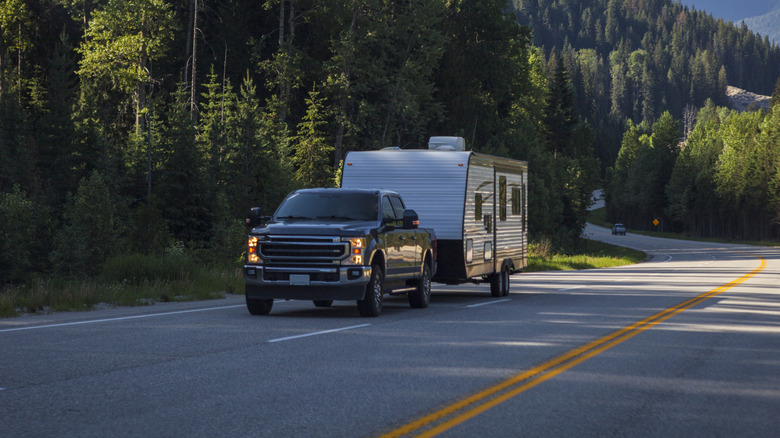
Towable RVs may seem like an economical choice when looking at the upfront costs of RVs, but these more affordable models can come with lofty knock-on expenses. While crossovers and SUVs are suitable for hauling smaller campers or trailer-style RVs, trucks can be more ideal — and sometimes necessary — for larger towable models. According to Jayco, travel trailers can weigh up to 12,000 pounds, while fifth-wheels can reach 16,000 pounds. Both those figures far exceed the towing capacity of many popular SUVs, and a 2025 Kaiser Associates survey showed that only 8% of those 55 to 74 were even interested in owning pickup trucks. That figure dropped to just 6% for those 75 and older, and part of the reason trucks are so unappealing to older drivers is undoubtedly the costs associated with them.
According to Kelley Blue Book, the average transaction price for a new full-size pickup truck reached $67,912 in October 2026, compared to $51,109 for all new vehicles. While there are some cheap pickup trucks that don't sacrifice size, purchasing a vehicle to tow an RV would dramatically escalate the total costs retirees face. Of course, trucks also come with other ownership costs, including insurance premiums, maintenance and repairs, depreciation, and fuel. Additionally, the parts and labor required to install a trailer hitch compatible with a towable RV can cost upwards of $300 to $650, per HomeGuide, and that figure can go up considerably depending on the type of RV you buy: For instance, fifth-wheels need a special type of hitch, which HomeGuide estimates can cost upwards of $1,800.
5. An RV's fuel economy can spike what a retiree spends on gas

Excessive fuel costs are another reason many retirees regret purchasing an RV. Generally, larger vehicles have poorer fuel economy due to their weight and wind resistance. The U.S. Department of Energy reports that fuel efficiency can drop by 1% for every 100 pounds. RV Share estimates that Class A, B, and C models have an average mile-per-gallon range from 6 to 18. For perspective, the Environmental Protection Agency reported in 2025 that the average real-world fuel economy for all passenger vehicles is 28.1 miles per gallon. So, fuel spending may prove a particular shock to retirees who buy an RV if they're largely used to driving traditional passenger vehicles.
According to AAA, the average price of a gallon of gas is approximately $3.91 as of early November 2026. The average passenger vehicle would only require about $139 to drive 1,000 miles at that price. Meanwhile, a self-motorized RV would guzzle anywhere from $217 to $652 worth of fuel over the same distance. Auto insurance aggregator Guardian Service reports that the average RV owner drives about 5,000 miles annually on the low end, which suggests seniors could spend about $1,085 to $3,260 per year on fuel alone for an RV, assuming November 2026 gas prices. Of course, these costs would be even higher in states with the highest absolute gas prices. Meanwhile, Ultimate Rides estimates even towable RVs reduce a vehicle's baseline fuel economy by 20% to 50%, so those may not prove to be particularly money-saving options in this regard, either.
6. RVs have unique and high maintenance and repair costs

Splurging on a celebratory purchase is one of the financial mistakes many retirees make the first year after leaving the workforce. If that purchase involves an RV, the recurring upkeep expenses it generates might put a damper on any celebration. It's fairly common for owners to spend over $1,000 per year on RV maintenance and repairs, and many people recommend planning for annual expenses equal to roughly 1% to 3% of the vehicle's value. On a top-of-the-line self-motorized model, that could easily come out to over $5,000 per year, and even more budget-friendly options might not take long to exceed the $1,000 mark.
Keeping up with oil changes, tire rotations, and other routine servicing doesn't eliminate the cost of issues you may experience on the road, either, as RVs have plenty of other features which can also necessitate costly repairs. Simon Kucher's Global Automotive Study 2025 reported that some of the most unexpected maintenance costs for RV owners include issues to do with the HVAC, electrical, and water systems, in addition to general wear and tear. Only 14% of new RV owners claimed to have not encountered a major unexpected cost. In Fall 2026, RV Repair Centers analyzed nearly 60,000 consumer reviews at service locations to determine how much RV owners tend to pay for common repairs. Fixing the water heater and refrigerator had median repair costs of $410.50 and $496, respectively. Meanwhile, awning and roof damage each had $500 median repair costs. Air conditioners yielded some of the priciest repairs, with a median bill of $1,000.
7. RVs can come with a severe tax burden in certain states

While there are plenty of strategies to minimize your tax liability in retirement, buying an RV can actually increase your overall tax burden. Seniors can face a variety of state-level taxes when purchasing and owning an RV, including sales tax, registration costs, and personal property assessments. Sales tax is a one-time fee applied to an RV's initial purchase, which can also come with local taxes, unless you live in one of the states without sales tax. According to the Tax Foundation, the average combined sales tax — which combines state-level and local rates — in the U.S. is 7.53%. If you purchase an RV for $100,000, this rate would come with an extra bill of $7,350.
Registration taxes represent another one-time fee that can take new RV owners by surprise. Similar to passenger vehicles, motorhomes and even towable RVs need to be officially registered with state governments. According to WildNotch, the average RV registration in the U.S. costs $63. However, these costs vary based on the vehicle type. Large motorhomes can cost over $400 to register, while pop-up campers may cost as little as $20. While sales tax and registration fees represent considerable one-off costs, property taxes are potentially the most burdensome tax penalty of RV ownership: Some states, such as North Carolina, Massachusetts, South Carolina, Missouri, Connecticut, and Virginia, include RVs in their personal property tax coverage, requiring owners to make sizable tax payments every year they own a motorhome or trailer.
8. Owning an RV can come with high insurance premiums
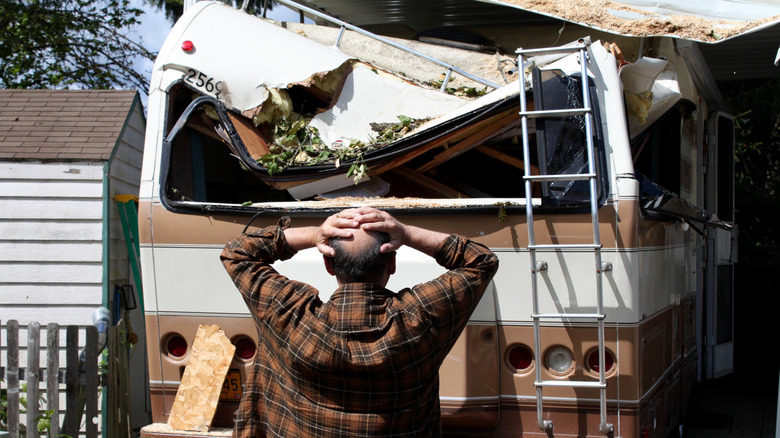
The full cost of proper insurance coverage is another reason many retirees regret buying an RV. Because of the dual-use RVs provide between accommodation and transportation, they often require special coverage that covers aspects of renters and car insurance. While there are plenty of add-ons depending on the type of coverage you desire, most RV insurance plans come with liability coverage, collision insurance, and uninsured motorist protection. Depending on the cost of the RV, the state in which it is registered, and the quality of coverage, The Zebra estimates RV insurance can range from $200 per year for basic coverage to $3,000 annually for full coverage.
Insurify provides some deeper insights based on RV class. Campers and travel trailers are estimated to have the most affordable insurance, starting at $180 annually for basic coverage, but reaching upwards of $1,000. Class B RVs come with annual coverage hovering between $480 and $1,000. Meanwhile, Class C premiums can jump between $540 and $1,500 per year. Retirees may encounter the priciest rates in the Class A category, though, with coverage costing owners an estimated $600 to $3,000 per year. Unfortunately, locking in RV insurance doesn't mean these annual rates will remain unchanged. Similar to other forms of vehicle coverage, your premiums can increase based on your driving record. Roamly projects that an RV owner found to be at fault in an accident could see their premium rise as much as 63%.
9. The resale market is not friendly to RV owners

Even factoring in the high ownership costs and the relatively quick depreciation of RVs, you're not guaranteed to recoup your RV's current market value on the resale market. After all, Americans aren't buying RVs like they used to: In 2021, wholesale RV sales hit a record high of 600,240, representing a nearly 40% increase from the prior year, per the RVIA. However, RV sales have experienced a notable decline since this all-time high. By 2025, shipments had nearly halved from the 2021 record, with only 342,220 units shipped. These figures aren't showing any signs of recovery, either: In September 2026, year-to-date sales stood at 230,511 — down 13.7% from the previous September.
RV owners also face a potentially long waiting period before a successful sale. In September 2026, National Vehicle released the results of a two-year study reviewing nearly 11,000 RV listings. Of the units that were sold, the median timeline between listing and purchase was 69 days. Class B RVs had the shortest median sales period of 60 days, with Class C following close behind at 61 days. Fifth-wheel sellers had to wait a median of 69 days, with trailers experiencing a median of 74 days on the market. Finally, Class A RVs took the longest, with a median sale period of 80 days (via PR Newswire). In stark contrast, the average pre-owned car sale took only 14.6 days in Q3 2026, per CarFlip IQ. Such an extensive period between listing and finalizing a sale may make it harder for retirees to access any capital tied up in their camper.
10. Parking and storing RVs can be costly on the road and at home

While RVs can eliminate the need for accommodation when you're on the road, you still need to find a place to park them. Given their large footprint, normally sized parking spaces usually won't get the job done. Thus, retirees need to factor in both the cost of parking an RV overnight when traveling and storage costs when it's not in use. According to an Insider Perks analysis of over 2,000 campground sites across 48 states, the median price for an RV campsite is $62 per night. As a result, taking a one-week RV trip in the U.S. would cost an estimated $434 in campsite costs alone. However, what you can pay can vary significantly depending on what state you're in and the time of year you book the site. Peak travel days and seasons, in particular, can spike nightly rates.
Although the average cost of living in an RV may make you pause, the spending may not even stop when you're not using it. While specific regulations vary by state, most cities don't allow owners to park their RVs on the street. The situation isn't much easier in neighborhoods, either, with many homeowners' associations in the U.S. prohibiting RV parking. An October 2026 report from RV Storage Rates estimated that the median monthly cost of storage was $85 for outdoor spots, $150 for covered storage, and $245 for indoor storage. In other words, simply storing an RV could cost retirees roughly $1,000 to $3,000 per year, in addition to all the other ownership expenses.