

This Once-Fading Type Of Car Is Making A Comeback As Prices And Gas Costs Rise

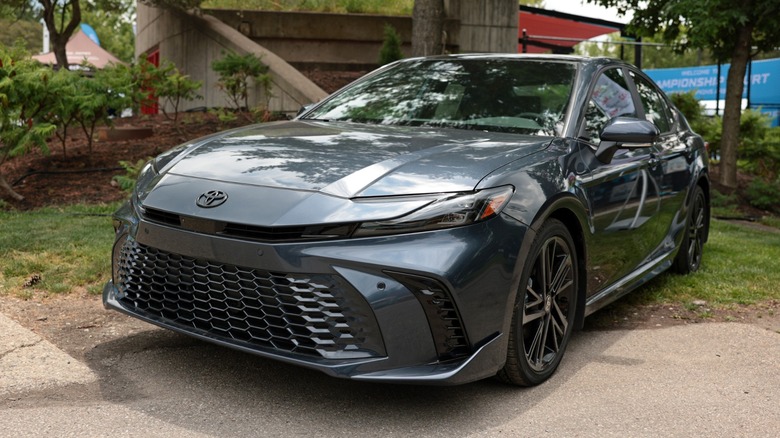
Sedans are making a comeback in the U.S. as buyers look for relief from expensive vehicles and gasoline. In fact, many sedan models are seeing increased sales. For instance, sales of the Honda Accord, recognized as one of the most reliable cars of 2026, rose 32.7% during the first nine months of 2026 compared with the same period in 2025, according to Honda. Another popular sedan, the Toyota Camry, also recorded an 11.2% increase in sales over that period.
This trend comes as September 2026 average new-vehicle transaction prices hit $50,562, just under the all-time record of $50,614 set in December 2025, according to Kelley Blue Book (KBB) data, via Cox Automotive. At the same time, gasoline has also remained expensive in 2026. When averaging the U.S. Energy Information Administration's monthly figures, regular gasoline was roughly $4.16 per gallon from April through September 2026, compared with $3.15 over the same time period in 2025.
This brings us to the demand for sedans, which not only cost less upfront but also generally require less gas than more popular SUVs. The average transaction price for compact cars, which comprises sedans and hatchbacks, was $27,977 in September 2026, compared to $37,614 for compact SUVs — a $9,637 difference. And, per a Environmental Protection Agency (EPA) vehicle trends report, model-year 2024 sedans/wagons averaged 31.7 miles per gallon compared to 30.2 mpg for car-based SUVs and 24.7 mpg for truck-based SUVs.
What choosing a sedan could save you each year
To illustrate potential fuel savings, consider driving 15,000 miles annually, matching the mileage used in the American Automobile Association's (AAA) Your Driving Costs report. If we then use a per-gallon gasoline price of $4.16, and EPA estimated mpg averages per vehicle type, annual fuel costs would be around $1,968 for a sedan or wagon, compared to $2,066 for a car-based SUV, and $2,526 for a truck-based SUV. That's roughly $98 to $558 in annual savings against SUV averages. Plus, particularly gas-guzzling SUVs and pickups could stretch this difference even further.
But that's just gas; when you consider other ownership costs, the gap between sedans and SUVs grows even larger. According to AAA, ownership and operating costs average $9,259 for a new small sedan, $10,555 for a medium sedan, or $11,670 for a compact SUV at 15,000 miles. These numbers also include depreciation, one of the highest costs of a new car. AAA estimates that small and medium sedans lose $2,745 and $3,664 , respectively, to depreciation annually, compared to $3,998 for compact SUVs.
Costs associated with insurance, reliability, and maintenance depend on the driver, location, and specific model, so a sedan's body style alone won't determine every bill. But in AAA's 2026 study, small and medium sedans did cost less in full-coverage insurance, averaging $1,623 and $1,788 a year compared to $2,294 for compact SUVs. Maintenance, which includes repairs and tires, averaged 11.10 cents per mile for small sedans and 11.42 cents for medium sedans, compared to 12.06 cents for compact SUVs.