

The 9 Most Valuable Rare Quarters, Ranked
We may receive a commission on purchases made from links.
The next time you get some spare change, it may pay very well to look closely at your quarters. It's possible that you could luck into a coin worth hundreds or even thousands of dollars without even realizing. Whether you were just handed some change or you're a savvy collector, being in the know can help you identify valuable quarters, some of which can be worth more than $1 million.
Getting your hands on the most valuable and rare quarters isn't easy, but there are a few key traits to look out for that will increase your odds of correctly identifying and obtaining one. First, it's essential to know your coins. Reputable companies such as the Professional Coin Grading Service (PCGS) and Numismatic Guaranty Company (NGC) have great websites to help with identifying truly rare quarters and their estimated values. Moreover, it's important to know the mint year. Quarters from 1964 and earlier, for instance, are prized by collectors for their high silver concentration. Other factors affecting value include how rare the coin is or if there are any notable pressing errors that make the quarter exceedingly unique.
Whether you're an experienced coin collector or someone who wants to begin collecting, there are some quarters that stand apart in prestige and value. These are the quarters you'll want to know about, as they are among the most rare and valuable of their kind.
1999-P golden-hued Delaware quarter
Beginning in 1999, the 50 State Quarters Program saw the release of a series of quarters with designs paying homage to each state across a 10-year span. The United States Mint rolled out five states' worth of quarters every year until 2009. By the U.S. Mint's own estimates, 34 billion quarters were issued across the decade.
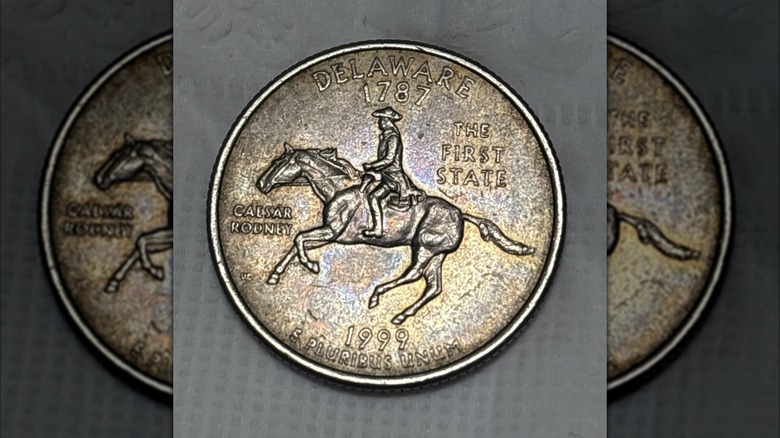
With Delaware as the first state to officially join the Union, it only makes sense that the U.S. Mint released the "First State" quarter in 1999, the inaugural year of the 50 State Quarters Program. Most of the coins turned out normal, but a few that went into circulation happened to have a golden hue to them. Anyone who held onto one of these rare gold-hued 1999-P Delaware quarters may be in possession of a particularly rare and valuable piece of currency.
The 50 State Quarters Program roughly lined up with the release of the golden Sacagawea dollar that was minted from 2000 through 2008. In preparation for releasing the official dollar, a small number of these Delaware quarters were cast using the distinct manganese brass alloy specifically formulated for the Sacagawea coin. While there are a number of Delaware quarters from the era plated in gold or displaying a similar hue resulting from another production error, individual quarters made from this alloy specifically are particularly coveted: One of these 1999 quarters sold for $3,840 through Heritage Auctions in 2019.
1937 double-die obverse Washington quarter
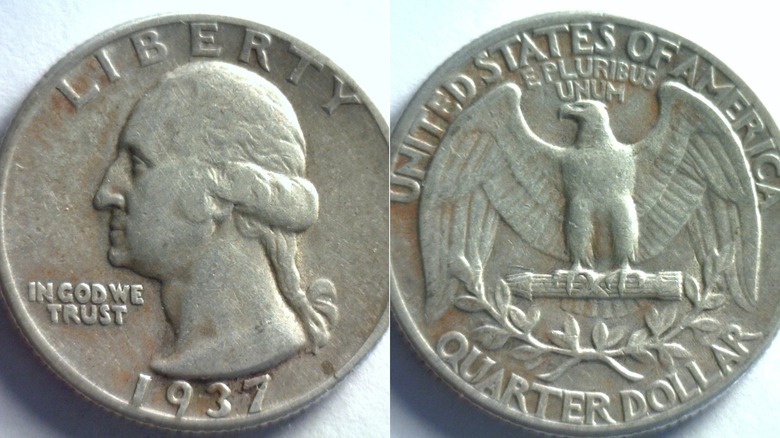
Though the golden-hued Delaware quarters were ultimately the result of deliberate testing, sometimes coins see their values increase off the back of a serious error. Such was the case for some 1937 Washington quarters, which came out double-die obverse (DDO). This error occurs when the front side of a coin gets printed with a misaligned die, resulting in the design being doubled and slightly overlapped.
The 1937 double-die obverse Washington quarter might be hard to distinguish at first, but if you look closely, the error becomes more obvious. The words "In God We Trust" are doubled, giving them a thicker, shadowy appearance. The year on the coin, 1937, is also visibly off-center. The combination makes it clear that you're looking at a DDO coin. In addition to the error, the 1937 quarters are generally considered more valuable compared to today's coins as they were released before U.S. mints ceased using silver. As such, quarters from this era contain 90% silver.
However, there are a number of DDO coins from the early 20th century that are worth hundreds of dollars or more, and mint-condition, uncirculated 1937 double-die obverse Washington quarters can yield a sizable payout. In 2006, a 1937 double-die obverse quarter was sold for a winning bid of $2,990 through Heritage Auctions, and the NGC also notes quarters in a similar condition are valued as high as $7,500 in 2026.
1962 Washington quarters (MS67+)
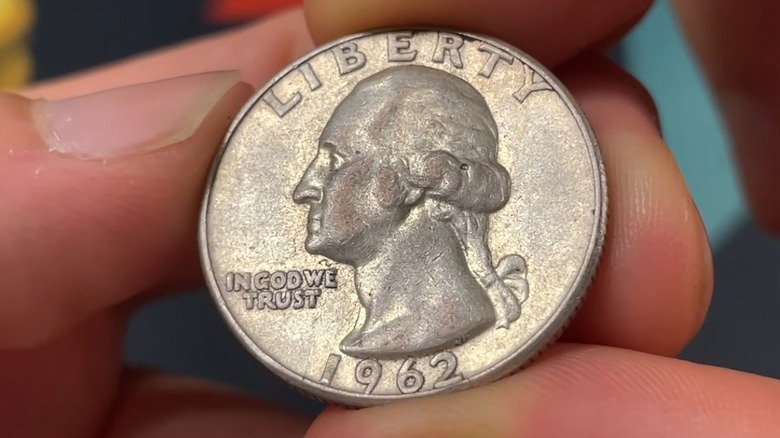
It's entirely possible that you had a quarter from 1962 at some point. And though they might not appear particularly remarkable at first glance, quarters from this era have some distinct historical significance that informs their value to collectors. Struck by both the Denver and Philadelphia Mints, these quarters are among the last to have been made of 90% silver. From the mid-1960s onward, quarters would be created using the now signature copper-nickel alloy associated with most U.S. coins. As for quarters of the early '60s, they were soon removed from circulation, but not just by the U.S. Treasury Department: Members of the public were also snatching these quarters up, and even hoarding them.
If you're looking for the most valuable of these quarters, per the NGC, it should be a grade of at least Mint State 67 or higher (MS67+), as certified by the PCGS. That means their mint state was appropriate for general circulation, as they were struck with just slight imperfections. A 2021 Stack's Bowers auction saw a winning bid of $5,280 for a 1962-D Washington quarter with a sunset-like colored front side and a nearly flawless reverse. A similarly colored MS67+ silver quarter from this year reportedly sold through Heritage Auctions for $7,637.50 in 2015. Though not for sale, Heritage Auctions states the highest offer to date was for $10,500.
1976-S Bicentennial silver quarter
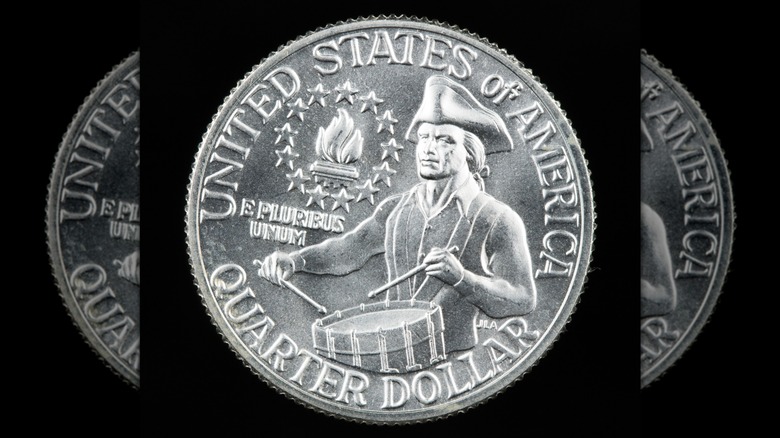
While there were many ways the United States celebrated its 200th birthday, one key measure involved minting a series of coins to commemorate the year. Namely, commemorative dollar, half-dollar, and quarter-dollar coins were released in celebration to help mark such a crucial national milestone. Bicentennial quarters are distinguished by having an image of a colonial-era drummer next to a torch surrounded by 13 stars representing the original colonies. The words "United States of America" and "Quarter Dollar" are likewise written around the edge.
Most of these Bicentennial quarters are clad coins, meaning they're made up of the familiar multilayer nickel-copper alloy that became the norm from the 1960s onward. However, special silver-clad quarters were exclusively made at the San Francisco Mint (1976-S) and released to collectors, rather than into public circulation. As such, they were rare and highly valued from 1976 onward, and have increased in valuation with the passing years. According to the PCGS records, a 1976-S Bicentennial silver quarter was sold at auction for a bid of $13,500 in March 2019. Heritage Auctions, meanwhile, recorded that another 1976-S Bicentennial silver quarter sold in June 2019 for $19,200.
1943 Double-Die Obverse Washington quarter
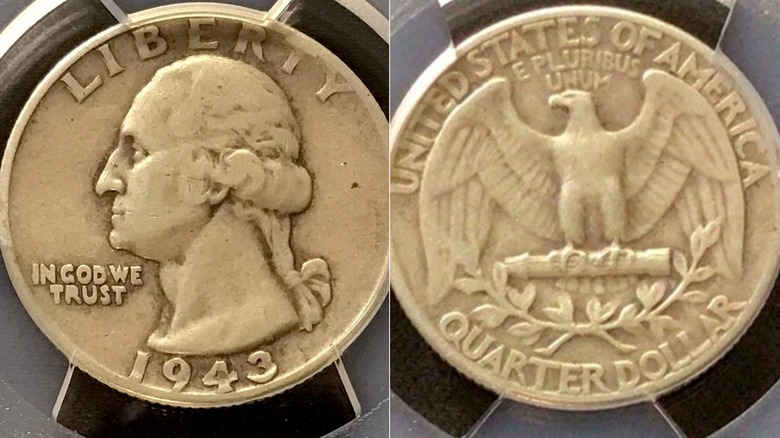
The 1943 double-die obverse quarter is a coin born from an error at the Philadelphia Mint. The coins feature a doubling of the letters in both "Liberty" and "In God We Trust," as well as slight doubling in "1943." The severity of the mistake varies across the affected quarters.
Even without the mistake, these quarters were made during the World War II era, and this tie to America's 1940s wartime economic history may be attractive to collectors on its own. As for the 1943 DDO quarters, the PCGS estimates that there are fewer than 220 known of these coins in a mint state. Of this number, it's believed no more than 20 are MS65 or finer. USA Coin Book estimated that 1943 double-die obverse quarters in good condition were worth around $1,006 in February 2026. In pristine condition, it's possible for one of these quarters to pay out even more money at auction. For example, a 1943 DDO quarter with an MS68 grading was successfully auctioned through Heritage Auctions for $11,162.50 in January 2013. In 2020, CoinWeek reported David Lawrence Rare Coins sold a 1943 double-die obverse, PCGS-verified MS67 quarter for $22,250.
1932-D Washington quarter
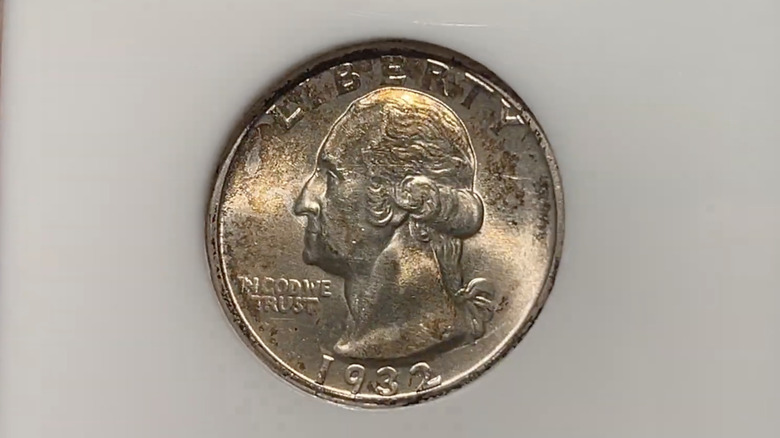
Quarters bearing the side profile of American president George Washington are so common, it's hard to believe there was a time before these coins were the norm. And yet the Washington quarter as we know it didn't enter circulation until 1932. The prior year, the U.S. Treasury Department initially intended to put Washington's face on a half-dollar coin in celebration of his 200th birthday, but ultimately pivoted to the quarter.
The 1932 quarters minted in Denver are considered very rare, as there were only 436,800 pieces created there. According to NGC estimates, circulated 1932-D quarters you may come across are easily worth hundreds of dollars. Should you happen upon an uncirculated regular strike 1932-D Washington quarter, you'll have stumbled across a small fortune. For instance, the NGC holds that a 1932-D quarter with an MS66 grade could hold a valuation of $90,000. As high as that may seem, Heritage Auctions documented that a particularly fine 1932-D Washington quarter sold at auction for $89,125 in 2001, while the PCGS confirmed another 1932-D quarter sold at auction in April 2008 for $143,750.
1916 Standing Liberty Type 1 quarter
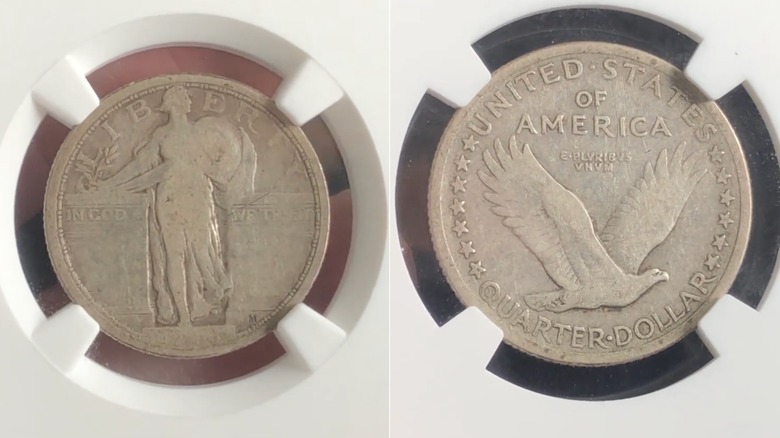
The 1916 Standing Liberty quarter is a significant piece for a few reasons. First, this particular minting represented a move away from the previous Barber quarter designs going back to 1892. Those coins featured a side profile of Lady Liberty on the obverse side. The new design, now known as Standing Liberty Type 1 quarters, featured a full-body view of Liberty standing before a gateway holding a shield in her left hand and a branch in her right. And yet, production of this original version of the design was ultimately halted due to controversy over Lady Liberty's exposed right bosom. Aside from that distinct design element, the Type 1 quarter features no stars below the eagle on the reverse side.
Millions of Standing Liberty quarters were minted in 1917. However, only 52,000 quarters featuring the original design were created in 1916, making this a very rare coin with a price tag to match. Per Heritage Auctions, a visibly worn coin earned a winning bid of $1,410 in September 2016. Meanwhile, NGC estimates a circulated coin in very good condition (MS58+) is valued at $14,000. But for those rare, uncirculated coins in pristine condition, the earning potential is far higher. In August 2010, an MS67-grade 1916 Standing Liberty Type 1 quarter sold through Heritage Auctions for $149,500.
1828 Large Size Capped Bust quarter
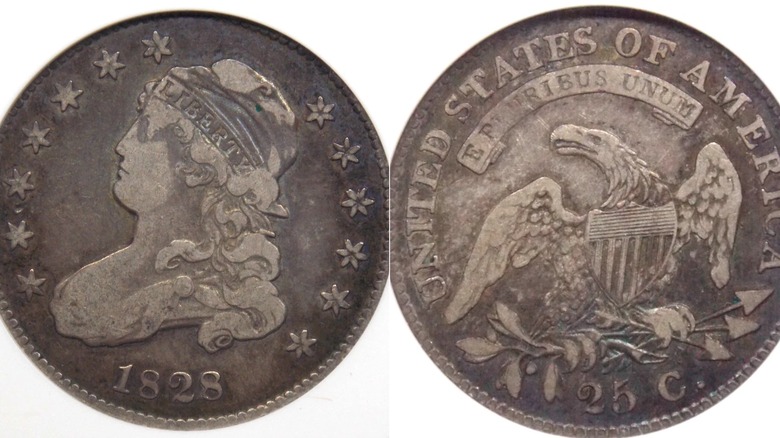
The 1828 Large Size Capped Bust quarter is an early U.S. coin which features a left-facing bust of Lady Liberty with "Liberty" written on her cloth cap. On the reverse side is an eagle with a shield on its chest, clutching arrows and a branch in its talons. In circulated condition, the NGC estimates these pieces are worth anywhere between $115 and $4,200. In mint state, some Capped Bust quarters are worth upwards of $25,000, and higher-grade uncirculated pieces are worth even more.
According to the PCGS, a MS66-grade quarter held a valuation of $108,687.50. Though this is an incredible value in its own right, there was a special mistake that caused some of these pieces to be even more rare and valuable. For example, when inscriptions for coin dies are punched by hand — as was the case for 19th-century U.S. coins — the inevitable human errors that arose as a result would occasionally cause memorable mistakes. The 1828 Large Size Capped Bust quarter was no exception: For example, some 1828 quarters were accidentally punched using the 50-cent denomination, before being later corrected to a 25-cent denomination. According to Heritage Auctions, one example of these error coins successfully sold for an incredible $352,500 in November 2013.
1796 Draped Bust quarter
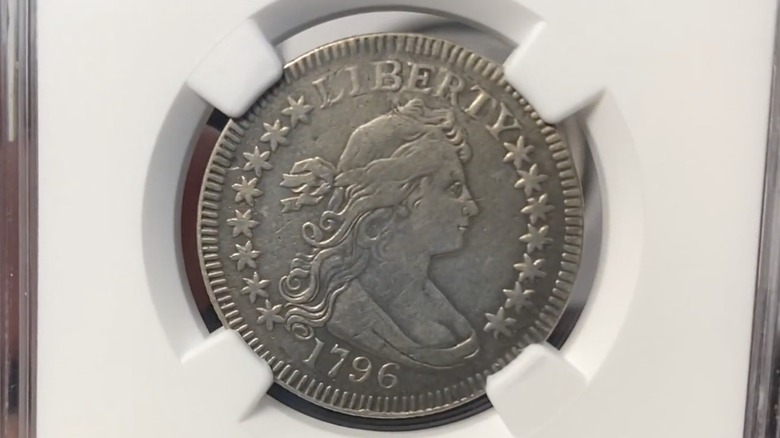
In 1796, just 20 years after the signing of the Declaration of Independence, America produced its very first quarter. In fact, it was the only quarter minted in the 18th century. The quarter's design includes a right-facing side profile Lady Liberty on the obverse side and an eagle clutching a pair of branches in its talons on the reverse side. This iconography would set the tone for U.S. quarter designs for well over the next century.
There were only 6,146 of these quarters, now known as Draped Bust quarters, created in 1796, making them exceedingly rare and quite valuable. Of these quarters, the PCGS estimated in 2025 that only 650 or so were still in existence. While some 1790s quarters are worth over $10,000, those in possession of one could potentially get even more: The USA Coin Book determined that a 1796 Draped Bust quarter that's in average condition could be worth $13,755 as of February 2026. Alternately, the NGC determines that quarters of this same grade could be worth $17,750. Meanwhile, even slightly worn examples of this coin are valued at at least $100,000.
However, at least two PCGS-verified 1796 Draped Bust quarters with MS66 grades have sold for seven figures: The first was auctioned off through Stack's Bowers in May 2015 for almost $1.53 million. The second coin, which was sold through Heritage Auctions in January 2022, had a winning bid of $1.74 million.