

America's Best State For Fiscal Stability In 2026 Is An Overlooked Destination In The Mountain West

In an era where U.S. national debt exceeds $40 trillion, per the Joint Economic Committee, fiscal stability is a poignant concern for many. Beyond federal concerns, the ability to stay afloat financially, even in the face of major disruptions, can be especially important at the state level. In 2026, U.S. News and World Report found that there's nowhere in the U.S. exhibiting stronger fiscal stability than Wyoming. The website ranked the Equality State No. 1 on its list of states with short-term fiscal stability, and No. 28 in terms of its long-term stability.
Seeing as how Wyoming is one of the cheapest states to retire, and only has about 6 people per square mile, per 2024 U.S. Census Bureau population estimates, it may come as a surprise that the state is financially sound. However, per a Truth in Accounting report, Wyoming had an impressive "Taxpayer Surplus" — the ratio of state money leftover compared to the number of tax-paying citizens — in 2024. That year, Wyoming had an estimated $27,200 left over for every person that paid taxes in the state. Notably, Wyoming managed to pulled this off without having an income tax. If anything, the state is largely renowned as one of the more tax-friendly states in the country. And while state taxes do play an important role in informing Wyoming's financial status, its approach to state funding ensures that the cash it has on hand comes from a diverse set of sources with stability in mind.
Breaking down Wyoming's state revenues
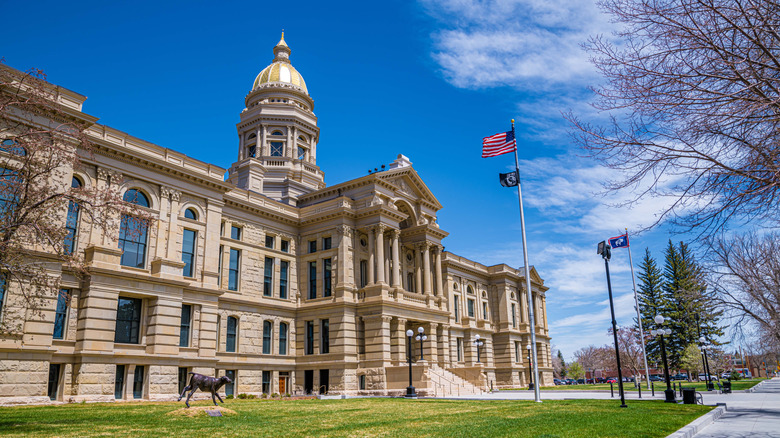
Truth in Accounting largely cites investment returns from Wyoming's state cash surplus as the driving force behind its fruitful economic position in the mid-2020s. States often reinvest unused funds in an attempt to keep the public treasury growing, and many state purses have actually benefited from ballooning interest rates post pandemic. To add to this — in addition to strong returns — Truth in Accounting's 2024 data found that Wyoming was still coasting off of financial aid provided by the federal government during the COVID-19 pandemic.
It's also worth noting that much of the Wyoming's revenue comes from mineral mining and trade, which many — including Wyoming's Governor Mark Gordon — note is volatile. This may inform why Wyoming's long-term fiscal stability ranking from U.S. News and World Report is considerably lower than its short-term ranking. Regardless, in 2026 it remains the financially stable home of the best retirement destination in the U.S., and in a February 2026 press release, Governor Gordon projected that the state budget would grow from $8.11 billion during the 2019 to 2020 budget cycle to $11.13 billion for 2027 to 2028.