

10 Costly Reasons You Should Avoid Buying A Chevrolet Traverse
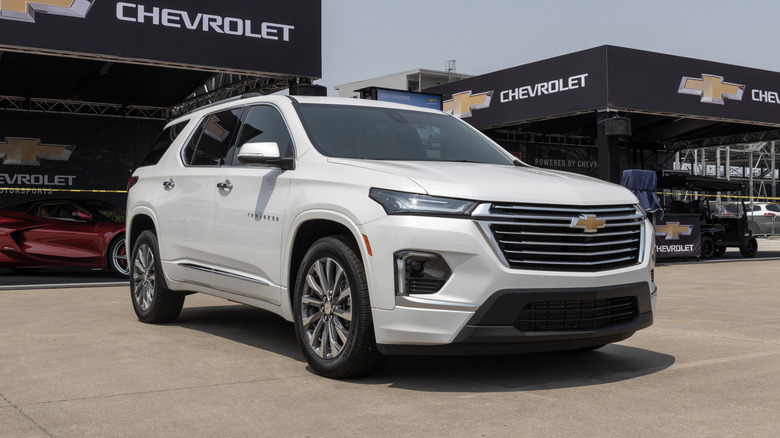
The Chevrolet Traverse has remained one of the marque's most in-demand SUVs. In fact, the General Motors Company reported 148,278 Traverse sales in 2025, representing a 40% increase from the prior year. Furthermore, those sales figures made the Traverse one of Chevrolet's top-selling vehicles in 2025, behind only the Equinox, Trax, and Silverado. The Traverse was launched in 2009 to fill the void left by the Trailblazer SUV and the Uplander minivan, requiring this three-row SUV to span segments by maximizing versatility. Generally speaking, the Traverse combines the comfort and maneuverability of a crossover with the functionality and space buyers expect from a three-row SUV. This marriage between practicality and performance has helped maintain the Traverse's long-standing popularity. However, the costs associated with owning a Traverse can extend well beyond its purchase price.
At first glance, the Chevrolet Traverse's financial burden is evident in its upfront cost, especially among its premium trims. A peek beneath the hood reveals a slew of other additional expenses, such as poor fuel economy and above-average maintenance costs. Furthermore, the Traverse may be a less economical choice than some competitors that offer comparable features at lower prices. The model's impressive sales numbers demonstrate its popularity, but consumers should still have all the information they need to make an informed decision.
To give potential buyers a broad financial perspective, the negatives demand attention too. Before coughing up a solid chunk of your savings or taking out a high-interest loan, consider these costly reasons you should avoid buying a Chevrolet Traverse. They just might save you from making a financially punitive decision.
Pricey trim upgrades
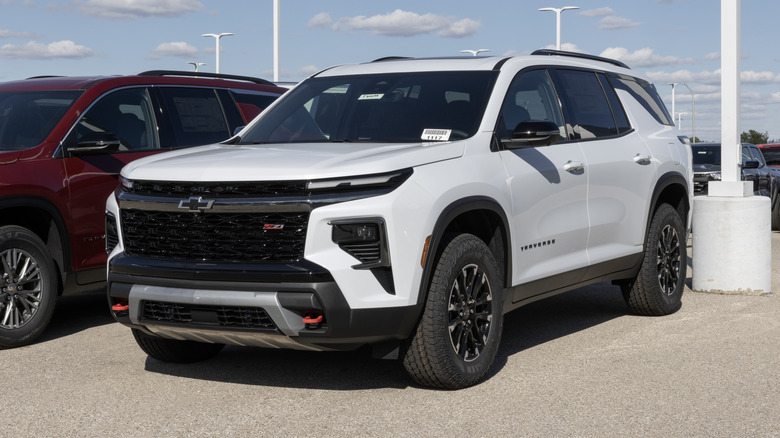
Sticker shock is one of the most common reasons that potential buyers reconsider a vehicle. After all, the upfront cost is often the first dollar figure associated with a vehicle and the single-largest one-time expense. A vehicle may rack up more in long-term expenses than it costs to buy, but these expenditures are spread out over time, making them more financially manageable and mentally digestible. According to Car and Driver, the 2026 Chevrolet Traverse has a manufacturer's suggested retail price (MSRP) — the amount at which automakers recommend dealerships sell a particular vehicle — between $42,795 and $59,395. What really stands out for the Traverse is how quickly trim upgrades add to the cost. This nameplate only comes in seven different trims, yet there's a nearly $17,000 difference in MSRP between the most affordable and priciest versions. For perspective, there are used SUVs you can purchase for less than $15,000.
Beyond the rapid increase in upfront cost, the Traverse also struggles to justify the higher prices of its upper trims. The entry-level LT trim and the most heavily equipped RS version don't exhibit many differences, despite being separated in price by more than five figures. The most notable difference is in the drivetrain. The most expensive trim has all-wheel drive, while the baseline option has front-wheel drive. The RS also comes with additional safety and convenience features, including a 360-degree camera, power outlets, a Bose speaker system, and an automated parking system. However, some of these features are available on lower-cost Traverse trims. While augmenting the driving experience, many of these pricey upgrades aren't essential for the average driver. Many customers would prefer saving these funds for models that offer more at lower price points without climbing the costly trim ladder.
Poor fuel economy
When assessing the financial weight of a vehicle, it's tempting to place most of the focus on upfront costs.. Whether you're buying new or used, the sticker shock is understandably going to cause more concern than long-term expenses. However, overlooking these ongoing costs can wreak havoc down the line when it comes to managing a vehicle's finances. For instance, the Chevrolet Traverse isn't the most expensive model on the market, but its poor fuel economy falls far behind the average. This discrepancy between a modest upfront cost and substandard gas mileage may not be obvious on its face, which highlights the importance of mapping out these prolonged expenses. FuelEconomy.gov, the federal government's official database of vehicle fuel efficiency ratings, estimates that the 2026 Traverse gets 22 miles per gallon combined. More specifically, this SUV averages about 20 miles per gallon in the city and 26 on the highway.
For perspective, the standard vehicle in 2026 averages 28 miles per gallon combined. Over a year, the Traverse runs up an estimated $2,800 in fuel costs, based on August 2026 gas prices and 15,000 miles of annual driving. Within half a decade, owners of the Traverse owners could spend approximately $3,000 more on fuel than drivers of the average vehicle. This premium may be higher for drivers who live in states with the absolute highest gas prices. It's worth noting that these figures refer to the standard front-wheel drive model. The all-wheel drive Traverse's fuel economy takes a hit due to the more energy-intensive drivetrain, resulting in a fuel efficiency of 21 miles per gallon combined, according to FuelEconomy.gov. This difference bumps the estimated five-year fuel premium to $3,750 compared to the average 2026 model.
High repair and maintenance costs
In addition to fuel costs, owners should also consider annual repair and maintenance costs when looking at a vehicle's overall expenses. These long-term upkeep expenses are another costly reason you should consider avoiding the Chevrolet Traverse. RepairPal estimates that this SUV comes with an annual repair and maintenance bill of $656. This is pricier than the average for both the Traverse's segment and the entire market. More specifically, RepairPal shows that the average midsize SUV carries an annual repair cost of $573. That means Traverse owners are overpaying on servicing by 14.5% compared to their counterparts.
While these ongoing costs may not appear egregious when annualized, they add up over time. For perspective, the Traverse's repair and maintenance costs would add up to $3,280 over five years and $6,560 across a decade if that annual average remained consistent. In comparison, the midsize SUV segment's average upkeep expenses would reach $2,865 at the five-year mark and $5,730 over a decade if its annual average also remained consistent.
CarEdge estimates that the Traverse's maintenance and repair costs are slightly higher, with the decade-long projection at $9,568. There's no exact science when it comes to projecting these expenses for owners, but both estimates suggest that the Traverse carries above-average upkeep costs. Of course, these maintenance costs vary based on model configuration, driving habits, and other specifics. Chevrolet may not be the most expensive car brand to maintain, but it has received some criticism over the years for above-average expenses. CarEdge even lists Chevrolet as one of the worst popular car brands when it comes to long-term maintenance expenses. Unfortunately, the Traverse doesn't save owners from the brand's reputation.
Excessive chance of significant repair

The Chevrolet Traverse's prolonged upkeep costs aren't the sole financial consideration for owners on the maintenance side of the equation. On top of hefty long-term servicing costs, this SUV comes with a heightened risk of experiencing a serious issue. According to CarParts.com, the Traverse carries an 18% likelihood of having severe problems. For context, vehicles in the same segment have an average probability of 13%, placing the Traverse's risk 5 percentage points higher than that of its competitors. Meanwhile, the market-wide average among all models is 12%, meaning the Traverse's risk of having a severe issue is 6 percentage points higher than the industry standard.
According to RepairPal, transmission issues are among the most common and egregious issues Traverse owners come across. More specifically, many model years struggle with a faulty wave plate, which is a small yet critical component allowing for a smooth transition between gears in an automatic transmission. Not only can a malfunctioning wave plate result in shifting issues, but it can also cause damage to other areas of the transmission when it comes loose. For the Traverse, this issue usually manifests as slipping between gears, a non-functional reverse gear, or rough shifting between 3rd and 5th gears.
RepairPal estimates that the initial diagnostics for the check engine light cost somewhere between $122 and $179. However, working on the actual transmission, if that's the underlying cause, will cost much more. RepairPal suggests these transmission-related services can reach up to $1,905. Fortunately, not every release is affected by these costly transmission issues. The seven years impacted include 2009, 2010, 2011, 2012, 2013, 2014, and 2016.
Quick depreciation and poor resale value

When looking at the costs associated with a particular vehicle, it's not sufficient to consider active payments, such as upfront costs, maintenance fees, and fuel expenses. To get a more complete financial picture, owners need to understand how quickly a vehicle loses value after purchase. The Environmental Protection Agency highlights depreciation as one of the most impactful hidden costs of vehicle ownership.
Unfortunately, this is yet another area where the Chevrolet Traverse can cost owners significantly. This SUV is one of the popular cars that loses more than half of its value within just five years of routine driving, leaving it with a poor resale value. According to CarEdge, the Traverse sheds about 54% of its original cost over half a decade. Keep in mind this estimation only assumes 13,500 annual miles and considers the vehicle in good condition.
Putting some dollar figures on this calculation can make the financial impact easier to comprehend. If you purchase a Traverse new for $53,127, it will likely lose $28,710 of that value, leaving you with a resale value of $24,417. By the 10th year, the average Traverse only retains 22.3% of its initial value. This means owners are unlikely to recoup a significant amount of their original investment when they go to resell. The only silver lining is that the Traverse is more affordable on the preowned market compared to other models which maintain their value more effectively.
Spotty safety records

Safety is one of the most commonly cited considerations among consumers looking for a new vehicle. A YouGov poll found that 56% of Americans report safety as their top priority when browsing models. Only price and performance received more attention from potential customers. Generally speaking, SUVs have been found to carry safety advantages when compared to other vehicle segments. The Insurance Institute for Highway Safety (IIHS) has found that this vehicle class offers more protection to passengers on average, mainly due to its larger footprint and heavier weight. Yet, that finding, borne out by thousands of crash test simulations over the decades, has a crucial caveat.
The IIHS clarifies that this broad finding may not accurately represent individual models. The Chevrolet Traverse's mixed safety reviews over the years offer a clear example of this discrepancy between segment averages and nameplate specifics. To be sure, both the 2025 and 2026 Traverse models received an IIHS Top Safety Pick classification, the independent testing organization's second-highest recognition. However, many older models failed to achieve this status, often receiving subpar crashworthiness results and safety feature ratings. Notably, headlight performance is a common issue among Traverse models, with some receiving the worst score on the relevant IIHS tests.
Frequent recalls
Virtually all major car manufacturers have been involved in recalls, which require automakers to address safety-related defects or noncompliance issues affecting particular vehicles. In fact, some of the least reliable Chevrolet cars have been determined in part by their significant number of recalls. The presence of recalls alone isn't enough to toss out a vehicle consideration altogether, but it's certainly a crucial piece of the financial puzzle. Not only can vehicles with recalls feature inherent safety concerns, but the implications of these issues could also lead to unforeseen expenses in the form of additional servicing costs or even medical bills. Unfortunately, the long-running Chevrolet Traverse has been no stranger to recalls over the decades, requiring careful consideration from owners regardless of their chosen year.
The National Highway Traffic Safety Administration (NHTSA), an agency within the Department of Transportation tasked with enforcing vehicle safety standards, maintains recall records for nameplates. According to the federal organization, the Chevrolet Traverse's initial release in 2009 had eight recalls. Each release between 2010 and 2016 experienced at least five recalls, with the exception of 2013, which had four. The nameplate hit a record of eight recalls in 2020. However, these issues have moderated slightly in recent production, with no recalls issued for 2022, 2024, or 2025 models. Some of the most high-profile focuses of recalls over the years have involved malfunctioning airbags, powertrain issues, frame defects, and tire problems.
Better value in the segment
Despite its undeniable popularity and laudable sales figures, the Chevrolet Traverse isn't one of the top-selling SUVs that are perfect for a retiree, or necessarily for most drivers, for that matter. This distinction is substantial because drivers can accept some trade-offs when focusing on a particular segment. For example, SUVs tend to have lower fuel economy, higher maintenance costs, and elevated MSRPs compared to mainstream sedans. The Traverse's shortcomings aren't only clear when compared to the broader market. Instead, this vehicle's pitfalls are on full display when stacked against other SUVs.
For example, Car and Driver ranks the Traverse 12th among the industry's available midsize, three-row SUVs. For context, the five leading nameplates are the Jeep Grand Cherokee, Honda Pilot, Toyota Grand Highlander, Hyundai Palisade, and the Kia Telluride. What's more, the two leading vehicles of this segment — the Palisade and Telluride — have a lower starting price tag than the Traverse. This model even falls short among the SUVs offered by its own brand. Car and Driver positions the Traverse dead last in its ranking of Chevrolet's SUVs and crossovers. These aren't surface-level assessments, either. The testing looks at hundreds of data points ranging from driving experience and spaciousness to value for money and fuel efficiency. Whether compared to the SUV segment overall or even within Chevrolet's own lineup, the Traverse falls short of much of the competition, all while carrying a higher starting price than many options.
In-depth research from iSeeCars further indicates how the Traverse fails on longevity. Looking at more than 300 million pieces of information, the independent testing organization concluded that this SUV has an average lifespan of 7.8 years or roughly 133,699 miles. The testing suggests that the Traverse only has an 8.3% likelihood of reaching 200,000 miles and is usually driven 13,055 miles annually.
Lack of standard built-in safety features
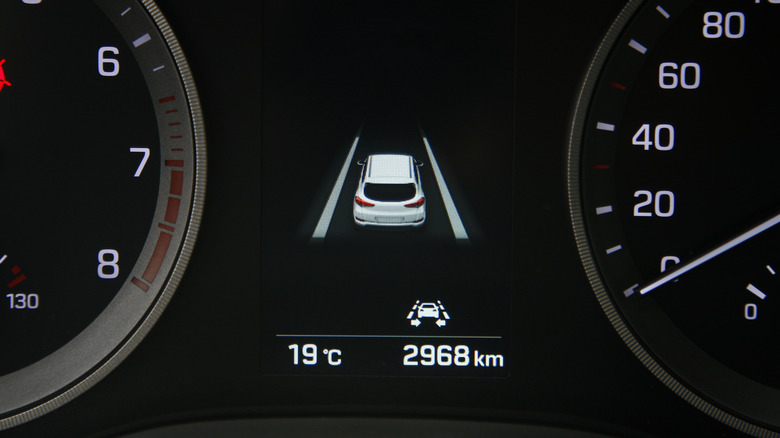
The Chevrolet Traverse's safety profile isn't only marred by some below-average IIHS ratings over many years. There's another financial consideration regarding the safety features offered based on model year and trim. Despite its top-tier pricing, this SUV didn't get standard forward collision warning or automatic emergency braking until 2022. If you're looking at a Traverse from any earlier model year, you may need to pay extra for an upgraded trim featuring these safety features. It's vital to note that older Traverse models are lacking compared to other models of the time, not compared to modern ones. Car and Driver sums up the issue well in its review, stating that most safety features are only available on more expensive trims, even though many competing models have them standard.
Chevrolet has undoubtedly improved the Traverse's suite of built-in safety features available in the entry-level trim, offering buyers a more reasonable safety standard for the cost. Yet, this is only an improvement among the nameplate itself. The Traverse still falls short of much of the competition when it comes to offering a quality safety package at a baseline price. For example, the 2026 Traverse doesn't include adaptive cruise control and lane-keep assist in its most affordable trim, requiring drivers to spend more for these features. For comparison, these are standard in various SUV models, including the Acura ADX, Subaru Ascent and Forester, Honda Pilot and CR-V, and the Hyundai Tucson, Santa Fe, and Palisade. In fact, many of these competitors even offer additional safety features in their standard packages, such as lane-centering.
Minimal warranty and maintenance coverage

The Chevrolet Traverse comes with a fairly run-of-the-mill warranty and maintenance coverage, which isn't a negative on its own. However, when compared to what competing brands offer for similar models, the Traverse becomes less-than-appealing. The 2026 Chevrolet Traverse comes with both a three-year, 36,000-mile limited warranty and a separate five-year, 60,000-mile powertrain warranty, according to ConsumerAffairs. Don't worry if you're still stuck deciding between buying new, used, or leasing. These factory warranties are associated with the vehicle, so eligible used models may still be covered if they remain within the covered period or mileage.
As Car and Driver explains, the Traverse's warranty coverage isn't anything special. The only real advantage offered by this model is a free maintenance appointment. In reality, there are several SUV counterparts that offer more in the way of long-term protection. For example, the 2026 Hyundai Palisade comes with a five-year, 60,000-mile warranty that protects against manufacturing issues. Additionally, this SUV's powertrain warranty is good for 10 years or 100,000 miles. Similarly, the 2026 Mitsubishi Outlander comes with a 10-year, 100,000-mile powertrain warranty and a five-year, unlimited-mile roadside assistance package. All new Kia SUVs are equipped with a 10-year, 100,000-mile powertrain warranty, a five-year, 60,000-mile manufacturing warranty, and a five-year, 60,000-mile roadside assistance package, which is one of the most generous packages on the market.