

What A $100 Grocery Budget Could Buy In The 1960s Versus Today
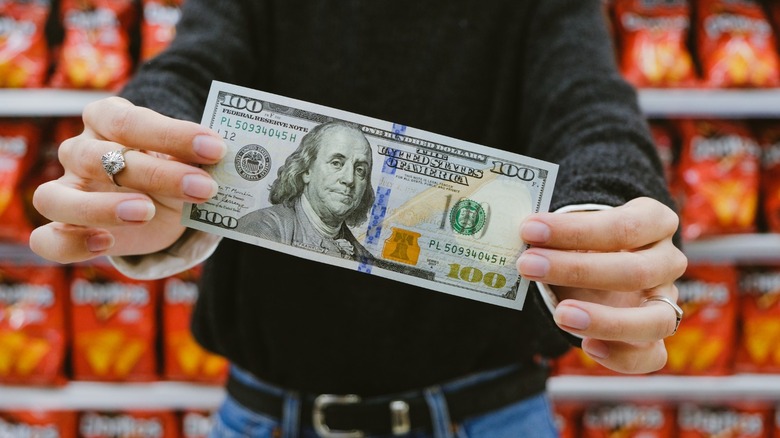
According to the Bureau of Labor Statistics' (BLS) CPI Inflation Calculator, $100 in June 1965 had the equivalent buying power as $1,061 in May 2026 dollars. In fact, the value of the dollar was so difference that $3,000 could buy a brand new car in the 1960s. Roughly the same applies to groceries. Per the Federal Reserve Bank of St. Louis' archive of BLS food-price data, a pound of white bread averaged 20.9 cents, hamburger averaged 50.8 cents per pound, milk was 47.3 cents per half-gallon, eggs were 52.7 cents per dozen, apples were 17.8 cents per pound, potatoes were 93.7 cents per 10-pound bag, canned tomatoes were 16.1 cents per can, and coffee was just 83.3 cents per pound in 1965. At those prices, $100 could have theoretically bought you 30 pounds of bread, 60 pounds of hamburger, 12 gallons of milk, 24 dozen eggs, 60 pounds of apples, 120 pounds of potatoes, 30 cans of tomatoes, and 15 pounds of coffee.
In June 1965, the BLS food-at-home Consumer Price Index was 34.0, compared with 321.047 in May 2026 — meaning grocery prices are about 9.44 times higher. As such, a $100 grocery basket in June 1965 had the equivalent buying power as $944.26 in May 2026. For additional context, following the USDA's May 2026 Thrifty Food Plan, a family of four could expect to spend $1,018.20 per month on food.
Why groceries cost over nine times more in 2026
The main reason why grocery prices have risen so much since the 1960s is largely due to cumulative inflation. That said, increased prices didn't happen evenly. USDA data shows that food inflation averaged 8.1% annually during the 1970s, including increases of 14.5% in 1973 and 14.3% in 1974. More recently, the COVID-19 pandemic produced another price surge thanks to a combination of labor shortages, supply-chain disruptions, and consumer demand. This pushed food-at-home prices up 11.4% from 2021 to 2022, according to BLS data. The aftereffects of this are still being felt by consumers — especially considering just how much they already spend on groceries every month.
Another accelerant for high grocery prices has been Trump administration tariffs, starting with Trump's first term. In fact, a 2023 report from the U.S. International Trade Commission found that prices rose about 1% for every 1% increase in the U.S. tariffs that were first implemented in 2018. Although some duties were later reduced or withdrawn, their effects did not disappear entirely, contributing to why many popular food items have increased in price in 2026.
With that said, groceries have not risen as quickly as general prices. The overall CPI increased about 10.6 times between June 1965 and May 2026, compared with 9.44 times for food at home. In relative terms, groceries have therefore become slightly cheaper compared to the complete consumer basket. According to the USDA, this is due to increased productivity among domestic agricultural farms.