

Midwest Cities Where You Can Retire Comfortably On $2,000 A Month

If you're making $2,000 a month, your earnings are in line with the average individual Social Security benefit as of January 2026, according to the Social Security Administration (SSA). But the figure falls far short of the average retirement income of a single person: According to the U.S. Census Bureau, adults over 65 years of age make just under $5,000 per month on average. Essentially, all of this is to say that with $2,000 a month, you don't have a lot to work with, and you might be receiving a retirement benefit that's less than the average.
That said, in the Midwest, $2,000 a month can still cover a comfortable lifestyle. Housing is cheaper, everyday expenses tend to stay below the national average, and many cities offer advantages like reliable healthcare, shorter commutes, and tightly bonded communities. That's why Midwest cities consistently show up in retirement-focused rankings from various outlets and affordability lists. Many Midwest states where these cities are located also rank as the cheapest to retire in.
When choosing the best cities below, focus was made on places already recognized as retiree friendly. Then it was narrowed down based on average one-bedroom rent, overall older-adult living costs measured using the Elder Index, and whether enough of a $2,000 monthly budget would still be left to cover essentials after paying for housing. By these standards, the cities that stood out were Cedar Rapids and Dubuque (a scenic and affordable place to settle in Iowa); Grand Forks in North Dakota; Sioux Falls in South Dakota; and Fort Wayne in Indiana.
Cedar Rapids, Dubuque, and Fort Wayne leave the most breathing room with a $2,000 budget
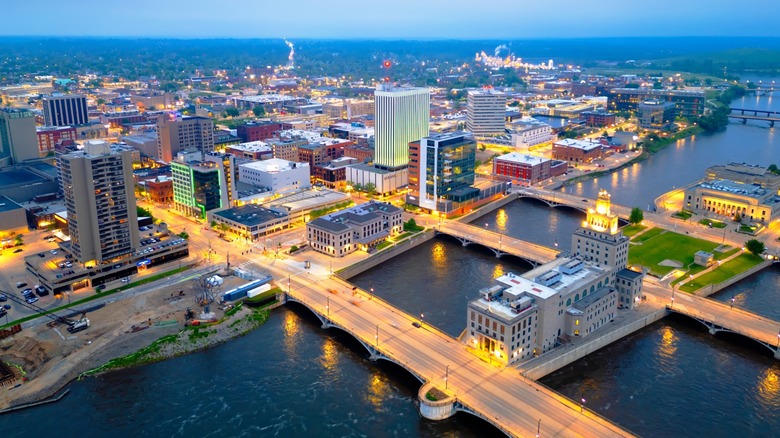
If you're wondering where your money will stretch the furthest, start by considering rent. Cedar Rapids, Dubuque, and Fort Wayne stand out in the Midwest because their average one-bedroom rents are low enough to keep housing costs from swallowing the whole check. As of April 2026, the average one-bedroom ran about $837 in Cedar Rapids, according to Apartments.com. Meanwhile, the average was $844 in Dubuque and $998 in Fort Wayne. On a $2,000 monthly income, that leaves roughly over $1,000 after rent in either city. That's still tight, but it's far more manageable than having to pay the national average one-bedroom monthly rent, which stands at $1,740 as of 2026, per RentCafe.
As for cost-of-living, Iowa and Indiana score 89.8 and 90.7, respectively, on the Missouri Economic Research and Information Center (MERIC) 2025 cost-of-living index. This places both states below the national baseline of 100, with notably low housing subindexes of 77.7 and 75.4. At the city level, Apartments.com says the overall cost of living in Cedar Rapids is 10.1% below the national average, while Dubuque's is 9.5% lower and Fort Wayne's is 6.6% lower.
It's worth noting, though, that none of these cities have an Elder Index renter cost below $2,000 a month. For homeowners without a mortgage and in excellent health, the lowest Elder Index cost in the three cities is in Fort Wayne, at $1,760 per month. Renters in Cedar Rapids, Dubuque, and Fort Wayne should expect to spend $2,085, $2,431, and $2,242, respectively, assuming they're in excellent health.
Grand Forks and Sioux Falls are also practical for retirees

Grand Forks and Sioux Falls are also affordable cities worth considering. In fact, Grand Forks has an Elder Index of $2,317 per month for single renters and $2,131 per month for homeowners, assuming excellent health status. Sioux Falls is even cheaper, with an Elder Index of $2,228 for renters and $1,975 for homeowners without a mortgage.
As of April 2026, per Apartments.com, the average one-bedroom rent was about $980 in Sioux Falls and $985 in Grand Forks, leaving just over $1,000 from a $2,000 monthly budget after rent in both cities. Overall, Sioux Falls' cost of living is 12.5% below the national average, while Grand Forks comes in 9.6% lower.
What really helps these cities stand out, though, is that lower costs do not come with as much day-to-day friction. The U.S. Census Bureau puts mean travel time to work at 17 minutes in Sioux Falls and at around 15 minutes in Grand Forks, compared with about 26 minutes nationally. For retirees, that translates into less time spent getting to doctor's appointments, stores, and everyday errands, not to mention paying less for fuel.
This accessibility stacks on top healthcare access, especially for Sioux Falls. Travel + Leisure recently highlighted Sioux Falls for the city's access to Avera McKennan Hospital and Sanford USD Medical Center. Meanwhile, Newsweek's 2026 best-in-state hospital list ranked the two facilities first and second in South Dakota.