

The House Has Strong Feelings On Trump's Canada Tariffs (And It's Not What You'd Expect)

On February 11, 2026, the United States House of Representatives voted to end President Trump's tariffs on Canada. A vote of 219 for and 211 against was bolstered by six Republicans who, in a surprising turn, voted against the imposition of tariffs on its close trading partner and former ally. The Republican defectors, Representatives Kevin Kiley, Jeff Hurd, Thomas Massie, Brian Fitzpatrick, Don Bacon, and Dan Newhouse, had their own reasons for their vote, despite Trump's veiled threat to sabotage their re-election campaigns. If nothing else, these votes siding with the opposing party's bill — proposed by New York Democrat Representative Gregory Meeks — despite potential political retaliation, demonstrates a strong belief in their decision. The votes also make sense to anyone who knows what tariffs are and who actually pays them.
President Trump has made his feelings abundantly clear about the perceived benefits of tariffs, specifically where Canada is concerned. Between April 2025 and July 2025 alone, Trump flip-flopped on tariff decisions 28 times. Still, President Trump has continued to weaponize the measure as a negotiation strategy and a punishment; the president recently threatened to impose 100% tariffs on Canadian goods for making a trade deal with China in January. While this no doubt adds to reasons why China's trade surplus is bigger than ever despite tariffs, it's still uncertain whether this turn will leave President Trump with egg on his face.
Here's how the House feels about the tariffs
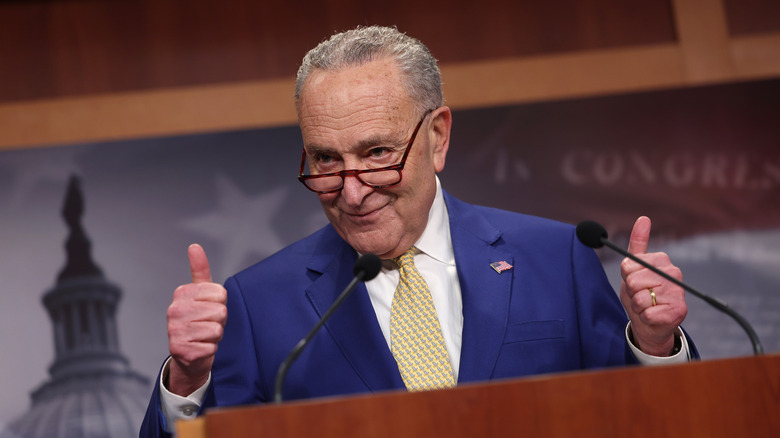
According to CNBC, the Democrats viewed the bill as bipartisan and argued that it would, in the words of Senate Minority Leader Chuck Schumer, "give Americans relief" from "price-spiking tariff tax" that is raising the cost of living. Democrat Representative Gregory Meeks, as per BBC, described the tariffs as destabilizing to the global economy, and all but one Democrat, Representative Jared Golden of Maine, voted in opposition to the tariffs on Canadian goods. For Golden, as per the Portland Press Herald, tariffs are "a tool to make America more self-sufficient."
There are a number of products that Americans buy from Canada that are impacted by tariffs. As per Republican Don Bacon on X, who supported the bill, "Tariffs have been a 'net negative' for the economy and are a significant tax that American consumers, manufacturers, and farmers are paying." In Bacon's case, he's unlikely to experience re-election challenges. He's retiring at the end of his term. As per CNN, Republican Jeff Hurd noted the negative impacts on the steel and agricultural industries in his Colorado district, as did Republican Dan Newhouse, who pointed out the rising cost of fertilizer and farming equipment in his Washington district. Republican Representative Thomas Massie, attacked the approach more than the tariffs, posting on X, "Taxing authority is vested in the House of Representatives, not the Executive." The bill still requires Republican-controlled Senate approval and a presidential signature to pass into law.