

The Income Of An Air Traffic Controller Will Make You Pause
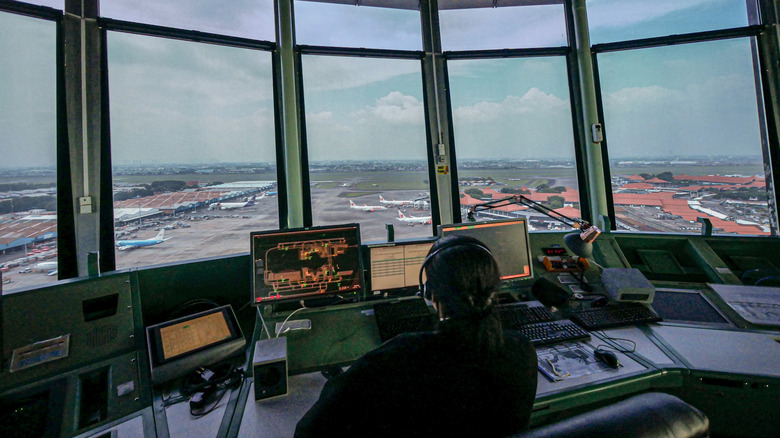
More than 3 million people take to the sky each day spread across over 44,000 flights, according to the Federal Aviation Association (FAA). Air traffic controllers are tasked with the intense and often stressful job of keeping these passengers safe by monitoring flights and directing pilots both on the ground and in the air. While tower controllers manage aircraft movement on runways and taxiways and in the airspace near airports, approach and departure controllers help airline pilots (who are also paid quite well) navigate arrivals and departures. En route center controllers, meanwhile, manage aircraft traveling between airports, helping maintain safe distances between planes. This crucial job can be a challenge, but it can provide an opportunity to build a financially rewarding career.
According to the Bureau of Labor Statistics (BLS), the median annual salary for air traffic controllers was $148,080 in 2025, making it one of the highest paying blue-collar jobs in the US. That said, the salary range is wide, with the lowest 10% making less than $78,420 per year and the highest 10% earning more than $215,610. Unlike many federal government jobs that operate on the General Schedule (GS) pay system, the FAA uses several compensation plans that vary by job category and experience. Most FAA air traffic control specialists are covered by the Air Traffic Compensation Plan, while the Core Compensation Plan applies to many other FAA employees. As of 2026, the FAA's Core Compensation Plan assigns salaries ranging from $25,719 for student positions to $207,931 for upper-level specialized air traffic controller managerial positions.
Why air traffic controller salaries are so high
With such high earning potential as an air traffic controller comes a list of challenges you'd need to overcome throughout your career. The day-to-day responsibilities involve working in an intense, fast-paced environment where even small errors can have serious consequences. Air traffic controllers are expected to monitor many flights and airspaces at one time, sometimes during high-stakes situations that require quick decisions. Strict rules and requirements also contribute to the demanding nature of the job. A long-term shortage of air traffic controllers has also contributed to demanding schedules, work-life imbalances, and fatigue among existing employees.
The FAA's education, experience, and eligibility requirements are also pretty daunting. Applicants must pass FAA aptitude testing, medical examinations, and security screenings before they can begin training, and only a small percentage make it through the entire hiring and certification process. Trainees must attend the FAA Academy in Oklahoma City for four to six months, then relocate to an assigned city for on-the-job training, which can take up to six years. The U.S. Government Accountability Office reports that approximately 2% of applicants successfully make it through the full hiring and training process.
Federal air traffic controllers are generally subject to mandatory retirement at age 56, although exceptions and extensions are possible in certain circumstances. However, bottlenecks in the training process make it difficult to hire enough air traffic controllers to replace retirees and burnt out employees. Higher wages, while definitely fair for helping to keep fliers safe, entice air traffic controllers to stay on the job and not worsen staffing shortages.