

Goodbye Le Creuset: This Is The Valuable Vintage Cookware Brand Collectors Look For At Thrift Shops
We may receive a commission on purchases made from links.
If you've been thrifting or searched through estate sales, you may have come across some old kitchen items that are worth a ton of money. Items like vintage Pyrex nesting bowls, jadeite dishes, and Le Creuset Dutch ovens can be especially coveted, with vintage Le Creuset dishes in good condition selling for upwards of $500 or more. But the next time you're looking into old cookware, there's another often-forgotten line of products that you certainly don't want to overlook: CorningWare.
The Corning Glass Company introduced the first CorningWare casserole dishes in 1958. Through the '80s, CorningWare produced a wide selection of ceramic cookware that often featured minimalistic floral designs displayed on the company's uniquely versatile Pyroceram ceramic-glass material. Collectors and resellers often look for these iconic vintage casserole dishes and cookware, and some pieces are valued at hundreds of dollars. According to professional antiques appraiser Dr. Lori Verderame, rarer examples of vintage CorningWare products can sell for between $50 and $500, depending on the item and design.
The most valuable vintage Corningware designs
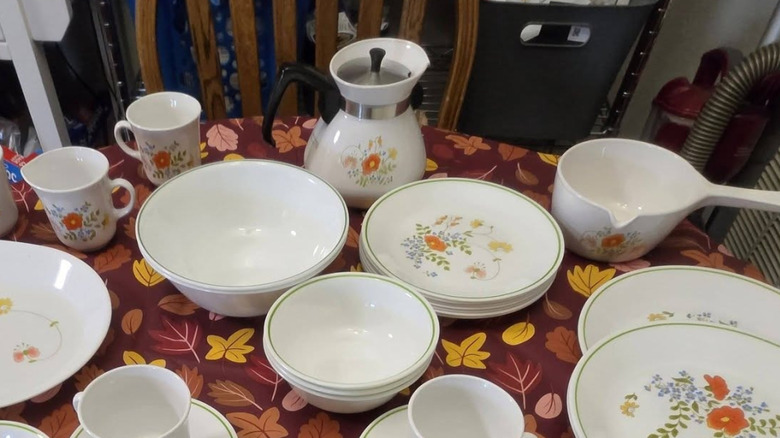
Collectors and resellers who prioritize value will want to seek out the less popular, limited edition, or rare CorningWare designs. For example, the Wildflower design is a discontinued line originally released in 1977 that features colorful orange-and-yellow flower artwork. In July 2026, a Wildflower percolator sold for $199 on eBay. One of the rarest series is Black Starburst — or Atomic Star — which features pieces embossed with simple black stars or metallic, flourishing star motifs. Cookware from this series can also be especially valuable, with a single casserole dish and lid selling for $179.50 in September 2026, and smaller pieces selling for upwards of $100. Similarly, the Floral Bouquet pattern features a simple floral line drawing with yellow elements. An electric percolator from this series once sold for $125 on Poshmark — and that was with missing components.
While more mass-produced CorningWare designs won't be worth as much, vintage examples may still offer good flipping value. Designs like the iconic Blue Cornflower and Spice O' Life – which features an array of vegetables and herbs — are sometimes found at thrift stores for as little as a few dollars, though it might help to know the best day and time to shop at your local thrift store if you really want to find a deal. If you can find them in good condition with lids, you may be able to sell individual pieces for upwards of $30, while sets could bring up to $100.
How to identify vintage CorningWare pieces
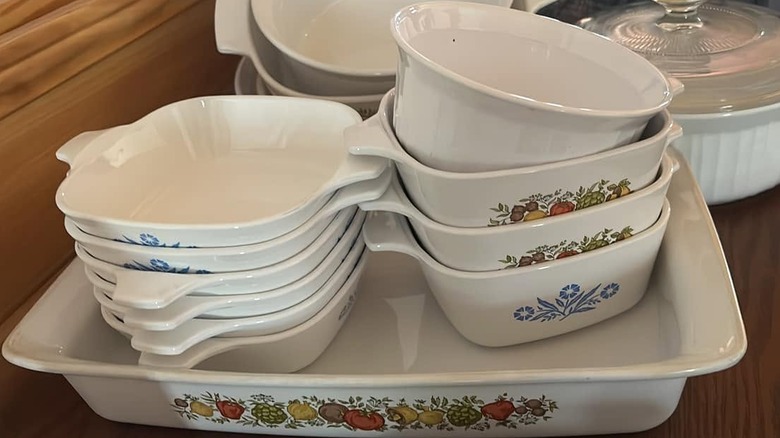
The primary feature that sets vintage CorningWare pieces apart from the competition is its material. Early CorningWare Pyroceram was only discovered in 1953 — just a few years before the first CorningWare products came out. It was found to be outstandingly durable and could withstand extreme temperature changes, meaning you can move it directly from the freezer to the oven to the table, and even use it on the stovetop. A 10-piece modern stoneware CorningWare set lists for $98.99 as of October 2026, while a similar nine-piece Blue Cornflower set sold for $299 on Ebay in August 2026. Its versatility, combined with beautiful designs that evoke nostalgia, is what makes it valuable to collectors trying to boost their net worths by put together a full set of vintage CorningWare.
There are a few signs to look out for when identifying vintage CorningWare: Though even vintage labels vary considerably depending on the set, older pieces often have a stamp marked with "Corning Ware" as two words — and sometimes just "Corning" on its own — while modern designs are more likely to display the brand name as one word. Some designs also have the production date printed near the pattern. Additionally, it's helpful to look for true Pyroceram products. If you see a design with a label that reads "Stoneware" or advising against using it on stovetops, odds are it's not vintage. Vintage CorningWare will also have a smoother, glass-like texture with a thinner build, and early examples have smaller handles, making them more valuable than later productions of the same design.