

Valuable $1 Bills You Might Have Lying Around
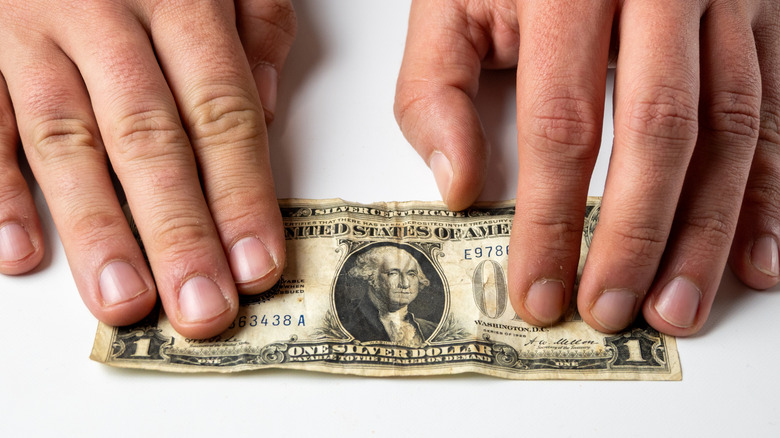
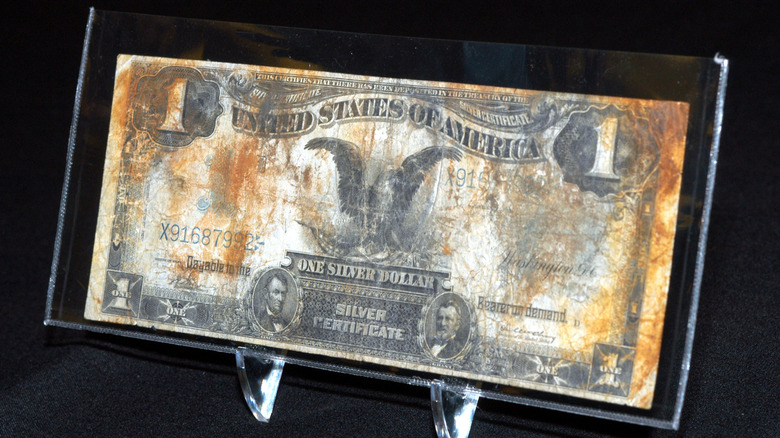
You may have heard of — or even found – valuable coins lying around, with some old or rare examples fetching high prices from collectors. However, coins, while popular, aren't the only U.S. currency that can be worth more than their face value. Certain $1 bills can also be valuable if you know what to look for and find one in the right condition. Among the $1 bills worth looking for are the 1862 Legal Tender Note, 1869 Rainbow Note, 1896 Educational Silver Certificate, 1899 Black Eagle Silver Certificate, and certain Series 2013B duplicate star notes.
The four older notes draw collector interest because of their age, place in American history, and distinctive designs, while the 2013 star notes are coveted because they resulted from an error where facilities in Washington, D.C., and Fort Worth, Texas, printed bills carrying identical serial numbers. How valuable each of these notes is exactly would depend on the exact variety, rarity, and condition of the bill. That said, estimates from the currency valuation service Greysheet range up to $36,500 for different 1862 Legal Tender Notes, roughly $24,000 for the 1869 Rainbow Note, $9,000 for the 1896 Educational Silver Certificates, and $10,000 for certain 1899 Black Eagle varieties. Meanwhile, Coin World reports that one matched pair of Series 2013B notes sold for $25,000 in 2022.
What to do if you find a potentially valuable $1 bill
Finding a bill that resembles any of these examples is not an automatic jackpot. You'll also want to check for specific differences in its signatures, seal, serial number, and printing facility, as these factors can dramatically affect its value. Take the Series 2013B notes, for instance: The star at the end of the serial number may identify one as a replacement note, but the replacement bills that have sold for significant value are typically paired with the match printed at the other facility with an identical serial number.
In addition to the variety, collectors also consider the note's condition. Collectors typically use a standardized process to identify high-grade dollar bills. Professional services such as Paper Money Guaranty (PMG) can authenticate a bill and grade it on a scale from 1 to 70, with higher numbers indicating better condition. Graders look for folds, tears, stains, poor centering, and other signs of handling. So, to get the best deal on a dollar note, you likely need to have stored it somewhere it remained safely untouched. If you end up finding one in a not-so-great state, don't try to clean, iron, tape, or repair it yourself, as that could end up causing further damage.
When you're ready to find a buyer, organizations like PMG have public databases listing paper-money dealers, and established auction houses can also help sell high-value bills. Before agreeing to a sale, though, be sure to check what similar notes have recently sold for and be clear on any fees involved in the selling process.