

The 9 Biggest Short Squeezes In The History Of The Stock Market
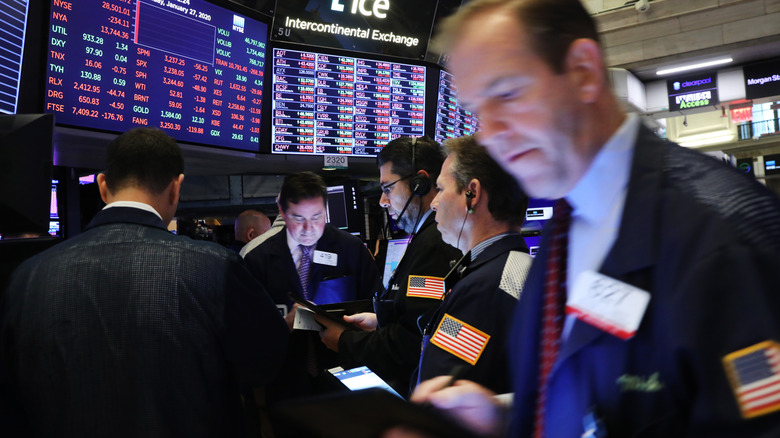
The short squeeze phenomenon showcases the fickleness of the stock market in a significant way. Most stock investors know that the basic contours of a share price's movement revolve around supply and demand. The more investors look to purchase a stock, the higher its price will move. With more demand comes the natural ability to sell the commodity at a higher price. Bloomberg reported in February 2026 that daily turnover had surpassed $1 trillion with tens of billions of shares changing hands daily, even during slower periods. There are lots of nuanced pressures influencing prices, and major societal issues, like warfare, frequently result in unpredictable stock market movements.
Typical investment behavior involves buying shares, which equates to a grant of confidence: By purchasing a stock, you anticipate that the price will go up. Alternatively, you can "short" a company, borrowing shares to sell at today's price, and then buying them back later on (ideally at a lower price) to net a profit and satisfy the loan. Where short selling exists, the short squeeze can exploit it, though. A short squeeze happens when share price increases, and short positions are closed by investors to cut losses. When this happens at a high enough rate, the sudden increase in demand can lead to a secondary spike in share price, setting off a cascade of frenzied sales to cover the short position, potentially skyrocketing price. The mechanics are straightforward, but the details of how each of these historic short squeezes were initiated are all fascinating and unique.
Piggly Wiggly (1923)
Perhaps the first short squeeze in U.S. stock market history, the Piggly Wiggly squeeze took place in 1923, after being listed on the New York Stock Exchange the year before. The company was founded in 1916 by Clarence Saunders, and it pioneered the concept of the supermarket. The company quickly issued shares over the counter (starting in 1920), and, in 1922, when it became a truly versatile stock option, there were already more than 1,200 locations in operation. Wall Street traders were involved in a bear raid on the company after a series of independently owned locations went bankrupt in the northeast, strategically shorting the brand in a coordinated effort to control pricing.
Saunders began secretly buying up all the outstanding shares of the brand that he could, taking on a $10 million loan (a little over $195 million in today's value) to help fund these efforts. Eventually, he announced that he owned all but 1,128 shares of Piggly Wiggly, and called in the debt that short sellers owed to the shareholders they had borrowed from, which was now effectively Saunders himself. He had virtually cornered the market, and demanded significant prices for the shares that short sellers needed to make good on their contracts. The NYSE closed trading on Piggly Wiggly, and short sellers escaped the encounter largely unscathed. Saunders was left around $5 million short of his repayment obligation, however, after the company was unable to resume trading on the exchange, and he ended the saga by filing for bankruptcy.
Herbalife (2012)
The Herbalife short squeeze is a bizarre tale of competing hedge fund managers. In December 2012, Bill Ackman, the CEO of Pershing Square, shorted Herbalife to the tune of more than $1 billion. His move came amid a tirade against the company during an investment presentation in which he claimed the brand operated as an illicit pyramid scheme. His massive short sale led to an unsurprising decline in share price by about 20% over the following three days. Ackman decided to hold onto his position rather than close it out, seemingly with a determination to end the company's viability based on his moral objection to its business practices. However, instead of seeing the brand's price continue to tank, other institutional investors started buying up shares in huge bulk, stabilizing its price.
The key actor on the other side of this game of tug of war was Carl Icahn. The billionaire investor started acquiring shares en masse, growing his stake in the company to 26% in the process. Early the following year, Ichan and Daniel Loeb each gained significant stakes in the company, both going public about their efforts. This drove the company's price back up, and by late 2017 it had gained 51% for the year, and Ackman actually responded by closing his short and buying into the brand instead. Ironically, Carl Ichan claimed to have made a profit of roughly $1 billion on the transaction, closely matching the short position Ackman initially took.
GameStop (2021)
The GameStop short squeeze that took place in early 2021 is almost certainly the most visibly famous example of the occurrence to happen in recent memory. It's among a selection of companies that were dubbed "meme stocks" and investors discussed the companies and trading strategies surrounding them on Reddit and elsewhere on the internet while coordinating efforts to influence their share prices.
GameStop came into focus in late 2020 with retail investors buying up as much of the company's shares as they could to artificially inflate its price. This is similar to the battle that occurred over Herbalife's pricing, but the GameStop squeeze took place as a cadre of retail investors taking on much larger entities. In reporting by CNBC from 2021, the chief investment strategist at Leuthold Group, Jim Paulsen, is quoted saying that "retail investors with the help of technology acting as a union in attacking is a new phenomenon." Instead of a wealthy trader seeing an opportunity to cut the knees out of a vulnerable short position, large numbers of small scale traders worked together to achieve the same end. The outcome was dramatic, with short sellers losing roughly $20 billion in the frenzy, as GameStop briefly rose to around $500 per share (up from a pre-squeeze price of around $5, making it officially within the definition of a penny stock).
Volkswagen (2008)
The Volkswagen short squeeze of 2008 came as a genuine surprise. This example of market control led to the most damaging loss for short sellers that had ever happened. In 2006 Porsche publicly announced a plan to increase its investment volume in its fellow automaker. This reveal, and the resulting ramp up of Porsche's stake in Volkswagen created additional market demand, pushing the price higher. By early 2008 Porsche had developed a roughly 30% stake in the brand and made it clear that rumors of a 75% target were unfounded. At around the same time, institutional investor analysis largely held that the company was overvalued, specifically because of Porsche's significant volume of buying, and began shorting the company.
Roughly six months after Porsche's assurances that it didn't intend to continue gobbling up Volkswagen, the company announced that it had indeed taken a nearly 43% stake in the brand, alongside 31.5% of the shares in cash-settled options, meaning it controlled the ability to fully acquire nearly the entire remaining balance of outstanding shares. This set off a wave of panic among short sellers with the math leaving them incapable of acquiring all of the shares necessary to satisfy these contracts without buying directly from Porsche. VW share price soared from around €200 to over €1,000 in a two-day period. No charges came of it, but Porsche's CEO was investigated over market manipulation, and hedge funds lost more than $30 billion in the bloodbath.
AMC Entertainment (2021)
AMC Entertainment was the focus of another Redditor-driven short squeeze during the wild investment landscape of the pandemic era. Unlike GameStop, AMC was a brand with good underlying metrics, but had been hammered by public health regulations and social distancing measures. The in-person experience of going to a movie theater took a serious backseat during this time, and lots of film projects were published straight to streaming platforms instead of going through the typical channels. This undercut theaters everywhere, including AMC, which operated over 1,000 locations globally at the end of 2019. This has contracted in the years since, with the brand owning around 850 in June 2026. Variety reported in March 2021 that AMC Theaters lost $4.6 billion in 2020 alone as a direct result of the pandemic.
A brand like AMC should have done exceedingly poorly in stock performance throughout these years, and hedge fund managers were quick to take advantage of this reality. However, as is the case with others that retail traders rallied around, this one took on a life of its own, stunning short sellers to the tune of $1.2 billion in losses in one week in May, alone, and $5.22 billion in total (via Benzinga). The brand's price rose from around $2 per share in early January 2021 to nearly $20 by the end of the month, and rose 2,300% in total between the end of 2020 and June of '21.
Tesla (2020)
Tesla has long been a quandary to traders. The company is constantly being shorted by institutional investors, and, at numerous times, the car company has been seen to be poised for prolonged downward pricing pressure. Yet, somehow Tesla repeatedly proves naysayers wrong on their predictions for the brand's outlook. At no time was this on fuller display than throughout the 2020. Bear positions were significant in the brand, but a raft of good news continued to buoy the company's fortunes to the tune of 743% during the calendar year. According to reporting by CNBC in January 2021, short sellers lost $245 billion in 2020 on positions across the entire stock market; Tesla made up $40 billion of that loss volume alone. The outlet notes that heading into 2020 and throughout the year, Tesla posted five successive quarters of profits, executed a crucial stock split (when shares split to make the company more approachable to smaller investors), and joined the ranks of the S&P 500.
CNN reported in early 2021 that in January 2020 short investors controlled roughly 19% of outstanding Tesla shares, but by the end of the year that had fallen to about 5.5%. The substantial pivot out of shorting the brand also helped give it pricing elasticity. Continued pressure on short positioned also served as a springboard for Elon Musk's personal wealth during the year. He has also routinely been among the highest paid CEOs in America, and much of his compensation is tied into Tesla stock.
KaloBios (2015)

The 2015 short squeeze of KaloBios came as a result of Martin Shkreli's purchase of 1.2 million shares (for a price of around $1.6 million). The company was in the process of a liquidation, and its share price had plummeted. Shkreli bought up a controlling interest in the brand, and his enormous investment sent the share price roaring back to life with a 700% increase in one day and around 10,000% in total during the period. Insiders anticipated that his takeover of the brand was a play to take his own company public without requiring an IPO (although he denied that this was the purpose).. Nasdaq reports that this process averaged a cost of roughly $27 million to the company going public.
Much of the price inflation that KaloBios experienced in the days after his takeover came because of his massive stake. The company had been shorted to the tune of around 250,000 shares, and his roughly 70% stake in the brand left little on the table for short positions to be made whole, initiating the squeeze and slingshotting his investment. However, even as a rush was on to locate outstanding shares to cover the short, bear traders were granted something of a reprieve when Shkreli was arrested on unrelated securities fraud charges and trading was halted at $23.59 per share before the company was delisted.
Beyond Meat (2019-20)
Beyond Meat went public in 2019 and quickly gained the attention of short sellers. It saw its price dip early on after a surge of post-IPO gains, leading to a massive pile on of bear positions. Fox Business reported in January 2020 that the company had as much as 40% of its stock tied up in shorting action, leading to prime conditions for a squeeze on the bears. Much of the negative pressure appeared to center on underwhelming visions for the brand's long term viability. IG reported in 2025 that negative outlooks were driven largely by underperforming profitability figures. Even with its share price booming in the early months, the brand was still posting quarterly losses, and that financial weight eventually dragged down the hype that surrounded it in the buzz of its IPO.
However, rolling into 2020, the short positions had become so large that a cascade of closed positions threatened to be initiated by small to moderate changes in the company's financial profile. This is exactly what happened when Dunkin and Snoop Dogg announced a collaboration with Beyond Meat, kicking off a chain reaction as the pricing momentum turned around. In total, Fox Business reported $587 million in market-to-market losses (losses on paper) in early 2020 and another $391 million in losses related to the squeeze in 2019.
PetMed Express (2021)

PetMed Express (stylized as PetMeds) was another Reddit-driven short squeeze that happened during the pandemic years. This was another brand targeted in large part due to an untenable short sold float figure. In mid-May, 35% of the company's stock was tied up in short sale positions (via The Motley Fool), making it a solidly exploitable stock for institutional investors or coordinated retail traders. This large figure followed an early-May report by Yahoo! Finance suggesting that PedMed Express was experiencing lackluster financials alongside increasing competition by other eCommerce pet care brands. The report specifically suggests, however, that a short squeeze was unlikely, even with short interest already at 28.5% at the time, continuing a trend that was a few months in the making.
That unlikely scenario is exactly what happened, though. The Motley Fool reported in early June 2021 that the brand's share price had risen by nearly 60% in a single day of trading, with an immense trading volume of around 10 million shares (compared to an average daily volume under 500,000). Price spiked in January, when the GameStop squeeze was being executed. Taken together, the company was a repeat stressor for short sellers, although there aren't official numbers available for how much bear traders ultimately lost while pivoting out of this besieged investment.