

The Income Of A Harbor Pilot Will Make You Pause
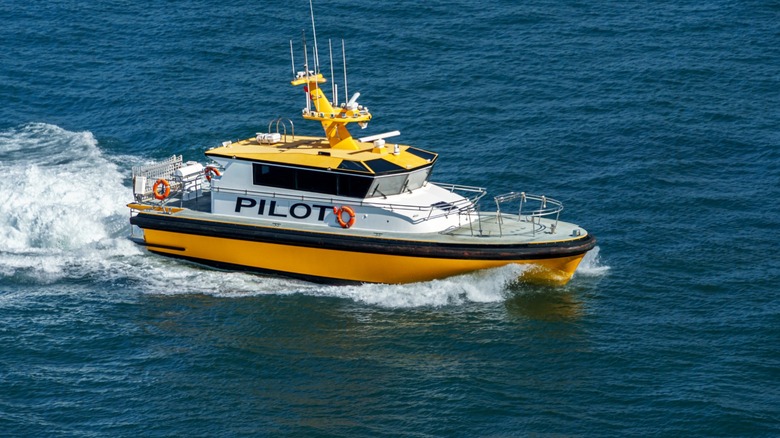
Have you ever seen a small boat — perhaps marked "PILOT" — racing alongside a massive cruise or cargo ship near a harbor? Although you might assume it's helping tow the larger vessel, it may instead be carrying a harbor pilot. Despite sharing a title with helicopter pilots, harbor pilots have nothing to do with aircraft. They are specially licensed mariners who board ships and help guide them safely into or out of port. Essentially, they serve as local navigation experts, advising captains who may be less familiar with a harbor's channels, currents, water depths, traffic procedures, and hazards.
According to ZipRecruiter, these maritime specialists earn an average of $130,916 annually. That works out to approximately $10,909 per month, $2,517 per week, or $62.94 per hour. However, the site places the median slightly higher at $141,300, meaning half of harbor pilots earn more and half earn less. ZipRecruiter places the 25th and 75th percentiles at about $100,000 and $155,000, respectively, while the 90th percentile is around $175,000. For comparison, the harbor pilot median is only $6,780, or about 4.6%, below the $148,080 median that the Bureau of Labor Statistics (BLS) reports for air traffic controllers in 2025 — another safety-critical profession counted among America's highest-paying blue-collar jobs. Still, the $130,916 average is approximately 88% higher than the $69,770 mean wage across all American occupations, per the BLS in May 2026.
With overtime and other compensation, actual earnings could be much higher than these ZipRecruiter figures. In Los Angeles, for example, Transparent California's 2025 payroll records show that five Port Pilots received more than $500,000 in total pay and only around half of it was their base pay.
Why harbor pilots earn such high pay
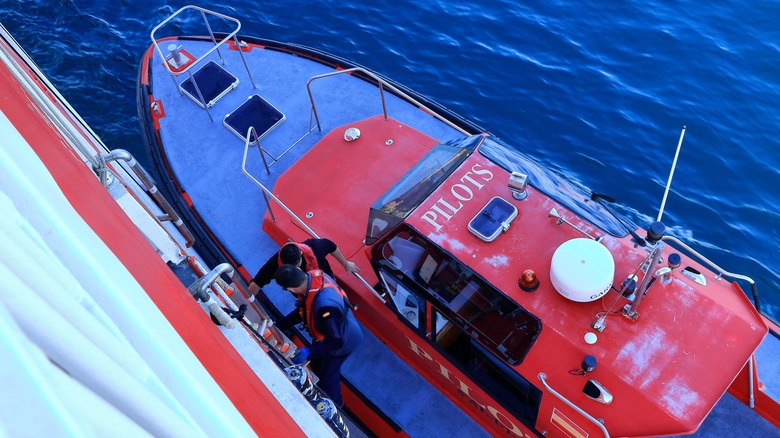
While being a harbor pilot is one of those high-paying jobs that don't require a college degree, it doesn't mean it's an entry-level shortcut. Apart from requiring U.S. Coast Guard-approved training programs, apprenticeships, and years of experience at sea, some employers still prefer candidates who also have bachelor degrees from a maritime academy. On top of that, harbor pilots generally need a U.S. Coast Guard Merchant Mariner Credential and may also need a state license, per the BLS. This means a harbor pilot candidate may arrive with a multi-year apprenticeship under their belt and extensive tugboat or deep-sea experience, according to the American Pilots' Association.
Not only does the job require highly skilled specialists working in potentially dangerous scenarios, but the supply of pilots is also intentionally restricted by the state where the harbor is located. The American Pilots' Association says that the state governments limit the number of licenses to what is considered necessary for safe and efficient service. Pilots also generally work through a single association or take turns accepting assignments under a regulated system. At the same time, all foreign ships and U.S.-flagged vessels involved in international trade are legally required to use a state-licensed pilot while passing through state waters. This leaves a relatively small group of pilots serving ships that are often required to use them, which helps explain why the job pays so well.