

Why You Were Right For Not Buying An Electric Vehicle In 2022
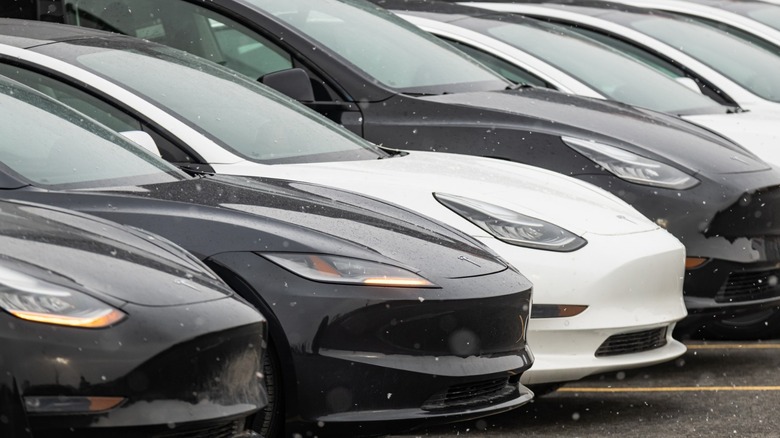
Those who were wary of buying electric vehicles (EVs) in 2022, and instead chose to wait to buy, may have saved themselves a lot of money. In 2022, the average price paid for a new EV was $65,111 in April — enough to buy a value-oriented luxury car – before climbing to a peak of $66,390 in June that year, per Kelley Blue Book. Fast-forward to July 2026, and the average new EV transaction price had fallen to $56,126, per Cox Automotive. When comparing June 2022 to July 2026 prices, the difference is $10,264, or about 15.5%, even with the average price of new vehicles remaining near historic highs in 2026.
In 2022, several factors converged to drive the prices of electric cars up. First, there was a general shortage of new vehicles thanks to pandemic-era plant shutdowns and chip shortages. In a 2024 speech at Stanford, Federal Reserve Governor Adriana Kugler explained that these shortages kept U.S. light-vehicle production under 9 million in 2021 and below 10 million in 2022, versus 10.5 million in pre-pandemic 2019. Dealerships largely took advantage of this scarcity, with a Bureau of Labor Statistics analysis of Securities and Exchange Commission (SEC) data finding that dealer markups increased from an average of 4.9% of a vehicle's retail price in 2019 to a whopping 11.5% in 2022.
For EVs specifically, battery-pack prices also rose 7% from 2021 to 2022 — to $151 per kilowatt-hour — due to high raw material costs, per BloombergNEF. However, by 2025, battery-pack prices had fallen to $108 as production expanded, competition intensified, and cheaper battery solutions became more common, leading to lower prices in 2026.
2022 buyers were also hit hard by EV depreciation

A car's value can depreciate surprisingly quickly, but EVs take this even further due to their quickly evolving technology. According to a 2026 study by iSeeCars, EVs lose 57.2% of their value after five years, compared with 41.8% across vehicles overall. This means that when it comes time to sell or trade in an EV, you're likely to get less value for it — something that financial author Suze Orman warns can leave financed owners underwater, or owing more than the vehicle is worth. 2022 EV buyers who bought near the price peak are dealing with normal EV depreciation on top of falling EV prices, meaning their already-expensive cars have likely fallen even further in terms of value.
For instance, a 2022 Tesla Model Y Performance started at $69,190, but in 2026, Kelley Blue Book puts its resale value at around $30,000 — or roughly 57% – less in just four years. That's about the same depreciation iSeeCars expects from a Honda Accord after 10 years. Another case, the 2022 Kia EV6 Light, started at $42,695, while a good-condition example in 2026 is valued at roughly $15,000 in a private sale — a drop of about 65%.
For better or worse, much of that loss has already been absorbed by the first owner. Therefore, if you're shopping in 2026, you can choose from many 2022 and 2023 EVs for tens of thousands of dollars less than they originally cost, while still getting relatively modern features.