

11 Baby Boomer Job Hunting Tips That Just Don't Work Anymore

Baby Boomers often mean well when they offer job hunting tips to Millennials or Gen Zers. Whether the advice is coming from parents, grandparents, or co-workers, the hope is you'll apply their experience in landing your dream job. However, as younger jobseekers will tell you, many of the tips baby boomers lived by in their prime working years hardly apply today.
Bear in mind that the average baby boomer began entering the workforce in the '60s, with the youngest members joining in the '80s. It's safe to say that the employment landscape looks much different in the 2020s than it did back then. For instance, BambooHR noted that Gen Z in general is having a hard time in the job market due to a perceived lack of soft skills. Millennials, meanwhile, are reportedly negotiating a tough job market amid severe stress and burnout. There's also the technology gap: During the baby boomers' working prime, typewriters could still be found in many an office. As of 2026, employees are expected to operate laptops and tablets, navigate the internet and emails, and increasingly utilize artificial intelligence (AI). With how much has changed in the workplace, the baby boomer approach to finding work may not work for Millennials or Gen Z employees.
With this in mind, we've come up with a list of common baby boomer job hunting tips that just don't work any more.
Finding jobs in person is always better than looking online

When hearing this advice, it's important to remember the context in which it is offered. Due to the technological restrictions of the era, many young baby boomers would not have had the ability to find work far from where they lived. They didn't grow up with the internet and email. Instead, responding to a job ad meant heading into town to directly inquire about a potential role.
For today's job seekers, much of the effort to find a job begins and ends online. For instance, Indeed claims to host 685 million job seeker profiles with 31 hires happening every minute. This matches feedback from recruiters, who share that online application submissions have surged substantially in recent years. As one recruitment expert shared with CNBC, sites like LinkedIn receive an average of 9,500 applications from job seekers every minute. Part of this surge is made possible by both the ability to work outside of the office and a growing preference for remote job opportunities.
As most of today's job hunting takes place online, timing is the more relevant concern. SearchSteward, for instance, found in June 2026 that 38.6% of job listings only stayed up for a week at most, with 25% of postings vanishing in six days or less. So, if you notice an online listing for a job you're interested in has only been up for a day, now's the time to apply.
Enthusiasm is enough to fill the work qualification gap

Baby boomers will often advise you to be as enthusiastic and ambitious as possible when applying for a role. Enthusiasm is, after all, essential for facing workplace challenges with positivity and joy. However, baby boomers might overestimate how essential that quality is today relative to hard skills. For instance, Express Employment Professionals released a November 2022 survey that found dependability was the top-preferred soft skill among hiring managers. Meanwhile, a 2025 SkillsRight survey showed that 86% of hiring managers are in favor of prioritizing an applicants' raw professional skills over factors like a resume lined with prestigious jobs and degrees. Enthusiasm can still be a great quality in an employee, but a "can-do" attitude isn't always enough to overcome a work qualification gap in the modern day.
Instead of just focusing on being as enthusiastic as possible, lead with a combination of hard and soft skills. Alongside dependability, Express Employment Professionals learned hiring managers also valued communication skills and a willingness to learn. As for hard skills, there's no getting around the need to garner whatever qualifications are necessary to improve your chance at landing the job. That may include getting a certification or advanced degree. Even without the degree, years of work experience in the industry will allow you to list relevant hard skills on your resume. By combining the right technical know-how with a positive attitude and a willingness to communicate, you may have an easier time seeking work.
Aim for industries that paid baby boomers the most money
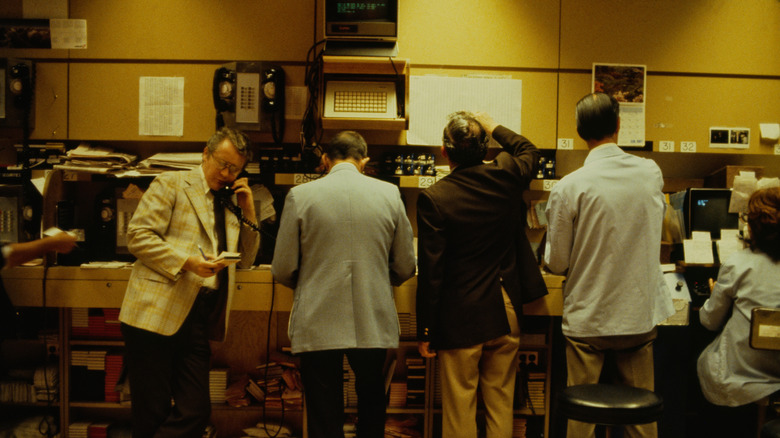
In late September 1984, the Rocky Mountain News shared its list of the top-paying careers in the '80s. If you wanted to make six figures, you needed to become an investment banker or a physician. The next-best-paid careers involved trading and selling stock, which paid $75,000 to $80,000 at the time. In general, when baby boomers were entering the workforce, the people around them making the most money were often doctors, lawyers, engineers, or working on Wall Street. However, there are some important changes that have taken place in the professional landscape since the 1980s.
First is how valuable a $100,000 salary is in 2026 compared to the decades past. Back then, earning six figures effectively guaranteed you were comfortably upper class. However, in the 2020s, there are several cities where households earning $100,000 annually are still struggling to make ends meet. In U.S, News & World Report's 2026 list of the 25 highest-paying jobs, the 11 most lucrative roles all pay a median salary of more than $200,000 — over double what the best earners of the 1980s were bringing in.
It's also worth noting that jobs in fields such as e-commerce or artificial intelligence (AI) didn't exist in the '80s. As such, baby boomers probably won't tell you to chase these career paths because they simply aren't familiar with them. You'll be better off pursuing roles in top industries from a 2026 perspective than relying on baby boomer tips — especially since some boomer careers simply aren't around anymore.
Apply to any available role, as any job is better than no job

The idea that "any job is better than no job" may seem a solid career rule to follow, even if it is somewhat cynical. The instinct that you need some form of employment is entirely understandable, but a bad fit can come at a serious cost regardless of the compensation. It's very possible to run into trouble if you indiscriminately prioritize getting any job over finding one that's truly a good mutual fit.
First, this practice raises the potential you'll land in a hostile work environment. Job seekers who are pursuing roles mindfully may inquire upfront about potential toxicity in the workplace. If, however, you're simply willing to take what you can get, you may be more reluctant to rock the boat if it could cost you a potential role. Unfortunately, this behavior may actually signal your vulnerability, and convince managers you're a good candidate simply because you lack the power and agency to immediately leave once in the role.
Second, when you're happy in your job-seeking process, it may help you discern what you prioritize in a position. The more clearly you define exactly what you want, the more straightforward negotiating compensation and settling into your role will be. Meanwhile, some note there is a positive correlation between job satisfaction and job retention. Getting a job just to have a job makes sense when you're unemployed. However, this advice may fall flat when you must summon the motivation to remain in a role that's a poor fit.
Put your full address on your resume

Adding your full address to your resume has different implications in 2026 than it would have in the 1980s. For baby boomers, having a return address on a resume made sense. At the time, you might mail out your resumes, as a lot of companies didn't start sending emails until the mid-'90s. In an era where communication options were so limited, it would have made sense to include your full address to ensure your potential employer would be able to reach you.
Today, many job seekers prefer not to include a full address on their resume. It might just be simpler to refer to a city and state, thus leaving more room on the document to highlight your skills and education. However, some job seekers opt out of listing their full address as a matter of privacy. Additionally, your complete address is pretty sensitive information, so there are potential risks that come with sharing it freely — especially through online portals.
Another reason job seekers shy away from listing their full address is the potential for discrimination. The hiring management platform Warden AI warns that ZIP code bias can occur when hiring managers decide to pass on a candidate based on their home address. Other biases may emerge when the company chooses to put up listings advertising a role in specific neighborhoods while ignoring others. The shift away from a full address can help curtail this type of bias, allowing the most vulnerable applicants a better chance at competing for job roles.
Pass on a job if it lacks a specific number of vacation days

According to a 2023 study of Bureau of Labor Statistics data by the Washington Post, workers in 1980 were nearly twice as likely to cash in on paid time off (PTO) than Millennial and Gen Z workers today. The frequency at which older generations used vacation days suggests that baby boomers were fully intent on benefiting from their vacation time when they took a job. In 2026, questions about vacation days address a lot more than simply how many there are on offer.
An October 2025 FlexJobs report found 23% of American workers did not take any vacation days in the year leading up to the study. A similar 2023 Pew Research Center study found 46% of workers don't feel comfortable taking vacation days. Reasons included fear of falling behind at work or concerns that taking time off would impact their reputation in the workplace. Based on the Washington Post's findings, it seems boomers were less likely to accept a similar silent agreement not to take time off as a means of showing their dedication to their position.
With this in mind, accepting job offers based on allotted vacation time becomes a little more complex. For instance, you may want to follow any mention of PTO in an interview up with a question of how many employees use their vacation days to get a better sense of how a potential employer approaches their vacation policy. It's also good to know if the hiring company offers unlimited paid time off or a specific number of PTO days.
Don't submit a resume that's longer than a single page
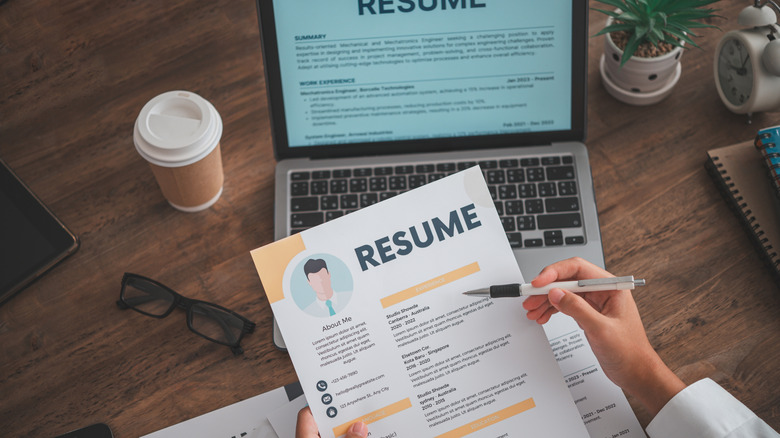
One job hunting tip frequently offered by older people in the workforce is to make sure your resume is a single page. Though this advice is quite common, some find that it's actually not necessarily true. For instance, government jobs demand very detailed resumes which might stretch them to over three pages. According to Executive Career Brand, it's not unusual for executive job seekers to submit resumes that are four to six pages long — though whittling them down to two or three pages may be a bit more preferable to some hiring managers.
In other words, the longer and more specialized the career, the more likely it is that a job seeker is going to need more than one page to efficiently communicate how well they fit a desired role. While a one-page resume could still work, depending on the job and its level of seniority, a two- or even three-page resume could still be acceptable, if not expected.
Rather than fixating on page length, make sure that your resume is appropriately formatted, easy to read, and includes all the relevant information mentioned in the original job ad. Without the relevant information, your resume may fail to get past the applicant tracking systems (ATS). ATS tools frequently help companies sort through hundreds to thousands of candidate applications. Rather than page numbers, it will likely be qualifications and relevant keywords that push your resume through the system.
Call the company to follow up about your application

It's important to remember that, for baby boomers, the telephone was the most direct way to contact someone for much of their lives. The other option involved communicating by mail after sending your resume and cover letter through the postal service. Instead of waiting ages to hear back by snail mail, a direct over-the-phone follow-up may seem like the best way to show ongoing interest in the role and find out quickly if a job interview is in your future.
Even though we have various methods of communication today, baby boomers might still advise you to follow up about jobs by phone. This makes sense, as boomers are the most likely generation to respond to cold calling themselves. Still, experts advise sending a follow-up email instead of a phone call, and email is also often the communication format recruiters prefer. If following up, instead of placing a call within a couple of days, experts recommend sending out a follow-up message after about a week.
For some, part of the desire to follow up may be to avoid getting ghosted — an experience that a 2026 LiveCareer survey found nearly half of all job applicants have shared in recent years. As annoying as this possibility is, you may still be better off adhering to modern job seeking etiquette. If the company shares when it typically gets back to candidates, trust it. If you don't hear anything, your best course of action could be to simply move on.
Include 'references available upon request' on your resume

While including a "references available upon request" line on your resume might feel extra professional and useful, it is generally a waste of page space. Instead, it may be best to think of it as symbolic of a time when your professional past wasn't a Google search away.
As of 2026, it's very common for working professionals to be found on websites like LinkedIn, Glassdoor, and Indeed, or via official websites and online portfolios. Today, it is easier than ever to find a digital trail of someone's work history. On LinkedIn, you can even scroll to a section that includes recommendations from past and current co-workers. As such, you may not need to go out of your way to include a list of references alongside your resume.
Rather than including the "references available upon request" line on your resume, check the job ad to see if there's any mention of references. If there isn't, assume that the hiring manager doesn't consider it essential for the initial application process. You are welcome to gather people willing to vouch for your capabilities — you may even be asked for references further along in the hiring process — but don't consider it a priority over details the job listing actually asks for.
Refer to experience, not market rates, for salary negotiations

Baby boomers tend to expect compensation to reflect their professional experience and longevity in the industry. However, younger job seekers who allow these notions to lead their own approach to salary negotiations might be putting themselves at a disadvantage.
Instead, getting familiar with the current market rate for the type of work you're searching for may give you a better chance at successfully landing a job. When preparing to accept a job offer, you can help improve your starting pay by doing some research beforehand. For instance, resources like Bureau of Labor Statistics data and industry surveys and reports can give you a sense of the average earnings people in your specific role can expect. While experience can certainly play a role, demand can as well. If an industry is saturated, demand may be down, which could negatively impact potential pay rates and negotiating power. Likewise, learning that your skills are highly prized will give you more confidence when demanding a reasonable salary.
Knowing the market rate is crucial to knowing how to move when seeking new job opportunities. Your experience speaks to what you know and what you can do. However, familiarity with your industry's financial climate will inform the type of leverage you will have when making salary demands based on your unique work history.
Look to job boards, fairs, or classified ads to find work

Despite what baby boomers might think, job fairs aren't the best environment for finding work in 2026. Disappointed attendees who took the time to print out resumes and appear in person have often complained about companies represented at job fairs simply directing them to apply for positions online or even advertising ghost jobs. On the other side of the table, experts also question how effective job fairs are for drawing in successful new hires. Print classified ads may have been the go-to for job seekers in the 20th century, but today's workforce mainly seeks jobs online.
Still, digital job boards present their own challenges. As we previously mentioned, LinkedIn alone sees thousands of job applications submitted every minute, so the word "competitive" barely begins to describe the current job market. A 2026 United Way of the National Capital Area survey found respondents applied to 62.6 jobs on average, with some submitting over 100 applications over a period of several months.
One potential alternative to spending time pouring over job ads and online job boards is career networking, which may even give you access to jobs that aren't listed to the general public. Joining professional organizations, keeping in touch with former co-workers, or becoming a mentee to knowledgeable professionals are all great ways to build connections in your industry. Together, these options could provide you an avenue for finding positions that are uniquely suited to your talents.