

The Best-Performing S&P 500 Stocks Of 2026 So Far
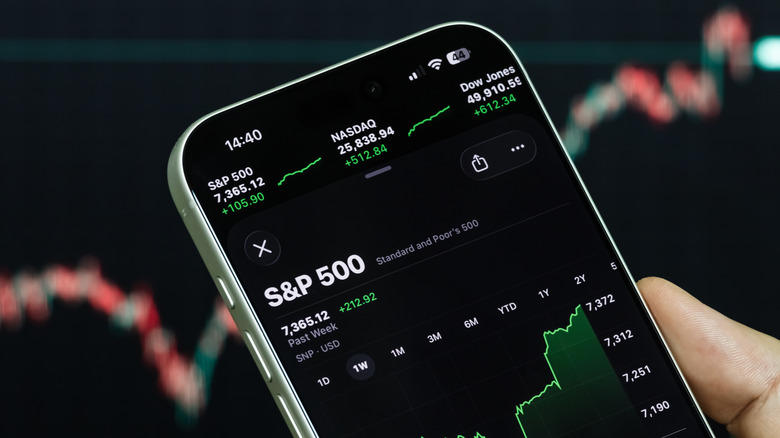
The S&P 500 is, in many minds, the best indicator of the overall health of the broader stock market. In fact, a $1,000 investment in the index roughly ten years ago would have yielded an annualized gain of over 13% (from 2015 to 2024). At its simplest, this index includes the 500 largest companies in the United States, and while the fortunes of these brands naturally ebb and flow, there is the added reality of an AI bubble looming large over the wider market. With that said, there are some breakout companies in 2026. Most notably, SanDisk, Micron, and Dell — all of which are benefitting from the current AI frenzy.
For context, there is a shortage in the supply of reliable computational hardware like memory chips. With AI data centers growing at a rapid pace, the need for these tools has eclipsed demand — ensuring that prices for things like processing power and data storage tools are skyrocketing. The result is a price boom specifically in the area of the technology marketplace that benefits these companies (but will ultimately hurt consumer electronics pricing).
While there are plenty of ways to invest in AI indirectly, the performance of the stock market in 2026 appears to be rewarding buyers who have gotten in on the hardware side of tech. While this is benefitting these three companies in the short term, you'll still want to approach them with caution as an investor, since buying shares of a company after a breakout success can often backfire.
SanDisk Corporation (SNDK) and Micron Technologies (MU)
Leading the pack by an astonishing margin, SanDisk Corporation (SNDK) has delivered an over 4,000% increase over the last year and a roughly 640% return year to date (YTD), as of mid-July 2026. These are astounding figures, driven largely by SanDisk's role as a key producer of the hardware that drives AI. The company has also signed several long-term contracts that guarantee continued revenues. These are all great features for an investor looking to get into a brand poised for continued growth. However, SNDK is trading with a P/E ratio above 60, indicating its status is overvalued. P/E or price-to-earnings is a measurement of a company's stock price compared to its earnings per share. While not a one-stop-shop of information, it can be an easy way to assess a company's value.
Micron Technologies (MU) is another massive performer in the 2026 S&P 500. The company makes memory chips, positioning it in a prime role to support the processing and computing power needed for the AI industry. The company shot up in value during a May 2026 price spike due in large part to a reported net income that grew by 15 times its figure from the previous year — $28.2 billion from a 2025 Q1 net income of $1.9 billion. As of mid-July, the company had experienced a share price increase YTD of over 235%, the continuation of a yearlong growth in value of just over 700%.
Dell Technologies (DELL)
Dell Technologies (DELL) makes personal computers, but the brand is also heavily involved in various behind the scenes elements of computing and data analysis. Unsurprisingly, this also includes the development of hardware infrastructure to support AI data centers and functionality. Dell provides servers to brands in the AI sector, which positions Dell as a core factor in the success or failure of many AI businesses. As such, Dell's Q1 2026 revenue was an 88% increase from the prior year (at $43.8 billion), which was a major catalyst for the company's share price growth as well as an over 200% increase in earnings per share.
These, and other factors, have catapulted Dell to new stock price heights in 2026. The company, as of mid-July 2026, was experiencing around a 260% increase in share price YTD. These features make Dell a company to potentially explore further for a short- to medium-term investment option. The company is also well-positioned as a consumer and enterprise level hardware builder, meaning it sits in a prime position to continue showing strong revenue figures regardless of what the future holds for the AI industry.