

The $3,000 Rule For Buying Cars You Shouldn't Ignore

Maybe your current car feels outdated, or perhaps you're among the millions of Americans who don't have a vehicle. No matter what inspires it, when the desire to get a new car finally hits, it can be advantageous to hold off on rushing into the dealership until you have the necessary funds set aside. One way to gauge if you're financially ready to buy a car is by adhering to "the $3,000 rule." In a nutshell, this guideline says prospective auto buyers should have at least $3,000 saved for car expenses. And when you really start breaking down everything that goes into getting a car, it becomes clear that this is a rule worth paying attention to.
When purchasing any car, whether brand-new or used, it's crucial to look beyond down payments and starting MSRPs. Those factors are certainly important, but they're far from the only expenses you'll wind up with as part of car ownership. While it's not a hard-and-fast financial law, the $3,000 rule leaves you with a helpful financial cushion, considering that you'll also have to pay for vehicle registration, auto insurance, maintenance costs, and of course gasoline (which the average American spends over $200 a month on, per The Motley Fool). The reality is that $3,000 might just barely cover annual expenses as it is, and in some states, yearly car ownership costs go far beyond that. But as a bare-minimum starting point, the rule could at least help you navigate the purchase without running out of funds.
The $3,000 rule accounts for more than just a vehicle's price tag
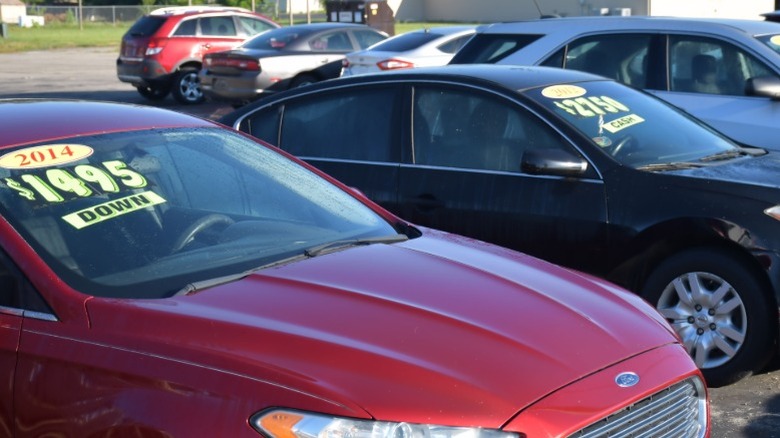
You could put the $3,000 toward the initial deposit, but seeing as most new cars sell for well over $20,000 in 2026, per an Edmunds report, $3,000 might not cover the recommended 20% down payment. That said, car down payments vary, and some dealers actually do let you drive off the lot after putting very little, or even zero, money down. However, these deals typically mean you'll have higher monthly payments and a lengthier payment plan. Regardless, having $3,000 or more set aside can still be very helpful for auto buyers. Plus, with cars depreciating quickly in value in their first few years, $3,000 can make up a sizable chunk of older vehicles' value — especially among the cars you should only purchase used.
Regardless, the $3,000 rule has become such common consumer guidance that auto dealerships across the U.S. now have entire pages dedicated to it on their websites. If you don't have $3,000 you can spend on a vehicle at this time, well, the rule advocates for not buying anything until you can meet that minimum savings threshold. This is to keep you from doing long-term damage to your bank account balance, credit score, and even your ability to purchase a car in the future. In other words, if you don't have $3,000 you can put towards a new vehicle, you just might not be financially ready to do so.