

How Does SpaceX Plan To Make Money?
On June 12, 2026, SpaceX went public on the Nasdaq after an initial public offering that saw the company raise $75 billion from the sale of over 555 million shares the day before. While this record-breaking performance shows just how much faith people have in SpaceX as a business, it might not be obvious to everyone exactly how SpaceX intends to make money.
SpaceX has been founder Elon Musk's most valuable asset for quite a while, with the company's income largely based on three main businesses: Rocket launches, satellite-powered internet service through Starlink, and AI technology. However, Starlink is the company's only profitable department as of going public, with service plans ranging in price from $55 to $175 per month. Per The Information, Starlink had already brought in $11.4 billion in revenue as of April 2026 — with its user base only continuing to grow.
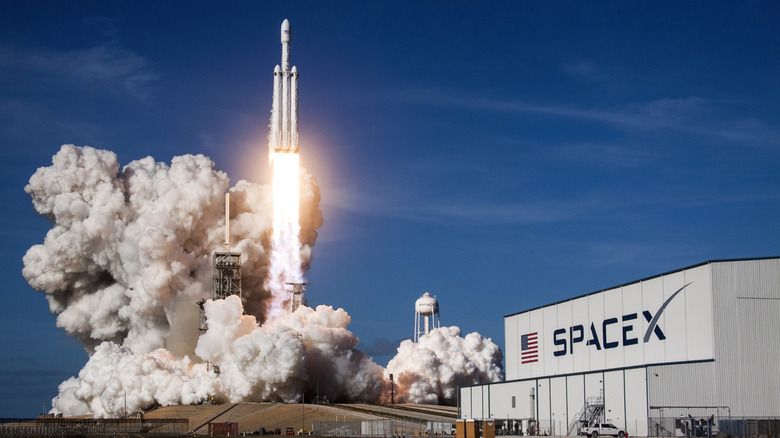
While neither of SpaceX's other divisions have turned a profit yet, the company appears to be working to remedy that. On June 16, SpaceX announced its merger with the highly successful AI coding company Cursor, after merging with Musk's own xAI brand earlier in 2026. While the company's AI infrastructure is already generating some revenue, these efforts will likely help it establish a stronger foothold in the AI sector. It also offers active commercial rocket-launching services, and redirects much of the money earned from both private and government contracts to further research and development of this technology. As SpaceX is already responsible for the vast majority of the world's rocket launches, the earning potential of this department could grow sizably as designs continue to improve.
SpaceX is already cutting costs and earning money
Before SpaceX went public, Goldman Sachs had previously predicted that the value of the company's AI department would increase from $3.2 billion in 2025 to $322 billion in 2030 (as first reported by The Financial Times). Despite the fact that consumers have been weary of the AI bubble for some time, other experts have echoed Goldman Sachs' sentiment regarding SpaceX's performance long term. Seeing as how major companies like Google have already established sizable long-term contracts with SpaceX to utilize some of its AI infrastructure, there is already evidence that SpaceX is capable of generating additional income. Meanwhile, major government entities have been hiring SpaceX as a contractor for years. Shortly before going public, the company also secured two contracts worth a combined $6.45 billion from Space Force, and those are unlikely to be the last.
The company also has the lofty goal of opening AI data centers in space, which Musk believes could push the boundaries of AI capabilities — and, presumably, profit margins — to new heights. Though many are skeptical about the feasibility of space-based data centers are, SpaceX already has the in-house resources to get hardware into orbit which would likely reduce overhead. After all, the company has been publicly lauded for developing uniquely cost-effective space travel technology, like its reusable rockets, for years. There's also the company's commercial space tourism branch to consider, which is estimated to charge upwards of $200 million per flight and is likely only going to increase in popularity in the coming years.