

The Most Affordable Way To Buy A Car Without A Down Payment
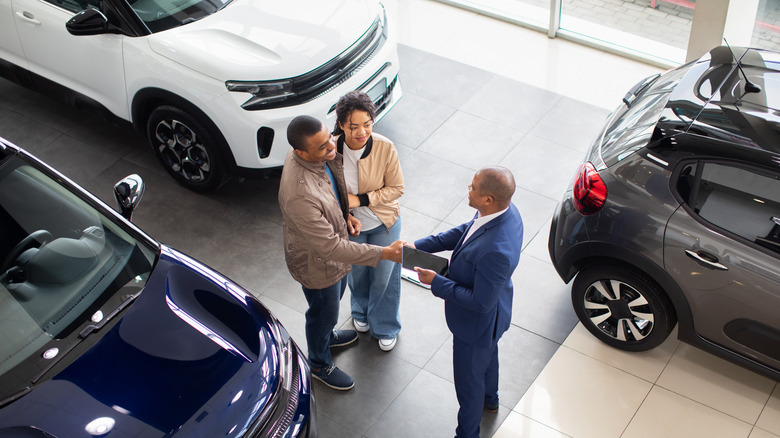
While buying a new car can feel increasingly difficult thanks to ever-increasing prices among both new and used vehicles, as well as high interest rates on car loans, those aren't the only concerns at play for many consumers. For instance, not having a down payment can be a significant barrier for those looking to buy a car. With that said, there are ways to help get around this particular hurdle. Most notably, zero-down loans can make it possible for consumers to purchase a car without needing to put any money down. This can make them one of the most affordable options out there for those without a down payment available — provided they shop around.
However, it's worth noting that this kind of loan can be harder to qualify for. We spoke exclusively with CAR-MAN-CHRIS, Owner of Carmanchris Auto Consulting (a concierge car buying service) about the things that consumers should keep in mind when pursuing a zero-down loan. He explained to us, "If you are a car shopper with strong established credit, say over a 720-credit score, and you have financed/leased a car in the past, banks and credit unions will find that you are more favorable in meeting their risk management criteria to finance a car with zero-down."
With that said, having imperfect credit is not necessarily a deal breaker when pursuing a zero-down loan. Chris told us that using a co-signor with strong credit can also help a person qualify for this kind of loan. However, he warned there are other considerations to keep in mind.
Zero-down loans can be affordable, if you choose wisely

There are several ways to ensure a zero-down loan remains an affordable option. For starters, ensuring you are not shopping for brand new vehicles — and avoiding expensive luxury vehicles — can help keep the amount you need to borrow down. Next, one of the biggest factors to keep in mind with zero-down loans is the interest rate. Since your interest rate can have a significant impact on your payments every month –- and therefore directly influence both the length of the loan and the amount of interest you end up paying long-term –- ensuring you can get as low of an interest rate as possible can be extremely important.
Chris told us, "To make buying a car more affordable when you don't have a down payment, you should inquire if your own financial institution offers auto loans and see what rate of interest they charge. You can compare those rates with the interest rates the car dealer is offering to see who has the better rate." Shopping around can be the best way to ensure you get the lowest possible rate available.
Another consideration for those that might not have a down payment could be to use an existing car. Chris explained, "Using a trade-in which may have value (equity) is a good idea, as it helps to reduce the principal amount being financed." This can have far reaching implications on not just your monthly payment amounts but also how much you spend in total over the length of your loan.
The potential pitfalls of zero-down loans

There are significant factors that can make zero-down loans more or less expensive. Chris explained, "When buying a car with no down payment, it means you are financing the total balance with interest. This means government fees like sales tax, tag/county registration fees/title, dealership document fees and any negative equity that may potentially be brought over from a trade-in are subject to interest, as they are part of the financed amount." While trading in a car with negative equity is already a bad idea according to Suze Orman, doubling down on this financial burden with a zero-down loan can lead to a long term debt cycle that's difficult to get out of.
Another consideration with a zero-down loan is how a lack of a down payment can affect your monthly car payment amount. While an alarming number of people already pay over $1,000 a month for their cars, joining that particular club could cause significant financial strain if you're looking to buy an expensive vehicle. This can be especially true if your budget is already such that you're unable to produce a down payment. Many car buyers end up extending the length of a loan in order to ensure lower monthly payments, however, as Chris put it, "The longer you finance the car means that you will pay more interest over time." Ultimately longer loan terms, like a 96-month loan, are a bad idea thanks to more accrued interest over the length of the loan. This means you can end up paying significantly more for the vehicle overall than if you had used a down payment.