

The Three Car Colors That Lost The Most Value In 2025

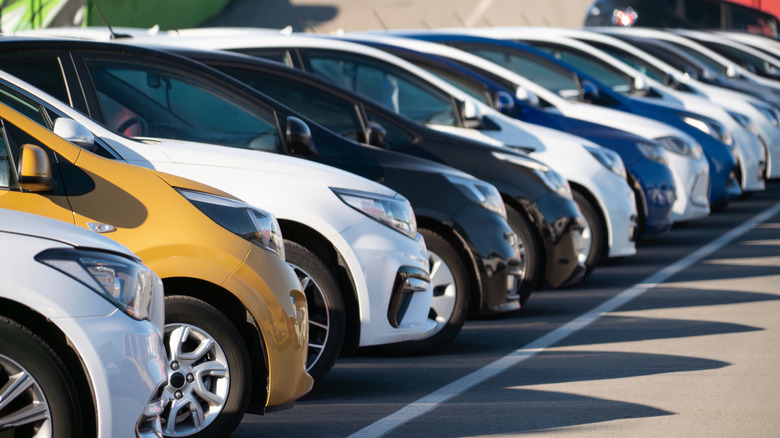
Unfortunately, cars can depreciate surprisingly quickly when purchased new. However, there are ways to influence just how much your new ride might drop in value in the coming years. Make and model both heavily influence resale value — with several models you can save thousands on by buying used — but color can also be surprisingly impactful on a car's value. According to a 2025 report by iSeeCars, gold, black, and white cars tend to depreciate the most over the course of three years. The study found that, on average, cars depreciate 31% in that time, but gold, black, and white models were the only options featured in the report to exceed that rate. Gold vehicles reportedly depreciated the fastest at 34.4% over three years, with white and black were close behind at 32.1% and 31.9%, respectively.
One potential explanation for this trend is that these colors simply aren't the most exciting to look at — which could inform why vibrant colors like green, yellow, and orange had the most favorable depreciation rates listed on the report. However, an iSeeCars analyst also suggested that these trends could be due to market saturation since cars in neutral shades are often easier to find for sale than more exciting alternatives — meaning there is a lower demand. This theory seems especially likely for black and white cars, as Edmunds reports that models in those colors made up 48% of all new car sales in 2025.
Other factors that inform how fast a vehicle depreciates
Accounting for inflation, black and white cars from the 2022 model year each dropped in value by over $15,000 after three years, while gold models dropped by $16,679 during the same time frame. So, if you're looking for a used car and don't have a personal color preference, you might have better luck finding reliable used cars for under $10,000 by snagging one in black, white, or gold.
However, there are other elements that can influence how much value a given car retains. For instance, mileage can be an essential consideration. Many contemporary cars can last 200,000 miles or more with the right upkeep. However, the higher the odometer goes, the more questionable the vehicle's longevity becomes. Vista Motors estimates that every 20,000 miles a car is driven can reduce its value by 20% — a rate that could drastically increase if the car's also been in an accident.
Original components are also attractive to many used car buyers. Whether a driver replaces something by choice or out of necessity, changing out a part on your car — and the engine especially — could reduce its overall value. Although, there are some exceptions to that rule. For example, replacing a full set of tires can easily cost $500 or more, so an owner who replaces their car's tires before selling it could list the car for more money as an incentive for buyers.