

This Once-Abandoned Billion Dollar 'Ghost Airport' Wasted A Ton Of Money
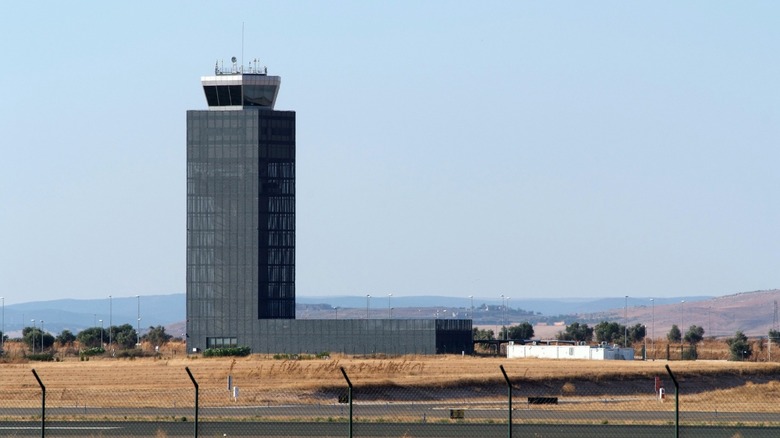
A shuttered building can be eerie enough, but what about an entire abandoned airport? Those traveling around Spain's Castilla-La Mancha region over the last decade may have gotten a glimpse of a peculiar dark tower and set of buildings next to a long, empty runway. This is Ciudad Real International Airport (CRIA), a billion-dollar project that quickly went bankrupt and became one of Europe's most spectacular infrastructure failures in modern history. In its latest resurrection attempt, the airport announced in a January 22, 2026 LinkedIn post it was resuming mixed-use aviation operations. However, whether this will be enough to lift CRIA out of the financial red remains to be seen. Because despite sitting as a ghost property for most of its life, what's really spooky is just how much money this airport wasted — and how quickly it did.
As the BBC reports, CRIA cost €1 billion to construct before opening in 2008. In case that doesn't seem too wild, that would be about €1.5 billion in 2026 when adjusted for inflation, or $1.7 billion. And this was all for an airport just outside of Ciudad Real, in a province home to just under 523,000 people (per Spain's National Statistics Institute data) at the time. For comparison, South Africa opened its R8 billion (roughly $483 million) King Shaka International Airport just two years later in Durban, a city of 2,739,000 people (per United Nations data). Unlike that airport — which is still operational — CRIA closed in 2012 and was auctioned off in 2015 for a measly €10,000 ($11,710).
CRIA's financial problems began before its first flight took off
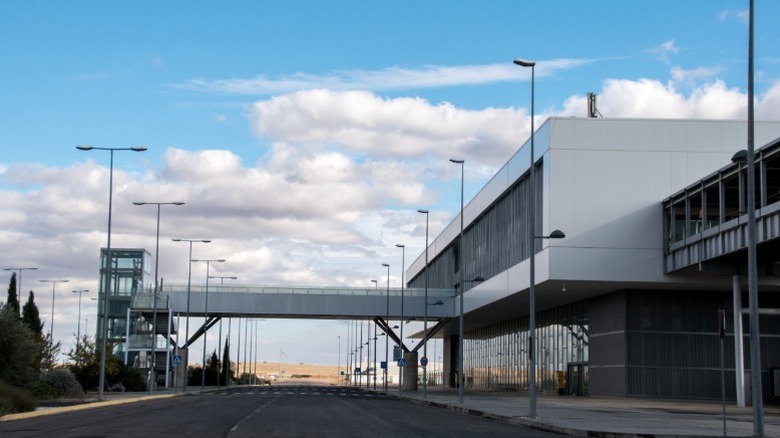
Expectations were high for CRIA. It was the first-ever privatized international airport in Spain, backed by several high-profile shareholders and designed to accommodate cargo traffic and passenger flights from low-cost airlines. And although it was built in a rural area 120 miles south of Madrid, part of the airport's pricey design included a connection to six different rail lines, including a high-speed connection to the capital. That train station was never completed, and a partially built pedestrian walkway to it was left sitting abandoned as a wasted construction cost.
According to a timeline compiled by Finanzas, failures to meet environmental standards resulted in repeated construction and operational delays throughout the early 2000s. But the airport still opened doors in 2008, a year of global economic crisis perhaps best known for the housing crash and some of the most scandalous bankruptcies in history. Sure enough, CRIA's top financier, Caja Castilla La Mancha (CCM), was experiencing its own liquidity problems and was eventually taken over by Spain's central bank in 2009. At the time, El Pais called out CRIA as a prime example of CCM's history of investments "with no visible return."
By the time the airport declared bankruptcy that same year, it was reported to be €290 million ($339 million) in debt by Elmundo. Not even that infamously pricey airport food would have helped it recoup those costs. Airlines had already begun abandoning CRIA in the meantime, with the last one, Vueling, announcing its departure in 2011.
CRIA is resuming operations after years of wasting money post-closure

After years of various redevelopment proposals falling through, CRIA was officially sold again in 2018, and, in 2019, it welcomed its first flight in eight years. But after the COVID-19 pandemic hit, the airport transformed into a low-cost storage facility for airlines, hosting some 70 planes during the pandemic's peak with no scheduled passenger flights. Although the airport announced plans to expand its holding capacity to 300 aircraft, half of the planes were moved back into their regular service by mid-2021, as pandemic-related travel restrictions eased globally. La Vanguardia reports that CRIA closed once again later that year, having defaulted on multiple payments to suppliers.
Nevertheless, new hope is on the horizon in 2026, with CRIA opening once again for passenger flights. CRIA's announcement says the move has come after a year of upgrades. This was likely not a cheap effort. As Forbes reported in 2019, CRIA continued to accumulate costs as its infrastructure began crumbling in disuse. Likewise, Madrid publication La Razon reported in 2013 that the airport still accrued annual costs of €35 million (over $41 million) in maintenance. With CRIA's financial future still up in the air for now, you might want to stick to other airports if you're looking for ways to save money while flying.