

Kelley Blue Book Says This SUV Is One Of The Best New Cars You Can Buy

Since model year 2015, Kelley Blue Book (KBB) has given out the Best Buy Awards in various vehicle categories, highlighting models with the best value proposition. For the 2026 model year, the Hyundai Kona received the Best Buy Award in the subcompact SUV segment. This marks the third straight year that the Kona has clinched the award, since it also topped Kelley Blue Book's list of Best Buy SUVs in 2025 and in 2024.
When Kelley Blue Book chooses models for the Best Buy Awards, it looks at pricing, resale value, safety, and the overall driving experience. The base price of the 2026 Kona sits just over $25,000, which, albeit not on the low end of the range, still undercuts some compact SUVs while delivering modern features, a surprisingly roomy interior, and scoring high points on the Insurance Institute for Highway Safety (IIHS) tests.
Then there's fuel economy to consider. Kona's base front-wheel-drive (FWD) model gets about 31 combined miles per gallon (mpg) — not bad for a non-hybrid. That could mean hundreds of dollars saved annually compared to driving larger, less efficient SUVs. Among other subcompact SUV base models, it outpaces the 2026 Honda HR-V, which has 28 mpg combined, and roughly ties with the best 2026 Chevy Trailblazer setup, at 31 mpg combined.
How Hyundai Kona outperforms rival models on value
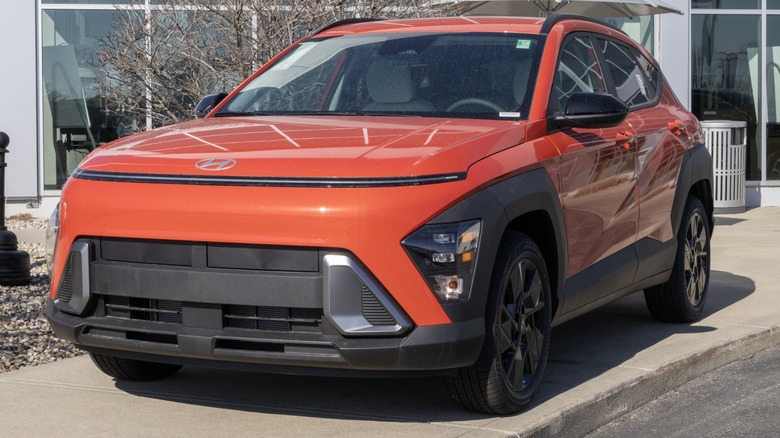
With a base price of $25,500, the 2026 Hyundai Kona isn't the cheapest subcompact SUV available. Sure, it costs less than some competing models, like the Honda HR-V ($26,500), the Subaru Crosstrek ($26,995), and the Ford Bronco Sport ($31,000). However, it's still a pricier option than the 2026 Kia Seltos ($23,790) and the 2026 Toyota Corolla Cross ($25,035). This means that Kona has earned its Best Buy Award because it gives buyers more of the things that enhance daily ownership without pushing the price too far upward.
For instance, every 2026 Kona comes with a 12.3-inch touchscreen, wireless Apple CarPlay, and Android Auto. In contrast, the base Seltos starts with an 8-inch screen, as does the Corolla Cross (Toyota's larger, 10.5-inch display is reserved for higher trims and upgrades). Kona also has 25.5 cubic feet of cargo room behind the second row; this is more space than you'd get with the HR-V, Mazda CX-30, Subaru Crosstrek, and a few other comparable models. Kona's top-tier trim, the SEL Premium ($28,550), adds a 190-hp turbo engine while still undercutting the pricier Corolla Cross XLE ($29,860), which runs a 169-hp 2.0-liter gas engine.
Also, the resale value of the 2024 and 2025 model years has been above the class average. For instance, Kelley Blue Book estimates that the 2025 Kona will lose about $13,200 in value over five years, compared with a five-year depreciation of roughly $14,300 for the 2025 Kia Seltos and $14,500 for the 2025 Mazda CX-30. Although Kona is considered a more reliable SUV than a Toyota Highlander, it's still too early to get trustworthy reliability figures for its 2026 model year. More broadly, though, Consumer Reports lauds Hyundai for being an affordable brand that generally makes reliable cars.