

How TCL TVs Stay So Cheap
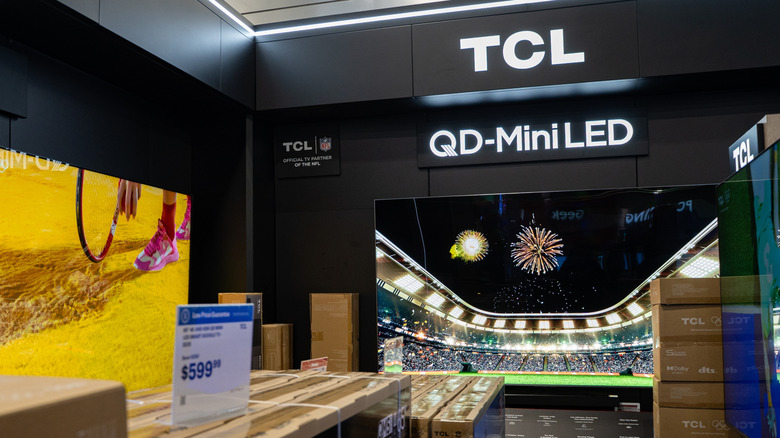
The Bureau of Labor Statistics (BLS) says the price index for televisions fell 94% between December 1997 and August 2015. And while TVs seem to be defying inflation, it's largely because consumers got increasingly more quality and a better TV experience over the years.
TCL has turned that long-running trend into a viable business model. In March 2026, a 55-inch TCL S5 could go for just $230 to $280, while a 55-inch TCL Q6 QLED model cost between $270 and $320. Meanwhile, Samsung's 55-inch DU7200 typically goes for around $370 to $390, and the company's 55-inch Q7F QLED is in the $380-to-$400 range. Sony's 55-inch Bravia is usually in the whopping $600-to-$700 range.
One key way TCL has driven down the cost of its TVs is by lowering the cost of the display panels — a component that contributes to about half of the cost of manufacturing a TV, per TrendForce. TCL gets a major advantage by getting panels from its display affiliate, TCL CSOT, which ranked second globally in TV panel shipments in 2024. In contrast, many major brands like Vizio get their panels from third-party manufacturers. Likewise, Samsung gets OLED TV panels from LG Display, according to Reuters.
Secondly, TCL uses similar strategies as Hisense to keep its TVs affordable. It all comes down to leveraging scale. TCL is one of the biggest players in the industry, shipping tens of millions of TVs every year. As the Financial Times notes, this scale lets TCL withstand component pricing pressures in a low-margin market and stay competitive. With that leverage, along with its game-changing partnership with Roku, TCL can offer feature-packed TVs at lower prices, all while operating on slimmer margins.
TCL's partnership with Roku gave the company an edge
In 2014, Roku launched its Roku TV platform, and the company chose TCL as its partner. The 2014 Roku press release said the move was meant to slash costs for original equipment manufacturers (OEMs) and praised TCL as the world's third-largest TV maker, with nearly 12 million sets sold in 2012. Thanks to the partnership, TCL gained a shortcut into the U.S. smart-TV boom without having to fund and manage the premium software ecosystem on its own, and this likely helped keep prices low for consumers. Capitalizing on this head start, TCL moved quickly to expand its retail operations, deepened its Amazon shipping networks, and bought Sanyo's Mexico plant to improve supply-chain efficiency in the Americas.
By 2024, TCL said its annual TV shipments had climbed to 29 million sets, up 14.8% year over year, giving it a global market share of 13.9%. In 2025, the market share rose again to 14.7%, good enough to rank it second globally. With total worldwide TV shipments of 208 million units in 2025, that implies TCL moved roughly 30.6 million sets in 2025. Samsung was still far larger at a share of 29.1%, or 60.5 million sets, but crucially, TCL now operates at a scale where low prices are a viable strategy.
That said, TCL is not winning by flooding shelves with low-quality TVs. In 2025, 65-inch-plus sets made up 30.5% of its shipments, 75-inch-and-up models hit 15.4%, and Mini LED shipments jumped 118% year over year. In North America, TCL's average selling prices rose more than 20%, while its retail volume still ranked third. This growth reflects the company's strategy of selling higher-quality TVs at prices low enough to keep expanding its market share.