

Everyone Avoided It In The '80s - Now Investors Want It For Portfolio Protection

Investors employ a number of strategies to protect their assets during times of economic volatility. Diversification of asset classes and flight to quality are two methods that can help navigate turbulence in the market. But even among quality investments (those that are considered relatively safe), gold stands out as an asset that is often relied upon in an unstable market.
But gold has had its dips as well. In fact, gold prices often go down as market sentiments improve. During the 1980s, for instance, gold faced severe corrections after an initial surge in price, which had left the metal at a low price of less than $300 per ounce. This drop kept investors reeling for many years. But come 2026, it seems like a large number of investors have once again turned to the precious metal, seeing it as a reliable asset that can protect their portfolios from market volatility.
The metal's reputation as a store of value is one of the major factors that control the price of gold, apart from inflation and global tensions that influence that perception. With gold crossing the $5,000 mark for the first time in history in January 2026 (growing by 60% compared to 2025), it is clear how strongly the market is tapping into this storehouse.
Gold had crashed severely during the '80s
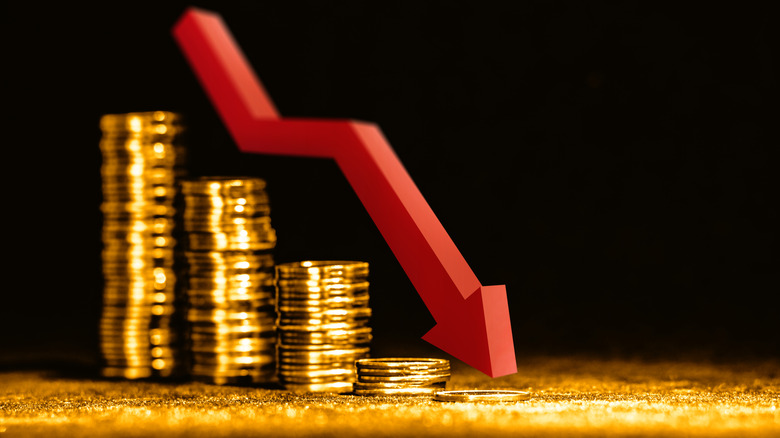
People invest in gold as a hedge against political uncertainty and periods of high inflation. At the beginning of the '80s, these factors converged to drive the price of the precious metal to sky-high levels. Inflation had hit double digits in 1980, while geopolitical tensions become inflamed due to the Iranian revolution and the Soviet invasion of Afghanistan. In response to all these factors, gold prices surged to a high of $850 per ounce in 1980.
One of the ways governments keep inflation in check is by raising interest rates. The Federal Reserve spikes interest rates to discourage borrowing and consumer spending, which subsequently thwarts demand for commodities. In response to the rising inflation in the '80s, interest rates were raised to exorbitant levels — well above 15% in the early years of the decade. Consequently, inflation did subside, and by 1982, gold prices fell to around $300 per ounce. With CD accounts offering 20% returns, many people pulled their money out of gold and deposited it into banks. Investors who bought gold at its peak had to endure a long bear market, as gold prices remained in the range of $300 and $500 throughout the decade. In fact, it took almost 30 years for gold regain its 1980 value.
Gold has become the go-to asset for investors once again
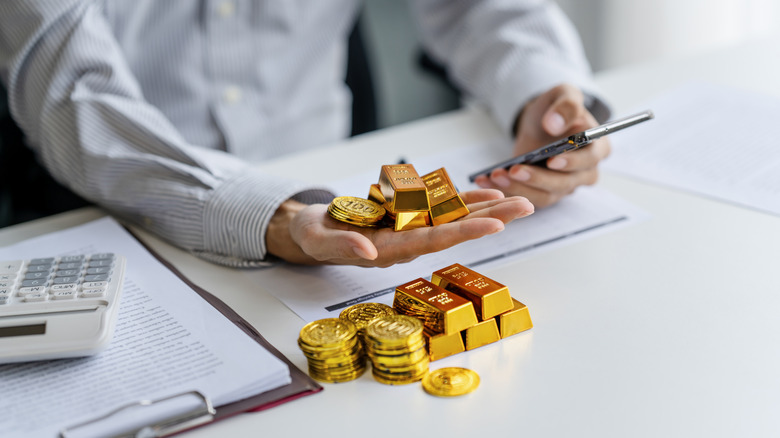
In 2026, the global market sentiment is again unsettled due to geopolitical flareups and failing supply chains. Central banks around the world have invested heavily in the precious metal to distance themselves from the weakening dollar. Disruptions in trade due to rising tariffs and interest rates cuts by the Federal Reserve have also influenced investors to move towards this traditionally defensive asset. All these factors marked gold's ascent to its historic $5,000 mark. Since the value of gold is not tied to any particular sector of the economy, investors think it's more likely to be stable compared to other assets, such as stocks or bonds. 2025 proved to be the best year for gold since 1979. By early 2026, both gold and silver had hit record-breaking highs.
Now, amidst fears of inflation due to rising oil prices, central banks are considering hiking interest rates again, a move that can lead to an economic slowdown. However, unlike in the past, it also seems that the inverse correlation between interest hikes and gold prices no longer holds true. Ever since 2022, gold prices have stood ground even amidst rising interest rates, representing investors' lack of confidence in traditional assets. Since the post-pandemic inflation smashed the conventional 60/40 equity-to-bond portfolio, with stocks and bonds both facing considerable losses, gold has gained even greater appeal as a safe haven asset.