

10 Baby Boomer Careers That Hardly Exist Today
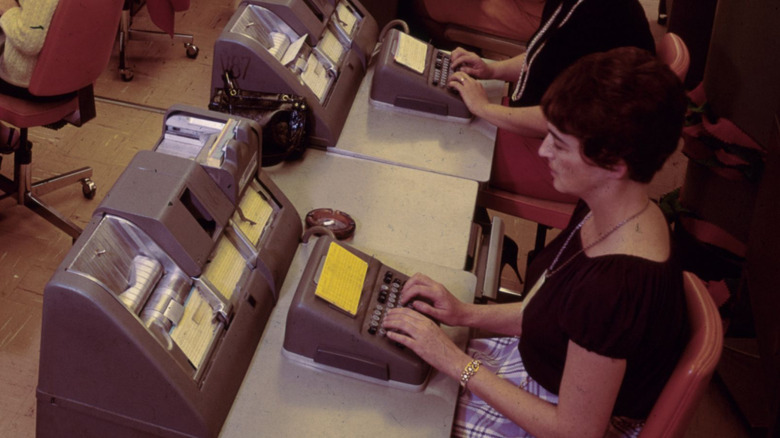
With each passing decade, entire industries that once thrived become obsolete. It's now common to hear baby boomer-aged Americans reminisce about jobs that either don't exist at all anymore or are rare enough that most younger people don't really talk much about them. For instance, the auto-manufacturing industry once employed many millions of Americans, with the United States Bureau of Labor Statistics finding it reached its peak around 1979. From the 1980s onward, automation took over, and this career field saw many human jobs replaced by machines.
Sometimes it's not that robots outright replace workers, but rather, the public loses enough interest in or the need for something that associated job roles become obsolete. Think about the last time you ever thought about an encyclopedia salesman; depending on your age, you may have never heard of such a job. Boomers hold a unique distinction among other generations. According to an MIT report, many career fields in the United States have only existed since the 1940s. In other words, many jobs that boomer-age Americans might have taken for granted as always likely to be around often included fields that quickly evolved throughout their heyday and subsequently went away within their lifetime.
While jarring, it's also fascinating to look back and explore the different career paths that aren't really around these days. Here are 10 such jobs baby boomers grew up with that hardly exist today.
1. Clock and watch maker or repairperson

The Indian Institute of Management Calcutta released a global watch industry overview that determined about 175 million units were produced in 1970 alone. These numbers represented the biggest watch-related industries in the world: Switzerland, Japan, and the United States. The institute also estimates that these watch units represented a valuation of about $1.3 billion. While this figure primarily focuses on watches and watchmaking, the demand for various clocks was likewise high during the era. Both products were also in the midst of a massive change, brought on by the quartz crisis, sometimes referred to as the quartz revolution.
Ultimately, the introduction of digital technology changed the way watches and clocks were made and repaired. While some adapted, others did not, especially Swiss watch makers and repair people who saw the luxury in painstakingly made traditional time pieces. But progress marched on, nonetheless, and these more modern clocks and watches now tell time far removed from what baby boomers grew up with. Today, if you want to know the time, you can check your laptop or smartphone. If you can't be bothered to glance up for any reason, you could simply ask Alexa or Siri and get a quick response.
Perhaps adding insult to injury, smartwatches are quite popular. Per Wired, Apple has reportedly sold over 280 million of its own brand of smartwatches over the last decade. Yet, when they break, it's an Apple store that's likely to get visited rather than a watch repair store.
2. Encyclopedia salesperson

There was a time in America, long before internet research, when if you truly wanted to learn about the world, history, and events, you needed to own an encyclopedia. Quite often, this meant buying a set of heavy, hardcover books. According to 13News Now (WVEC), a reputable set of encyclopedias could cost anywhere between $1,000 and $3,000. Spending that kind of money took serious convincing, which was largely what encyclopedia salespeople were best at. These door-to-door salesmen and women were typically hired by companies like Encyclopedia Britannica to convince households across the country that to keep up with world knowledge, it was essential to buy a set of their pricey books.
While encyclopedias of the time were expensive even by boomer era pricing, it's hard to argue that these books didn't open up a world of information to enthusiastic learners of the time, children and adults that were decades away from having the World Wide Web at their fingertips. And yet, it was the introduction of the internet and its growth in popularity from the '90s onward that spelled doom for both the popularity of encyclopedias and the careers of encyclopedia salespeople everywhere. By 1990, encyclopedia sales had reportedly hit $650 million worldwide; a decade later and the industry was struggling. By 2012, Encyclopedia Britannica printed encyclopedias represented roughly 1% of its earnings; around the same time, the brand shifted focus to maintaining its presence digitally. It's now simply referred to as Britannica through its official website.
Encyclopedias and similar methods of sharing knowledge have collectively moved to the internet, with people more likely to ask questions of AI chatbots than flip through book pages. While encyclopedia salespeople aren't completely gone, it's a career field that is a far cry from what it was a decade ago.
3. Darkroom technician

It used to be that families captured memories on cameras and then turned the film over to darkroom technicians for development, sometimes directly, but often through major retailers. These professionals relied on special chemicals and processes that required a dark room (hence the name) to ensure pictures came out correctly. It's true that darkroom technicians are still around; Glassdoor estimates the career pays between $45,000 and $72,000 per year. However, the field isn't in demand by nearly as much as it was during the 1960s and 1970s.
Although Polaroid's instant photo technology was technically introduced decades before, these cameras started to come into their own during the 1970s. These greatly impacted the need for darkroom technicians, as American households now opted to capture and develop their photographs in the moment, preferring instant gratification to handing over their camera film to someone else. Then came the rise of digital cameras, with film being replaced with SD cards, capable of holding a great many more pictures, and for far longer than traditional film rolls. Many major chains like Walmart and CVS no longer even have darkroom technicians at their stores, leaving development to third parties; an alleged consequence of this change is that the original film is usually lost forever.
There is still some need and desire for traditional photography and so darkroom technicians. However, it's a much smaller career field today, and as this progress, it might reasonably become job that hardly exists in the near future.
4. Punch card operator
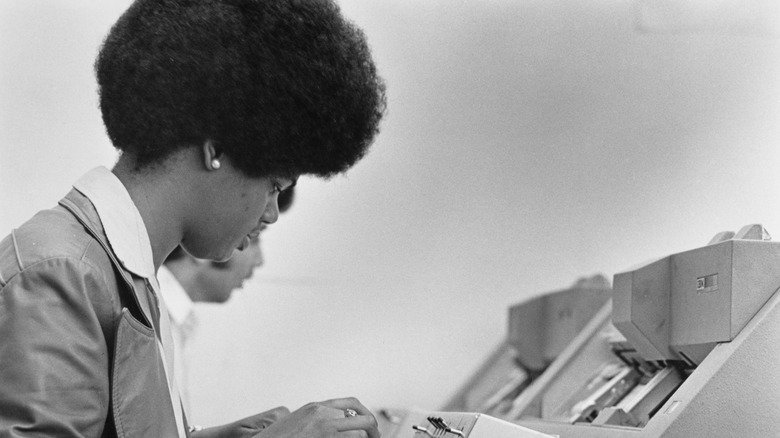
Computer technology has undergone an incredible array of changes, not just in terms of how the average person interacts with computers, but the various jobs associated with them. Punch card operators represent a field of such professionals who were relied on to process swaths of information using special sheets, typically yellow pieces of paper made by IBM. They were trained to key information into the paper that were punched with holes in a specific way that would allow the data to get processed by the computers of the time.
In a Facebook comment on a post about early 1970s IT jobs, a man named Cari Furr claimed that his first job after high school was as a punch card (also called key punch) operator. The role reportedly paid Furr $400 per month in 1972, which would have worked out to a salary of about $4,800 per year. According to U.S. Census Bureau records for that year, this was significantly higher than the median income for individual earners of the time, which was approximately $3,521. No doubt, baby boomers of the time appreciated how well this career paid, but what few likely anticipated were the changes to computing that would render it obsolete within a decade.
As instrumental as IBM was to punch card technology, the company would likewise usher in the demise of the entire industry by pivoting towards floppy disks and other data storage tools. Punch key operators represent a field that largely vanished beginning in the 1980s, and today you'd likely have to ask a boomer-aged American to explain what this role was.
5. Movie projectionist

According to May 2023 numbers released by the U.S. Bureau of Labor Statistics, there were just 2,110 men and women working as projectionists in the motion picture and video industries, with an average pay of $40,30 per year. These estimates are likely a far cry from a time when movie projectionists were an essential part of not just movie theaters, but the entire film industry itself.
Movie projectionists would handle heavy equipment and had to know when to change film reels seamlessly, accounting for intermissions and movie trailers. A poorly trained projectionist could make or break a movie experience, so it was essential that they knew how to correctly position the equipment and match the audio. The ongoing march of technological progress has expanded to the movie and television industries, fundamentally changing the role of traditional movie projectionists while also greatly endangering it. While you may still see emojis that reference film or film reels, these video storage devices were eventually replaced. Likewise, many movie audiences no longer wait on a projectionist to handle various reels of film; instead, the process is mostly automated.
Many theaters continue to compete for customers with popular streaming companies like Netflix and HBO Max, and some even release movies the same day. With the average American more comfortable than ever enjoying brand new releases from the comfort of their own homes, movie projectionists, traditional or otherwise, represent a career field that's dwindled into the hundreds. While the job hardly exists today, it's not hard to believe this career could be gone outright within the next decade.
6. TV repair person

By the time boomers were born, TVs were a staple of the American home, with some estimating that over 90% of households owned or had access to at least one television set by the 1960s. Yet, for as popular as this medium became, TVs of the time weren't always reliable. In fact, these products were so often in need of fixing, that they fueled the need for TV repair people. It's important to note that a brand new color TV in the 1970s might cost about $500. While this doesn't seem like much today, adjusted for inflation, that amount works out to be more than $3,300.
Because TVs of the time were so expensive, rather than have to save up hundreds of dollars to buy a new one, it was easier and more affordable for American families to prolong the life of a TV through repair. By 1973, at least one ad suggested the belief that becoming a TV repairman represented a stable, long-term career opportunity. However, that sentiment would abruptly change by the 2000s with the rise of the flatscreen TV era.
The quality of TVs were, in truth, steadily improving over the decades, perhaps as a way of justifying the steadily inflating prices. However, the TV industry made what some objectively might consider a fatal mistake: they made their products too well. Many Americans not only owned high quality TVs, but they simply were not desperate for a new one. This lack of demand led to TV prices plummeting. The TV repair industry was hit hard, as we now live in a time where TVs are so cheap, Americans will simply replace them most of the time rather than spend money on repairs. With CNET reporting much of Gen Z doesn't own a TV, it's not surprising this particular career hardly exists these days.
7. Toll collector

According to the Federal Highway Administration, toll roads have existed in some form in the United States since 1792, though their presence in the modern era began to be felt post-WWII with the rollout of the coast-to-coast highway system. In the following decades, it was normal to halt at booths and hand money to a toll collector. These people remained a vital part of traffic regulation for some years, collecting money from Americans that, per the AAA Club Alliance, contributes to the cost of maintaining America's roads and bridges.
The job is fairly straightforward, if not monotonous. According to ZipRecruiter estimates, a toll collector working today might make between $27,000 and $30,000 per year. However, human toll collection isn't exactly a stable career option, as many people have already been replaced by automated toll machines. Drivers simply deposit money into a machine, collect a paper and cameras are used to identify anyone that fails to pay the appropriate toll fee. From collection to identification, it's a system where human workers aren't needed as much as they were decades ago. You might find you hardly ever see a human collecting tolls today; it's likely you might not see any at all in just a few short years.
8. Video store clerk

There was a time when baby boomers and their kids loved nothing more than driving down to the video rental store, likely a Blockbuster or local off-brand franchise, and renting some movies for the weekend. Video store clerks were a fundamental part of this experience. As demonstrated in an iconic Blockbuster training video, they're trained to help customers navigate rows of movies, track and share when the newest films were available to rent or own, or sell snacks for their customers to enjoy while watching rentals.
When the discussion arose on the r/blockbustervideo subreddit, former video store clerks claimed their pay started at around $4 per hour, with some claiming to have gone on to make over $30,000 per year. As reliable as a career as this might have been from the late 1970s through the 1990s, the dawn of Netflix would make it so this specific job would hardly be around today. Video stores were largely able to navigate the change from VHS tapes to DVDs; the format change may have even made renting more affordable to some.
But Blockbuster failed to see the vision offered by early Netflix executives, so much so that the company infamously laughed the men out of the meeting room. But by the 2000s, no one at Blockbuster was laughing, as Americans began to enjoy watching movies on the internet, or through streaming platforms like Netflix. They no longer need to leave their homes to rent or even own movies, making the video store obsolete and paving the way for video store clerk jobs to largely represent a piece of nostalgia rather than a viable career.
9. Typist
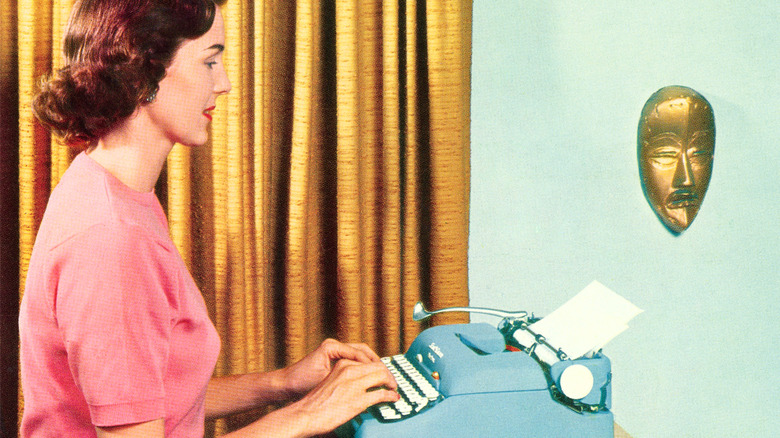
Depending on your age, the subdued sound of a laptop may seem strangely quiet when compared to the more robust sound of a typewriter, for decades the standard tool of various office workers, but especially associated with typists. These professionals largely preceded the era of modern computers, though in some cases worked parallel to the key punch operator, typing up various documents for industries that still relied heavily on hard copies rather than computer data.
This career field would eventually be deemed a job for women workers, which may have impacted how society viewed it and its pay. In fact, for every dollar a man earned in the U.S. during the 1970s, research shows women earned nearly $0.40 less (via Qualtrics). Even so, the typist position helped pave the way for more and more American women to enter the workforce and begin to enjoy greater financial freedom. Unfortunately, the typewriter gave way to the personal computer, which greatly impacted the need for typists at all. The role was subsequently folded into other positions, from secretaries to virtual assistants, and today, may disappear forever thanks to automated services provided through the use of artificial intelligence.
Though typists are hardly as visible as they were when boomers were young, many will still fondly their hard work, the progress they represented for women working outside of the home, and the iconic sound of their professional typewriters.
10. Automotive manufacturer
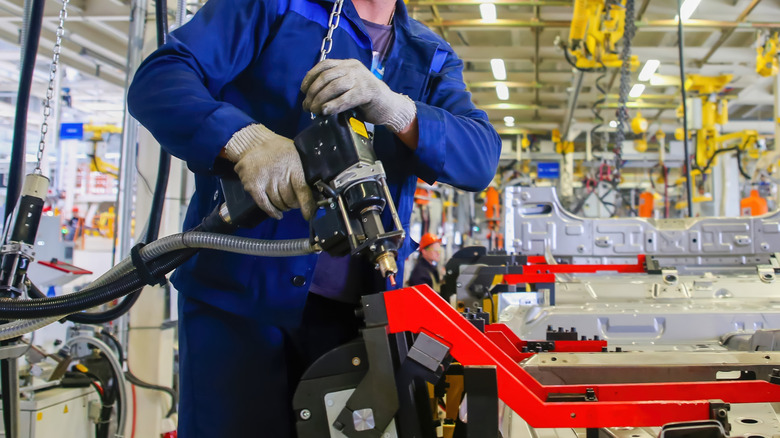
By June 1979, per the U.S. Bureau of Labor Statistics, the manufacturing industry was at the peak of its golden era. It's estimated that 19.6 million Americans had manufacturing jobs, with millions of that number working directly for America's automotive industry. These manufacturing professionals were responsible for collaborating with others to build the vehicles that many people rely on to this day. Michigan was, and remains, the heart of automotive manufacturing. According to a 2013 Federal Reserve Bank of Chicago article (citing IPUMS population data), Michigan alone accounted for about 400,000 automobile factory workers, a number that held steady throughout the 1970s.
Things took a drastic turn for the automotive industry by the 2000s, with one study finding that between 2000 and 2010 alone, nearly a third of manufacturing jobs had vanished. Automobile factory workers found themselves displaced by automation, with robots replacing line workers on assembly lines, capable of quickly and precisely putting together vehicles, all without getting paid.
While automotive manufacturing jobs have not entirely gone away, the numbers are much lower than what boomers would have seen during the 1960s through the 1980s. Even now, humanoid robots are reportedly being prepared to take an even larger share of manual assembly work away from human workers. As such, human-based automobile manufacturing roles represent a career that is becoming increasingly obsolete, with reasonable expectations that it could one day be a job that simply no longer exists.