

The Unexpected Cost Of Bacon In The 1970s Vs. Today
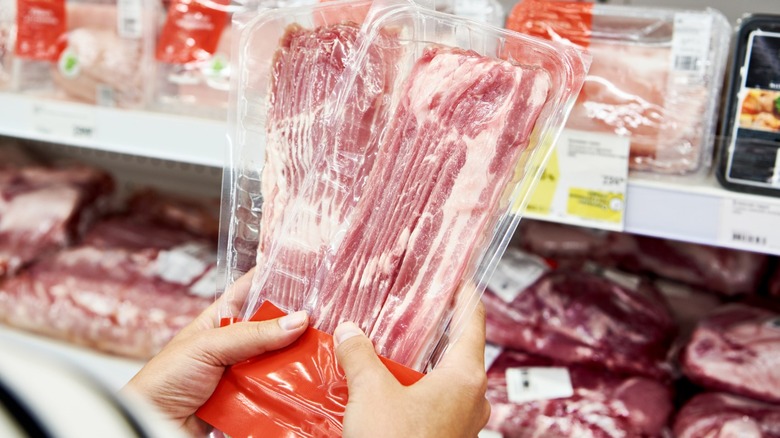
With inflation, wage stagnation, Donald Trump's tariffs, and the resulting rising food costs, the mid-2020s aren't exactly the most stable stretch in U.S. economic history. Times like these beg questions of precedent, forcing many to look back at the past for either answers or nostalgia. Staple food prices have been hit hard, and bacon, one of America's oldest and most popular breakfast ingredients, costs $6.904 per pound on average, as of February 2026. Compared to $5.394 in February 2016, that's a jump of 28% in 10 years.
If you rewind the clock to the 1970s, you'll notice even more surprising bacon data. Full disclosure first: The Bureau of Labor Statistics (BLS) doesn't have readily available bacon prices from those years, which is part of why published estimates vary. GOBankingRates, for instance, places bacon prices at roughly 82 cents up to $1.59 per pound across the 1970s.
Using BLS Consumer Price Index (CPI) data, reverse-engineered price estimates confirm this general price range. For instance, adjusting the benchmark January 1980 price of $1.45 per pound with bacon CPI indexes yields estimated per-pound prices of $1.35 in 1975 and $1.65 in 1979. With these calculations in mind, you end up with a 1970s price range of roughly 82 cents to $1.65 per pound.
However, the real shocker is that when you adjust these prices for today's inflation, that range works out to roughly $7.09 to $7.89 per pound in February 2026 dollars. With an actual per-pound price of $6.904 as of February 2026, that means bacon is now effectively 2.62% to 12.50% cheaper than it was in the '70s.
Bacon may cost less compared to the 1970s, but is it more affordable in 2026?

Bacon's high price point in the 1970s was largely caused by the economic instability of the decade, a tough period in American economic history that's now known as the Great Inflation. There were numerous issues at the time, including general inflation, food inflation, agricultural feed shocks, and volatile meat supply cycles. But the 1970s catastrophe aside, the supply side of the industry has also made genuine strides in recent decades. Research from the United States Department of Agriculture (USDA) found that there have been massive gains in hog farming since the 1970s, while supply chains have become more efficient than they used to be.
Either way, the average household income in the 1970s yielded less bacon per dollar than it does in 2026. The U.S. Census Bureau found the median household income was $11,800 in 1975, $16,530 in 1979, and $83,730 in 2024. That means a household could buy 8,741 pounds of bacon in 1975 and 10,018 in 1979; if the 2026 household income remains around the same ballpark it was in 2024, it'll yield about 12,128 pounds of bacon. Additionally, there are now multiple nifty ways to save money on bacon, which could help you bring the prices down further.