

The Cost Of McDonald's First Happy Meal Deal May Not Be What You'd Expect
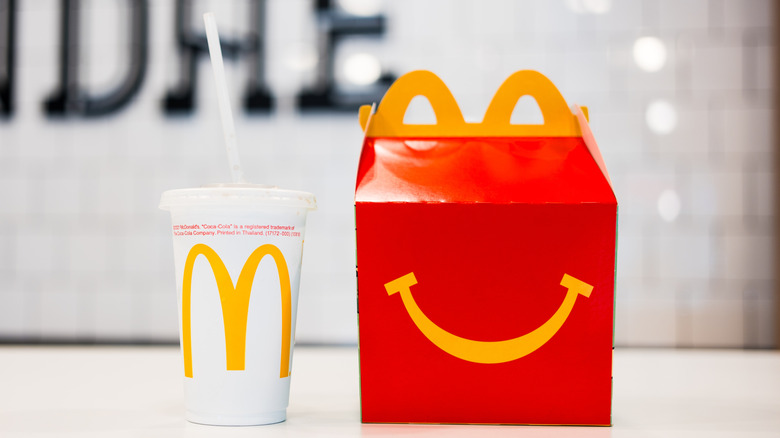
While McDonald's doesn't disclose exactly how much money it makes from its Happy Meals, there's no doubt that it's a financial cornerstone for the franchise. There are some clues to how well they sell, including McDonald's 2024 proxy statement revealing that collecting one penny from every participating Happy Meal sold in 2022 generated $5.9 million for Ronald McDonald House Charities. That figure implies that roughly 590 million participating Happy Meals were sold that year.
It'll be a rousing story to tell if it reached these heights from nothing, but Happy Meals were a smart product launched by one of the most powerful restaurant brands in America. The first Happy Meal arrived in June 1979, when it was called the "Circus Wagon Happy Meal." The combo came in a decorative box, which included small toys like a spinning top and McDonaldland erasers. Since then, the meal has become a cultural icon, with some collectors' Happy Meal toys valued at hundreds of dollars.
McDonald's sold the first Happy Meal for $1.10, which is worth about $4.97 in February 2026, according to the Bureau of Labor Statistics (BLS) CPI Inflation Calculator. At around $5, it's not far from the lower end of what Happy Meals go for in 2026. That suggests the basic idea of the Happy Meal hasn't become outrageously more expensive over time once you factor in inflation. That said, some of the pricier Happy Meal listings, like those including McNuggets, land closer to $7, or roughly 40% above that inflation-adjusted 1979 price.
Why McDonald's could afford to keep the first Happy Meal so cheap
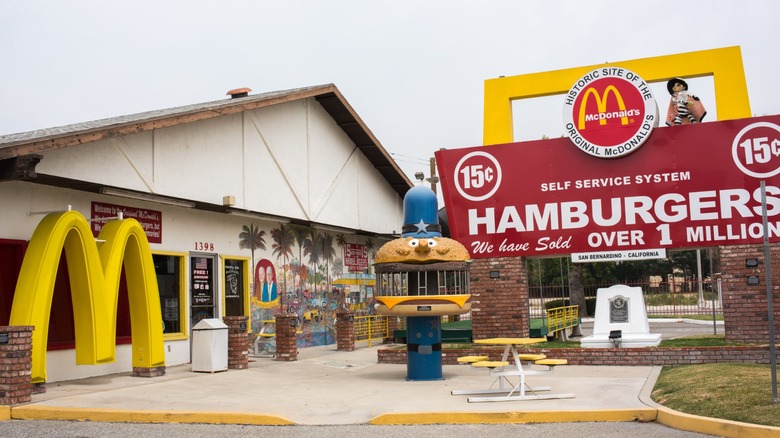
By the end of the '70s, McDonald's was a fast-food behemoth, with 5,200 outlets and $4.6 billion in sales in 1978. But it wasn't invulnerable, as there was pressure from inflation and rivals like Burger King, Wendy's, and Burger Chef. McDonald's was even cutting burger prices in 1979, dropping regular hamburgers from 43 cents to 38 cents, while its ad team admitted the company was losing ground with kids and families.
According to a 1979 Time report, customers were ordering down during the 1970s Great Inflation economy, passing up pricier items for smaller portions. So, a $1.10 Happy Meal was a strategic move. Cheap enough to feel like a family-friendly deal in an inflationary year, it was nonetheless launched by a company large enough to absorb a lower-margin kids' bundle if it drove traffic.
A shrewd business move at the time, the Happy Meal now enjoys the kind of multigenerational nostalgia and brand loyalty most chains would envy. For context, the nostalgia is so strong that a single Happy Meal toy camera from the 1990s went for over $2,000 in 2025. McDonald's simply realized early that a cheap meal could do far more if it also felt like an event. Nearly five decades later, seeing how McDonald's makes a profit of just 1% to 5% on its meal deals, it seems the brand is still willing to use cheap combos as a traffic driver.