

The Salary Of The National Guard Might Surprise You
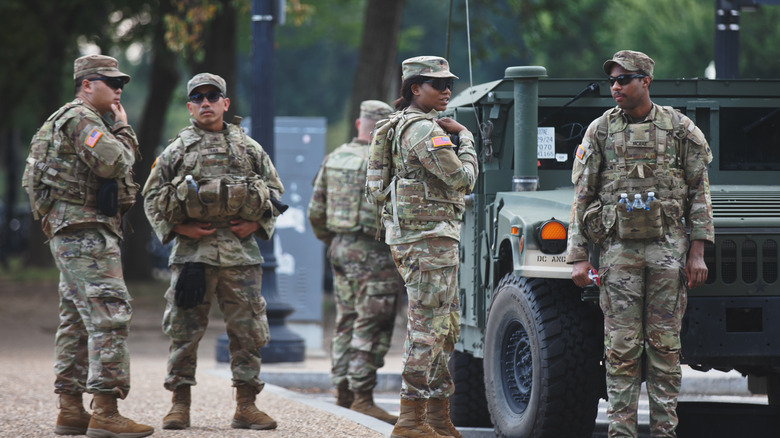
The National Guard is the central combat reserve of the Army and Air Force. Made up of the Army National Guard and Air National Guard, this military branch serves both the state and federal governments. So, Guards can be deployed under a state governor to contain natural disasters and civil unrest during peacetime or be activated by the president for federal missions at home or overseas.
Thus, there is no centralized salary for a member of the National Guard. What members earn depends on rank, time spent in the force, and whether they serve part time, full time, or are enlisted in state active duty. Most people serve in the National Guard part time, which demands one weekend of drills each month and about two weeks of annual training. Instead of a fixed salary, members receive "drill pay," which is calculated as a fraction of active-duty pay and depends on rank and years of service.
According to the Defense Finance and Accounting Service (DFAS), an enlisted service member with the rank of E-4 earns about $419 for a four-drill weekend if they've been in the service for two years or less. Meanwhile, an O-3 officer who's served the same amount of time can make around $738 in the same period. A year's earnings from drills and annual training starts at roughly $4,000, but can go significantly higher than that depending on rank. Meanwhile, when Guards are placed on full-time order or deployments, they are paid the same active-duty basic pay as regular service members. In 2026, that ranges from $2,407 to about $19,000 monthly plus additional benefits and allowances.
What benefits do full-time National Guard Members get?
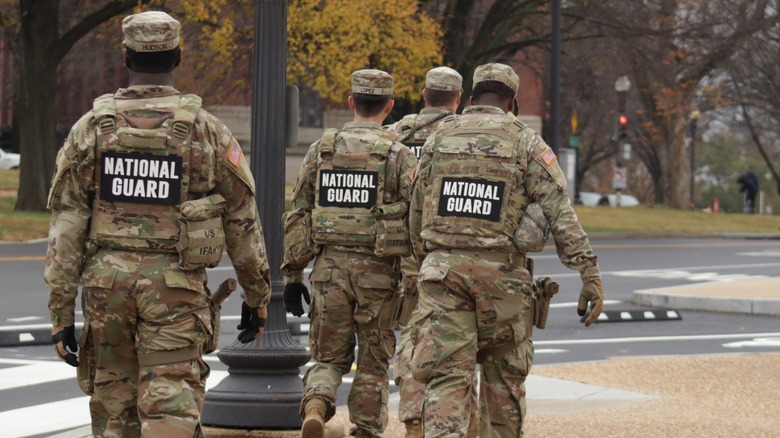
While compensation for State Active Duty varies from state to state, National Guard service members who are serving full-time for the federal government — including those serving in Active Guard Reserve (AGR) roles — generally receive the same compensation as regular active-duty service members. Many of the tax-advantaged allowances the government gives to offset living costs for soldiers apply to them as well. For instance, Guard members can get Basic Allowance for Housing (BAH) to help cover housing expenses and Basic Allowance for Subsistence (BAS) to mitigate the cost of food. They can also take advantage of military discounts if they shop in the right places.
As for healthcare, full-time National Guard members and their families typically qualify for Tricare, the military's healthcare program. Tricare offers several coverage options, all dependent on duty status and eligibility. It's worth noting that Tricare for Life and Medicare make for one of the most comprehensive retirement healthcare support combos, covering some senior medical costs Medicare usually won't.
National Guard members can also receive benefits related to education and retirement. Thanks to programs such as the Post-9/11 GI Bill, which helps cover tuition and education expenses, Guard members who complete qualifying federal service may also get financial help furthering their education. Finally, full-time Guard service can contribute toward military retirement, and members may also receive paid leave, life insurance coverage through Servicemembers' Group Life Insurance, and other federal benefits similar to those offered to active-duty troops.
Do part-time members get the same benefits as full-timers?

While traditional (part-time) National Guard members get some benefits, they're not as comprehensive as the perks full-time members receive. Traditional members do not get BAH or BAS allowances, for instance, as the U.S. Department of Defense specifically says those are only for service members on active duty to offset living costs.
Like the allowances, Tricare for part-timers is also limited. They have to purchase Tricare Reserve Select, which is a premium-based health plan available to Selected Reserve members and their families. However, they must not be covered under the Transitional Assistance Management Program, which is designed for people who have just lost eligibility for Tricare, and they also have to be ineligible for Federal Employees Health Benefits (FEHB).
Drilling Guard members do not get official leave, as they only need to show up relatively few times a year. However, they do get retirement pay, as they accrue retirement points from drill periods, annual training, and by virtue of just being members of the National Guard. Since many National Guard members are civilians who often have other jobs, combining this retirement scheme with a healthy 401k, savings, investments, and Social Security could possibly set you up to have enough money to retire rich — or at least live out your golden years in comfort.