

The Cost Of An Original Taco Bell Taco Will Stop You In Your Tracks
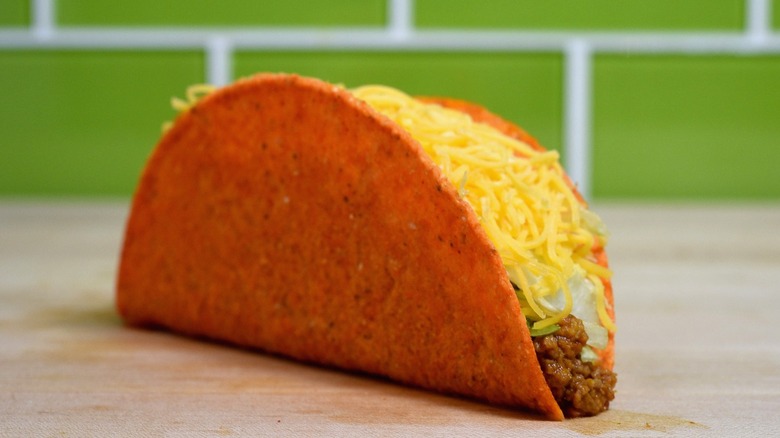
Taco Bell came into existence because its founder, Glen Bell, noticed that the lines in traditional sit-down Mexican restaurants were too long, and their prices could be lower. He thought that with such inexpensive ingredients and relatively simple recipes, it should be easy to turn Mexican food into fast food. Bell was right, and his insight paid off massively when Taco Bell became wildly successful shortly after its first location opened up in 1962.
The quick-assembly crunchy-shell tacos proved to be genius. Instead of frying tortillas to order, Bell used pre-fried shells that staff could quickly fill with beef, lettuce, and cheese. This preparation approach made tacos as fast to serve as burgers. At the same time, Taco Bell offered something different from the burgers and fries that most other competing fast-food franchises were selling at that time. But what made Taco Bell even more attractive was just how cheap the tacos were. Early tacos from this franchise sold for as low as 19 cents. This price let the chain compete directly with McDonald's at the time, which sold hamburgers and cheeseburgers for about 20 and 25 cents, respectively.
Fast-forward to 2026, and the Crunchy Taco, which is the most similar to the original taco in terms of ingredients, costs $2.19. That's over 11 times the price of the original Taco Bell taco. However, when you adjust 19 cents for inflation, the original taco becomes $2.07 in February 2026 dollars. This means the cost of the quintessential Taco Bell taco has risen by only 12 cents after 60 years, much unlike the price of Burger King's Whopper, which has gone up significantly since the 1950s.
With rising costs, how has Taco Bell's signature taco price managed to scale with inflation?
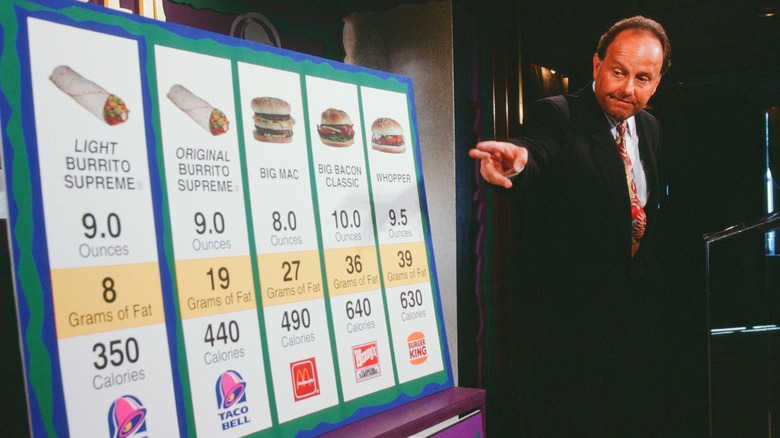
Taco Bell ranks highly among the fast food chains with the best value meals and simultaneously holds a top-five spot on the 2025 QSR 50 annual fast food list. These combinations of scale and value positioning are at the core of why Taco Bell has kept its signature taco's price close to inflation over several decades.
Taco Bell's menu is built around a small set of relatively cheap, interchangeable ingredients. Many of its menu items rely on a combination of tortillas, seasoned beef, beans, lettuce, cheese, and sauces. That means Taco Bell can buy these ingredients in large quantities, which lowers the cost through bulk purchasing and simplifying its supply chain. This approach allows the restaurant to transfer some of those savings to the menu. As for labor costs, the tacos are easy to assemble and, therefore, don't require specialized labor. Since the late 1980s, Taco Bell's ingredients have come pre-prepared frozen from centralized manufacturing plants. Using an assembly-line system, all the kitchen staff have to do is put the individual ingredients together. Such a system allows Taco Bell to efficiently process a large number of orders with relatively few staff members.
Of course, some menu items, like the tacos, are deliberately priced lower to keep customers coming. Successful fast-food chains don't need to a make profit on every item; that's why Taco Bell could afford to give out sauce packets for free before 2024. Having a loss leader on the menu attracts more customers, who might spend more on higher-priced specialty items, helping drive the margin.