

Big Money Moves Trump Made In The 90s
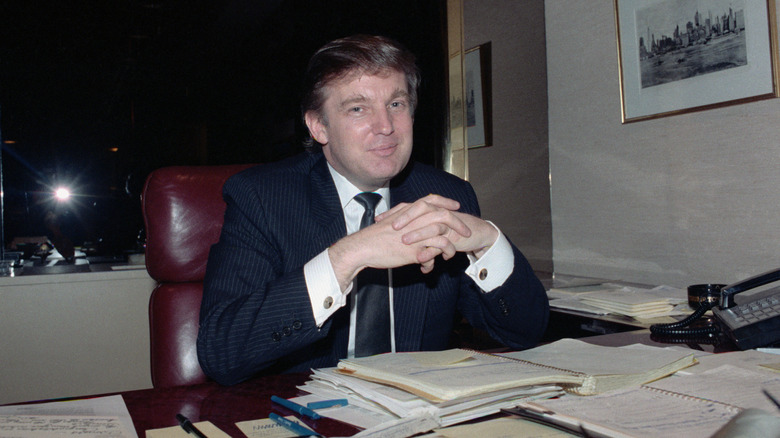
Forbes reported Donald Trump's net worth to be around $7.3 billion in 2025 — roughly $3 billion of which was accrued in the time since he reclaimed the Oval Office. One of the richest presidents in U.S. history, Trump's Cabinet has a staggering net worth in its own right. However, Donald Trump has seen some rough times as well, and the '90s were particularly bumpy. Early into the decade, Trump was staring down massive debt. The '80s saw him try all kinds of business ventures, from the short-lived Trump Shuttle airline to the casinos he opened in an attempt to capitalize on the legalization of gambling in Atlantic City. But by the early '90s, he was in dire straits. Trump Shuttle disappeared in 1992, and the early years of a recession sent his other businesses in a downward spiral that left him $3.4 billion in the red.
But after executing a series of drastic financial moves, he did eventually crawl out of that deep hole. From restructuring loan repayment deals with banks to selling off sizable assets and finding ways to benefit from bankruptcy and tax law, Trump spent much of the '90s making moves that set him on the path to multi-billionaire status.
Trump negotiated with banks to restructure his enormous debt
In order to get out of his colossal debt, Trump negotiated a major restructuring deal with his creditors. Out of the billions of dollars that he owed to more than 70 banks in 1990, $800 million was personally guaranteed, per Reuters, pushing him towards personal bankruptcy. The banks understood the mess that Trump was in, but they ultimately decided his status with the public was still valuable. Instead of seizing all of his properties outright, they chose to keep some — like his casinos — in business, and allow Trump to remain the face of the operations to hopefully recoup more of their losses than they would through foreclosure.
The banks quickly began liquidating assets by selling his yacht and airline. They also put Trump under a monthly allowance of $450,000. While a credit specialist involved in the process revealed to Reuters that the lenders had sensed something deeply wrong with Trump's finances and first initiated the call for restructuring, Trump claims in his book "The Art of the Comeback" that he was the one to approach them about the issue.
Trump convinced the banks to lend him $60 million in new loans, which would also help him suspend interest payments on the older ones. Despite the fact that some of the largest debts Trump had incurred were to Citibank and Bankers Trust, those two companies provided the majority of these additional funds.
Trump sold (or was forced to sell) a lot of his assets
Trump had to sell a number of his assets to stay afloat during the '90s. Right at the beginning of the decade, when Trump missed an interest payment, banks took over the reins of the short-lived Trump Shuttle airline. The company had been hemorrhaging money and losing ground to competition since it launched in 1989, and was ultimately bought by U.S. Airways.
In addition to enacting the change in ownership, Trump's creditors also reduced the $135 million personal debt he incurred to start the company to $35 million. Later on, in 2011, Trump talked about the experience in a positive way. Discussing the business with The Street, he said, "I ran an airline for a couple of years and made a couple of bucks. The airline business is a tough business, but I did great with it."
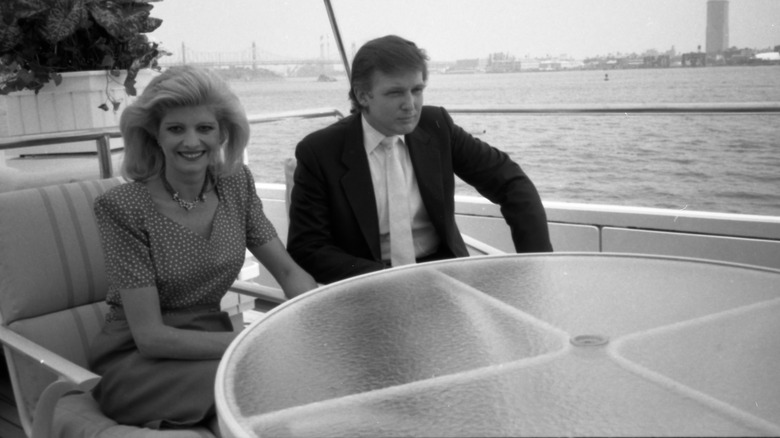
Apart from his venture into air travel, Trump also had to let go of his yacht, The Trump Princess, to avoid the consequences of bankruptcy. Trump had paid around $30 million to get the boat off The Sultan of Brunei, but had to sell the 281-foot yacht to Saudi billionaire Prince Al Waleed bin Talal for $20 million in 1991. A few years later, the prince would also buy Trump's Plaza Hotel in New York City.
Trump turned his casinos into a publicly traded company
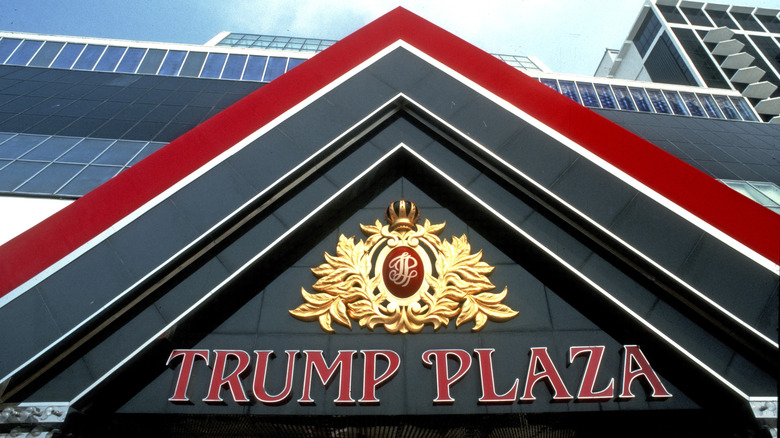
Trump decided to turn Atlantic City's Trump Plaza into a publicly traded company in 1995. The decision was instrumental in shifting all the risk to stockholders and getting him out of massive personal debt. Nonetheless, Trump still owned a majority of the company. However, the new company, Trump Hotels and Casino Resorts, kept losing money in the following years, eventually going bankrupt in 2004. Even so, The Washington Post reports Trump was able to make more than $44 million for himself amid all the company's losses.
Trump Hotels and Casino Resorts successfully raised $140 million through its initial public offer in 1995, per NBC News, selling 10 million shares despite the fact that some of Trump's casinos had already filed for bankruptcy by that point. Alongside making Trump Plaza public, Trump also sold ownership of his other casinos –- Trump Taj Mahal and Trump Castle –- to this company for $890 and $485 million, respectively, per Finaeon. As part of the Taj Mahal deal, Forbes reports Trump pocketed $51 million of cash while continuing to collect loans worth millions from the public company in the years to come. Trump Hotels and Casino Resorts had lost over $1 billion by the time it filed for bankruptcy in 2004, per The Washington Post.
Trump used his business losses to avoid income tax
In 1995, Trump once again used his mountain of debt for his own gain by taking advantage of U.S. tax law. According to The New York Times, Trump reported more than $900 million in losses on his taxes that year. While this may not be a great look for a businessman, it may have saved him from paying income tax for more than a decade thereafter — and it was perfectly legal. If you incur a heavy business loss, you can offset the loss against your W-2 wage and reduce the amount of taxable income. These deductions, called Net Operating Loss (NOL) deductions, can be forwarded to the next year and applied to up to 80% of that year's taxable income.
Years later, Trump reminisced about this type of dealing in some 2019 tweets. He wrote (via VOA News), "Real estate developers in the 1980's & 1990's, more than 30 years ago, were entitled to massive write offs and depreciation which would, if one was actively building, show losses and tax losses in almost all cases. ... [Almost] all real estate developers did — and often re-negotiate with banks, it was sport." Since entering the political sphere, Trump's often operated on a similar ethos. He famously said at a 2016 campaign rally, "It's called other people's money. There's nothing like doing things with other people's money" (via The Washington Post).