

5 Reasons A Retiree Regrets Buying A Honda CR-V
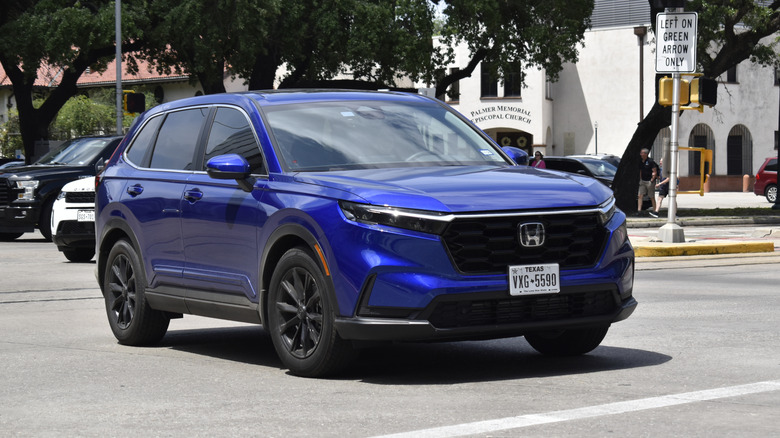
The last thing you want as a retiree is to choose a car that you end up regretting. There are certain questions you should ask yourself before you lock in the thousands of dollars on a car decision. But the most important of them all is this: What are my priorities in retirement? If low maintenance costs, high resale value, low upfront spending, and plenty of cargo space matter most, then a Honda CR-V could be a good fit. In fact, the high resale value perk is so strong that the CR-V ranks among Kelley Blue Book's best SUVs you can buy, partly because of how well it holds its value.
However, once things like comfort, power, performance, and fuel economy enter the equation, the CR-V's suitability for retirement drops sharply. Unpredictable reliability and poor ride quality are other common reasons Honda's C-SUV is one of the worst cars for a retiree. That's probably why, despite how practical it is, the CR-V is not the most popular vehicle among baby boomers, who form a good chunk of today's retirees. According to Insurify's 2023-2024 analysis, the Ford F-Series truck is the most popular vehicle among the cohort, and it's almost antithetical to the small economy compact crossover that's the CR-V.
Honda CR-V is a known theft target

Whether you're retired or not, one of the worst things you can experience is coming out of the grocery store to an empty parking spot because your car has been stolen. Unfortunately, the CR-V is one of the most consistently stolen vehicles in America. According to a 2023 National Insurance Crime Bureau (NICB) report, Honda CR-V ranked among the 10 most-stolen vehicles nationwide in 2022, with 13,832 reported thefts. Even more telling, NICB identified the 2001 model year as the single most-stolen CR-V that year. This matters, because retirees could gravitate toward older, paid-off models to lower upfront costs and avoid heavy depreciation. In NICB's report on vehicle theft through the first half of 2025, the CR-V still appeared in the list of top 10, with 4,889 thefts recorded between January and June.
What's more, the Highway Loss Data Institute (HLDI) has previously identified certain CR-V trims from 2023 and 2024 model years — particularly AWD and 4WD variants — as having higher-than-average whole-vehicle theft claim frequencies relative to other vehicles in their class. When you combine the older statistics with the newer ones, you get a picture of a car that might be more attractive if a thief had to choose from a group of vehicles. If you live in a metro area where vehicle theft rates are higher, the combination of location and model popularity with thieves can push your insurance premiums higher.
Low power could put limits on an otherwise active retirement
On paper, most non-hybrid CR-Vs don't look weak. The standard 1.5-liter turbo in the 2025 model year has 190 horsepower and 179 pound-feet of torque. However, this on-paper power doesn't translate well to driving if the reviews hold any water. Consumer Reports says the CR-V can feel underpowered, particularly when you need extra acceleration for hill climbs and highway merges. Car and Driver's testing also backs up the "adequate, not eager" vibe, clocking a 0-to-60 mph time of 8.1 seconds.
This might be a bigger deal than you would expect in retirement. Your CR-V could be decent when you're driving it alone, but it might begin to struggle if you've got grandkids and luggage, or when you're on a road trip in hilly areas. In fact, an Edmunds reviewer docked points off the driving experience because you have to use a heavy foot when driving through mountain slopes, which doesn't exactly make for effortless touring.
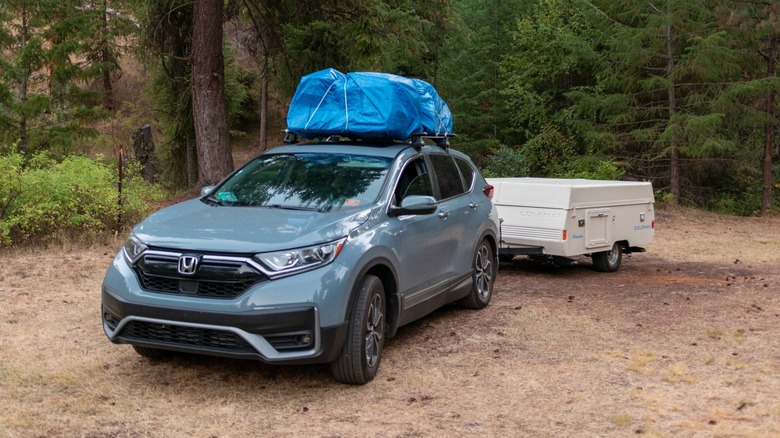
And if your "active retirement" includes towing anything, the ceiling is low: The maximum towing capacity is 1,500 pounds for gas models and 1,000 pounds for hybrids. Roughly 1,000 pounds might cover a very small utility trailer, a pair of lightweight personal watercraft on a basic trailer, or a small motorcycle setup. At 1,500 pounds, you might manage a small aluminum fishing boat or a lightly loaded cargo trailer. Forget about anything like travel trailers, full-sized pop-up campers with complete gear, or big boats of any kind.
A CR-V is not a good choice if comfort and ride quality are priorities in retirement
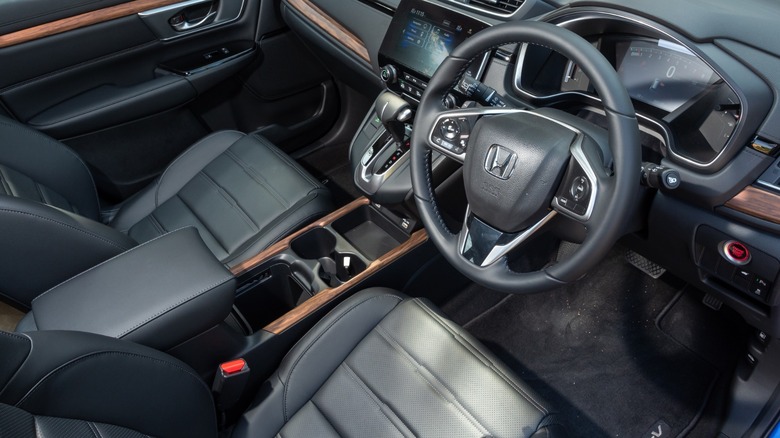
There are cars that somewhat fit both the economy and luxury categories, but Honda CR-V isn't one of them. While the CR-V is widely acknowledged for practicality, multiple verified reviews point out that it doesn't offer the plush ride some retirees might expect on long highway trips.
Consumer Reports, for instance, notes that the CR-V has a firm rather than cushy ride quality. Owner reviews aggregated by Edmunds include complaints about front seats feeling narrow or overly firm, particularly on longer drives. If you're a retiree with back or hip sensitivity, you may find that firmness less forgiving as time goes on.
Noise is another issue to consider. When testing newer trims like the 2026 CR-V TrailSport, Car and Driver found these are noisier at highway speeds than other CR-V variants, specifically listing highway noise among its downsides. Retirees with long road trip plans might find that the wind and tire noise fatigue could become an annoying problem. Perhaps the hybrid CR-V could be better here? Unfortunately, Edmunds reports that when pushed — especially on inclines — the CR-V Hybrid's powertrain can also become very noisy. Car and Driver similarly observed that under hard acceleration, what you mostly get is more engine noise rather than satisfying power delivery.
Spotty reliability has marred the history of CR-Vs
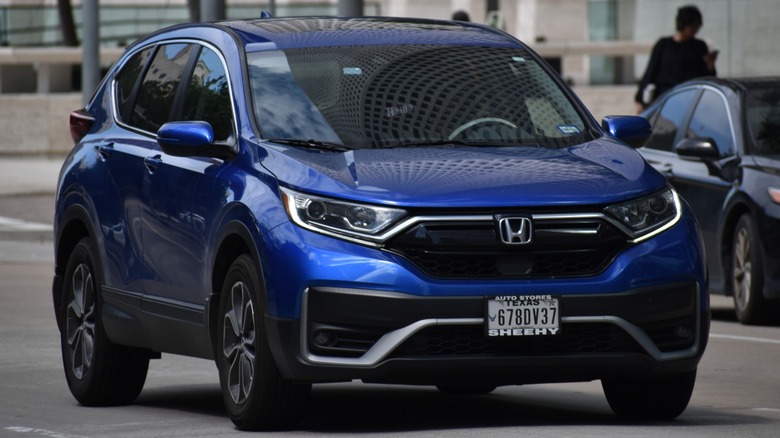
Like other Japanese marques, Honda has earned a reputation for reliability, but when you examine specific CR-V model years, the story becomes a bit less consistent. Consumer Reports, for example, flags certain earlier model years like the 2002 CR-V as less reliable compared to same-year counterparts, citing multiple trouble areas and an extensive recall history. That's not a death sentence for the nameplate, but it shows that reliability has historically varied by generation, and sometimes not for the better.
Apart from the early 2000s, the mid-2010s also had some problematic model years, like the 2015 CR-V, which became known for an irritating vibration that drivers could feel when stopped while in gear. The later 2017 to 2018 models, equipped with Honda's 1.5-liter turbocharged engine, were often reported to mix fuel with engine oil. Car and Driver said this oil dilution issue was more common in cold weather and on short trips — scenarios that retirees could likely be in.
Recent Hondas have also struggled with safety system issues. The National Highway Traffic Safety Administration (NHTSA) has had to open investigations in 2022 into reports of unintended automatic emergency braking activation in 2017 to 2019 CR-Vs. Honda has also issued large recalls affecting newer CR-Vs up to the 2025 model year for issues ranging from steering gearbox defects to fuel pump failures. This doesn't mean that every CR-V is unreliable; many owners log years of trouble-free driving. But as a retiree on a fixed income, the cogent risk of landing a problem year could be more disruptive to you than to a working adult.
Fuel economy is good but not great

If you're buying a compact crossover primarily to save money at the pump, the CR-V's numbers look good at a glance. But if fuel economy were truly a priority, then you might want to reconsider. According to EPA ratings, the 2025 Honda CR-V (gas, FWD) has a gas mileage of 30 mpg combined, while AWD versions drop to 28. The CR-V Hybrid (FWD) improves to 40 mpg combined, and 37 mpg combined with AWD. Those are respectable fuel economy figures for a compact SUV. But when you compare them to popular economy cars that retirees might also consider, the CR-V doesn't look like the most optimized choice. For context, the Toyota Prius (FWD) offers up to 57 combined mpg, the hybrid Toyota Corolla does up to 50 mpg combined, and the hybrid Honda Civic is rated 49 mpg combined.
Assuming you drive 12,000 miles a year, the difference between 30 mpg and 50 to 56 mpg can mean hundreds of extra dollars you'd spend every year on fuel. Over a five-to-10-year retirement ownership window, that gap will compound to thousands. Even the CR-V Hybrid, while competitive for a crossover, still lags behind true efficiency leaders by nearly 10 to 16 mpg. If maximum fuel savings were the primary goal instead of cargo space, ride height, or SUV styling, then a sedan or a dedicated hybrid would likely be the financially sharper choice for retirement.