

Donald Trump's New Retirement Plan Would Change Your Savings Forever
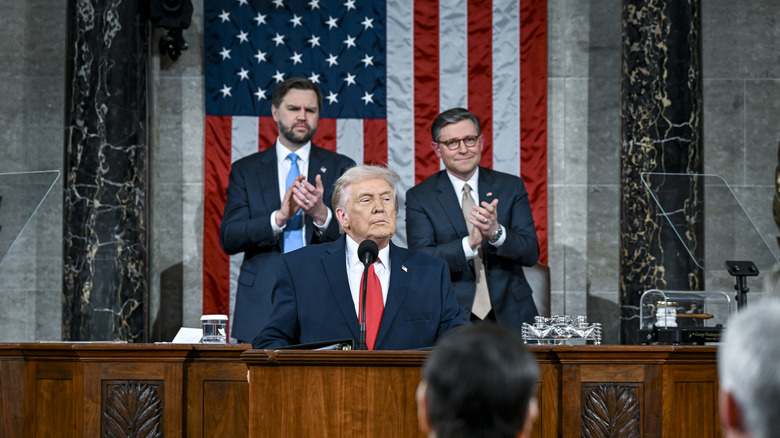
Starting with the One Big Beautiful Bill Act, President Donald Trump's administration has made a point of pushing policies that directly affect the finances of Americans. These have ranged from the Trump accounts for kids to the recently proposed retirement accounts for private sector workers. In the recent State of the Union address, Trump announced a proposal to extend the opportunities for retirement savings to American employees in the private sector, who often lack a 401(k) or other form of employer-backed retirement savings plan.
The proposal didn't come out of nowhere — it addresses the growing lack of retirement security among Americans. According to a Bankrate survey, more than half (57%) of adults in the U.S. say they are behind on retirement savings. Meanwhile, the National Institute on Retirement Security reports that the median balance on a retirement savings account among Americans in the workforce is a meagre $955. For context, Northwestern Mutual's 2025 Planning and Progress Study reveals that Americans target roughly $1.26 million as a savings figure needed to retire comfortably.
The administration has recognized this gap and announced plans for retirement accounts that extend the benefit of a retirement savings plan to private sector workers. The accounts will resemble the Thrift Savings Plan (TSP), a low-fee retirement savings already in place for federal employees. Like the TSP, the new accounts will give Americans access to diversified low-cost index funds and will be transferred from job to job. Better still, the accounts come with a government-funded benefit of up to $1,000 to incentivize participation.
How the new retirement plan offers Americans retirement security

For most Americans, retirement security doesn't come from picking the right investment, but from having a structure that allows them to build retirement savings in the first place. According to the National Institute of Retirement Security, 47% of private-sector workers don't have a workplace retirement plan, and only 17% of U.S. workers had a defined-benefit pension plan as of December 2022. Without either of those structures, workers have to take the initiative to secure their future, and research shows that most don't take it without a nudge.
This is where Trump's proposal steps in with a dedicated savings and investment account and the benefits to match. While the accounts give private sector workers access to low-cost investment options, the government matches their contributions with benefits of up to $1,000. The benefit part comes from Saver's Match, a federal program created under the SECURE 2.0 Act in 2022. Under the program, starting in 2027, the government will match up to 50% of $2,000 of the individual's contribution.
The federal match is an annual benefit rather than a one-time incentive, and it's targeted specifically at lower- and moderate-income workers. Eligibility is limited to single filers earning no more than $35,500 and joint filers earning up to $71,000. For private sector workers, the impact of these benefits is substantial. Morningstar's retirement outcomes model projects that the benefits could generate a cumulative wealth of $2.03 trillion across all eligible Americans by retirement age.
The holes in Trump's retirement savings proposal
While Trump's retirement savings proposal presents a great fiscal policy for the working Americans who have been left behind, there are a few questions that still need to be answered before it can get off the ground. First is the issue of whether the president has the authority to implement this policy on his own, without legislation. In an interview with NBC News, Treasury Secretary Scott Bessent expressed that the administration can get the proposal approved via reconciliation, which is a way for Congress to enact legislation with majority voting.
Whether this proposal will help get people financially ready for retirement is another question. The benefits promised are designed to match 50% of the contributions made; if no contributions are made, no benefits go out. This is a barrier for most lower-income earners; a 2022 Survey of Consumer Finances reported only about 13.2% of households earning $30,000 had retirement accounts. Speaking with CBS News, retirement expert and Director of The New School for Social Research's Wealth Equity Lab, Teresa Ghilarducci, said, "I only expect about half of low-income workers to open up an account because, especially if they are young, they don't have the money or they have other reasons to save — people are in a lot of debt."
Finally, a lot of the plan's details are still unknown. The only income thresholds currently published are those tied to the existing Saver's Match, and it's not confirmed whether Trump's expanded proposal keeps those same caps or introduces new ones.