

The Cost Of Johnny Cash's 1965 Bail Might Surprise You
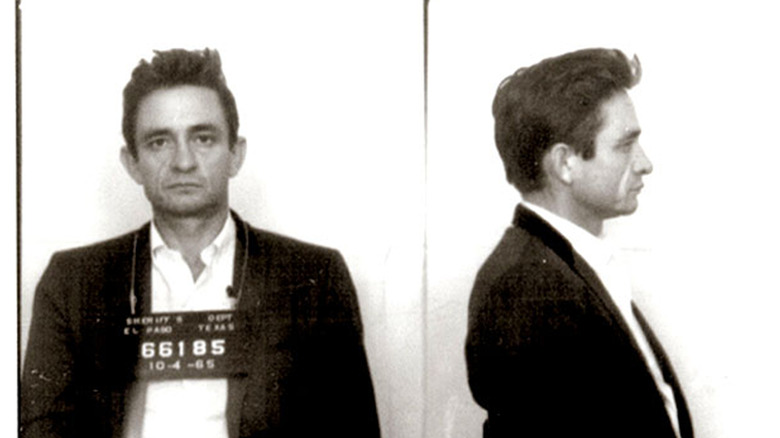
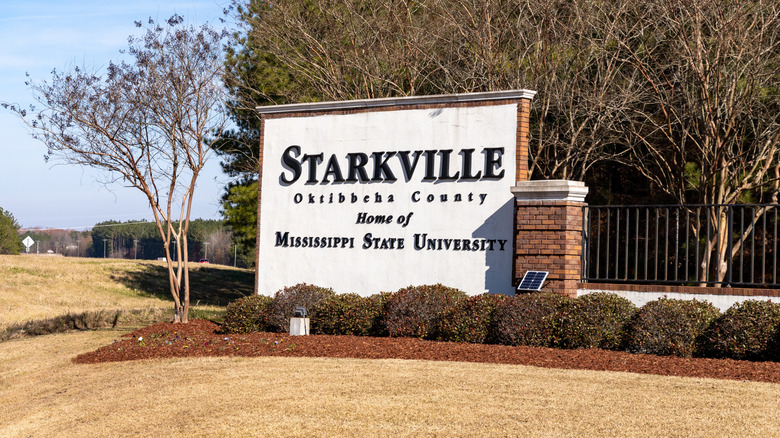
Singer, songwriter, and guitarist Johnny Cash always had a tumultuous relationship with the law, and he often sang about it throughout his nearly 50-year career. While some of his songs, such as "Folsom Prison Blues," only featured fictional accounts of his outlaw exploits, there was quite a bit of truth laced into the lyrics of "Starkville City Jail." Named for the town of Starkville, Mississippi, the song recounts one of the times Cash was actually arrested.
On May 11, 1965, Cash played a show at Mississippi State University (MSU) and proceeded to enjoy an indulgent night out in Starkville. Around 3 a.m., he was found drunk and meandering around private property, prompting a local to call the police. When the officers arrived, Cash told them he was just picking flowers, but that explanation didn't save him from getting arrested and brought to Starkville's Oktibbeha County Jail. According to NPR, he spent the night there before paying a $36 bail and going on his merry way. While not everyone gets their bail money back, the city did posthumously pardon Cash for his crimes in 2007 and even repaid that $36 to his daughter Kathy during the aptly named Johnny Cash Flower Pickin' Festival. Even back in 1965, that fine probably wouldn't have been enough to add Cash's name to the list of rockstars who lost all their money, but it was a pretty sizable fee by that era's standards.
Could Johnny Cash really afford a $36 bail in 1965?
By 1965, Cash was already a country music sensation. His first No. 1 hit, "I Walk the Line," came out in 1956, and he spent the decade that followed touring heavily and pumping out a series of records that would prove to be popular. So, despite the fact that $36 had roughly the same buying power in 1965 as about $370 have today, it's safe to assume that was still effectively pocket change for someone with Cash's resources. In the 21st century, it's not uncommon for colleges to pay lesser-known artists $1,000 or more to perform. We don't know how much MSU paid Cash that night, but odds are a star as big as him would have left comfortably in the green even after a legal mishap. If nothing else, Cash is not a celebrity who died in debt, so he evidently recovered from the expense by the time he passed away in 2003.
Notably, that $36 bail is actually relatively steep by modern standards. Today, the state of Mississippi threatens a maximum fine of just $100 for public intoxication. However, if the police had charged Cash with trespassing instead of public drunkenness, his punishment may have been a bit more fitting of the crime. As of 2024, the maximum punishments for trespassing in Mississippi include a $500 fine, six months in jail, or both.