

We Ranked The 11 Best Dividend Stocks For Long-Term Income

Dividend investing can be a lucrative approach to managing long term financial needs. Buying into stocks that deliver quality dividends to their shareholders can provide a consistent stream of additional income that grows slowly but steadily over time. Some investors have even found that they can realistically live off the proceeds of their dividend investing strategies. Some of the most aggressive dividend producers can see yields in the 20% range, but these aren't always quality investments. Dividends, by nature, extract capital value from companies to deliver it to shareholders, so extreme yields are typically unsustainable. Excellent dividend stocks, on the other hand share a few common characteristics.
A good payout rate is always important, but sustainable price stability is also key. Even if you don't plan to sell your underlying shares, prolonged negative pressure threatens your mobility and may force the company to slash its dividend rates to shore up its operations. One way to explore a brand's current and long term value in this regard is through P/E ratios (or price-to-earnings). Across the market as a whole, a P/E ratio of around 20 has historically acted as a rough guide to indicate "average," although the 10-year figure for the S&P 500 is currently 39.1, and sector-specific trends can vary wildly.
Moats are also crucially important for dividend investors in particular. This is a lesson that value traders frequently take from the example of Warren Buffett. He tends to hone in on companies with multiple income streams and strong financials, creating a "moat" around the "castle" that is the company's business model, metaphorically. These 11 stocks come from across the spectrum of the stock market, but they each share these bedrock principles that can make for stable dividend producers that drive long term income.
1. Stanley Black & Decker (SWK)
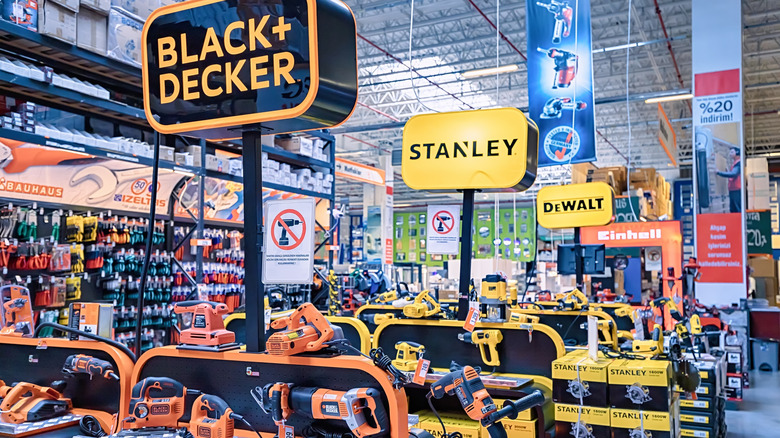
Stanley Black & Decker (SWK) is a massive conglomerate brand. The brand calls itself "the world's largest tool company," giving it a starting place of great strength in its primary area of competition. The conglomerate business owns some of the most prominent names in the tool world, including DeWalt, Craftsman, Irwin, Stanley, and Proto. The brand is a forward facing manufacturer of commercial solutions, including security services and specialized aerospace and industrial equipment. It's also a key player in the consumer marketplace for tools and equipment across user need areas.
SWK maintains a market cap of $14 billion and a sector designation of industrials. The brand's 12 month trailing average dividend yield (TTM) is 3.68%, marking it as a valuable income producer. However, the brand's 12-month average is slightly higher than its 5-year average of 2.79%.
Stanley Black & Decker trades in a 52-week range of $54 to $93.17 and is currently trading near that highwater mark. Even so, the brand features a P/E ratio of 19.2, marking it at a fair if slightly undervalued price point. In 2026, an investor is looking at a quarterly payout amounting to $3.32 total per share, with a $1,000 investment in the company yielding 11.15 shares and generating $37.02 for the year. It also generated a +4.73% price appreciation over the last year and a -3.63% change over 10 years.
2. Johnson & Johnson (JNJ)
Johnson & Johnson is an unavoidable force on pharmacy shelves across the country and the world. The brand produces wildly successful products like Tylenol and Motrin, Listerine, Nicorette, and Neutrogena. JNJ makes equipment for hospital and other medical center use, and it produces consumables outside the basic pharmaceutical space, like numerous contact lens ranges. JNJ is involved in cancer research and Alzheimer's studies.
The brand maintains a market cap of $589 billion and has cemented itself as a multifaceted health care juggernaut with numerous revenue channels buffering its earnings potential and long term value. JNJ's 5-year dividend yield is 2.73%, slightly higher than the current TTM value of 2.38%. JNJ has exhibited 64 years of consecutive dividend payout value increases and offers a payout rate notably higher than the 1.58% average across the health care industry, making it a solid long term play for multiple reasons.
JNJ offers a 52-week pricing range of $141.50 to $246.35 with a P/E ratio of 22.64. Buyers getting into JNJ in 2026 with a $1,000 investment will yield roughly 4.11 shares at its current price and value change of +55.19% over the past year and +133.6% over 10 years. With a $5.20 per share payout value this year, that stake translates into an annual payout of $21.36.
3. Clorox (CLX)
The Clorox Company (CLX) is the household products titan behind the hugely popular cleaning product sharing the same name: Clorox. Clorox is just one arm of the brand's earnings network, though. In fact, household products account for just 28.3% of the company's total $7.1 billion revenue in 2025. Its highest earning segment was the health and wellness wing. Clorox owns additional brands including Hidden Valley Ranch, Burt's Bees, Brita, Purell, and Kingsford. The broad base of brands under its umbrella make for a solid moat to support long term growth and plenty of value to investors.
Clorox has built a market cap of $14.7 billion with a 5-year dividend yield averaging 3.16% and a TTM of 3.96%, significantly higher than the average across consumer staples (at 1.89%). Clorox delivers quarterly dividends with 48 years of continuous payout figure increases. It also features an average price recovery of 2.5 days, making it a strong bounce back option in the direct aftermath of dividend payouts scraping cash value from the brand's coffers.
CLX's 52-week price range sits between $96.71 and $159 per share, and is currently trading in the low-middle band of this distribution with a 19-flat P/E ratio. A $1,000 investment in CLX would currently yield 8.03 shares with a $39.86 dividend payment on a baseline value of $4.96 per share. The stock is also producing a -17.82% value change over the last year, and a 10-year movement of -3.99%.
4. First Trust Senior Floating Rate Income Fund II (FCT)

First Trust Senior Floating Rate Income Fund II (FCT) is the first fund on this list. Instead of a single company, this is an investment product that bundles assets together in an effort to generate retirement income through distributions (essentially, as a dividend). FCT produces an 11.59% yield, which is significantly higher than the typical payout rate. However, unlike other investments on this list, FCT is a buy and hold forever type of decision. It's not focused on delivering value appreciation, and trades in a tight 52-week range of $8.61 to $10.41. The fund commands a market cap of $257 million.
The double digit dividend value is an attractive buoy for anyone looking to inject some rocket fuel into their dividend strategy, although with a consistent dip in its pricing this shouldn't be a key pillar in your approach but rather a high value augmentation to a diversified portfolio of income generators. FCT pays monthly, which is nice for seniors looking to drive regular retirement income into their bank account. A $1,000 investment in FCT would deliver 100.91 shares with a $117.05 annual dividend payment in return (or $9.75 per month).
5. Dover Corporation (DOV)
Dover Corporation (DOV) delivers a lower yield than its sector average (industrials, at 2.36%) with a 0.9% TTM value. Even so, Dover remains a valuable option for dividend investors seeking stability and some added growth opportunity. Dover is a brand that makes a wide range of products, including digital and software solutions for industrial and manufacturing businesses. It also develops key equipment and tools as well as consumable parts. These segments give it a strong moat, even as Dover won't be a brand that most consumers encounter directly in their own lives.
Dover Corp. features a market cap of $32 billion with a 5-year average dividend yield of 1.25% and 71 years of consistent dividend increases. This isn't eye popping, but it does outpace other brands like Microsoft in its ability to provide a steady trickle of additional dividend income while also delivering a solid pace of growth: MSFT offers a 0.78% 5-year dividend average, but a higher growth rate (a $1,000 investment in Microsoft at its IPO would result in a $4.3 million value as of late 2024).
Dover's 52-week range lies between $143.04 and $237.54 and is trading very close to the top of its range with a 23.97 P/E ratio. Dover's annual payout stands at $2.08 per share, and a $1,000 investment would yield roughly 4.3 shares with an annual dividend of $8.94. That's a little pedestrian, certainly. But it's a good payout rate when adding in the context of its pricing change. Over the last year, DOV has added +15.97% in share value and its 10-year change is +470.43%.
6. American Electric Power Company (AEP)

Lots of electricity companies make for interesting investment opportunities. Many are publicly traded, but American Electric Power Company (AEP) is one of the largest in the country with operations ranging across 11 U.S. states. Another interesting feature of the brand is its proximity to AI power needs. Barron's notes that AEP can be a solid play for an investor seeking to tap into AI-adjacent investment opportunities. AEP is also expanding its reach, with a plan to invest $72 billion over the next five years.
AEP commands a $68 billion market cap with both emerging technology access in play and a stable base of operations to drive long term stability. The company delivers a TTM of 2.97% and a 5-year average dividend yield of 3.53%. AEP has raised dividends annually for 16 years, driving long term upside on the dividend front, too.
The company trades right at the top end of its 52-week range ($97.46 to $129.92) and is trending generally upward over the short term. It features a P/E ratio of 21.04. A $1,000 investment in the brand would yield 7.72 shares at its current price, with a $29.34 payout over its four, quarterly dividend deliveries for the year. Over the last year, AEP has returned a +28.55% price movement, and over 10 years it's generated a +112.92% value increase.
7. Realty Income (O)
Realty Income (O) is the largest net-lease REIT on the market and the sixth largest REIT overall. As a REIT investor, you're expecting to rake in high dividends that are essentially derived from rent and other real estate proceeds generated by the fund's portfolio of property holdings. REITs deliver a kind of passive income that can be significantly more lucrative on the whole than direct investments in the real estate market. O maintains a portfolio of over 15,000 single tenant properties and possesses a market cap figure three times larger than the next highest fund in its class.
O's market cap is $60 billion, and it has large holdings in North America and Europe across numerous countries. The fund is leveraged in a range of stable real estate investments, driving a good blend of assets that suggest a solid overarching performance heading into the future.
Realty Income is currently producing a 4.98% TTM, with a 5-year average yield at 4.88%. Over the last three years, O has delivered dividends at a rate of over 5% (5.72% in 2025), so a drop is something to watch for buyers considering getting into this monthly income producer. It's also trading with a 45.14 P/E ratio, offering another data point to be mindful of when buying into the asset. Fortunately, the stock is trending upward, so shifting out of a position in the future isn't off the table. It does tend to experience cyclical pricing movements, however. A $1,000 investment would yield 15.2 shares with an annual payout of $49.26 ($4.11 monthly). O is performing well over 1-year and 10-year windows, with growth of +19.66% and +21.65% price movements, respectively.
8. Altria Group (MO)
Altria Group (MO) is the company formerly known as Phillip Morris. The brand works in the tobacco arena and its primary income drivers are tobacco products and nicotine addiction solutions. As a result, the brand hits both ends of what is unfortunately a lucrative consumer space. For this reason, it's a generally stable growth option with a significant dividend production figure thrown into the mix. However, green investors and others looking for sustainable, socially conscious brands to buy into will likely want to keep searching considering the damaging impact the tobacco industry has meted out on the public.
Altria features a market cap of $112 billion and lies at the heart of the tobacco consumer's marketplace interactions. Some of the brand's products include Marlboro, Black & Mild cigars, and products like Skoal and Copenhagen. The company is also heavily invested in Anheuser-Busch InBev and brands dealing in the cannabis business, giving it a wide reach and a solid moat. MO's dividend yield is among its more eye catching figures. The brand offers a 6.21% TTM and a 7.59% 5-year dividend production average. These figures cast a long shadow over the 1.89% average across consumer staples as a sector.
MO's 52-week pricing range is narrow ($52.46 to $68.60), and it's trading at the top end of the band while possessing a squat 12.36 P/E ratio. Investing $1,000 in the company would deliver 14.86 shares with a dividend yield of $63.02 for the year. The cigarette maker has increased dividend payouts for 57 straight years, too. Altria enjoys a +25.38% price performance over the last year, but its 10-year return saw a significant dip during the pandemic years, leading to a slightly anemic +9.97% growth.
9. Hormel Foods (HRL)
Hormel Foods (HRL) is the corporate name behind a significant range of meat and other deli products. Hormel owns Spam and Skippy, as well, two iconic brands that buyers will almost assuredly know, even if they don't usually pick them up during the weekly shop. The sheer scope of Hormel's portfolio makes it a stable option, even though its focus is largely contained to the area behind the deli counter and its immediate vicinity.
HRL features a market cap of $13 billion, and offers a significant 4.96% TTM, far outpacing the sector's 1.89% rate. The brand's 5-year dividend average is a bit lower, at 2.76%, but it has increased every year since 2018, with a notable jump in 2025 that is on track to continue its high performance again this year.
The brand's P/E ratio is 17.11, and it's trading near its 52-week low. Basic indicators suggest it may be undervalued at present, leading to a possible rebound with an upward trajectory in the future. Its 52-week range is $21.03 to $32.07, and a $1,000 investment would buy a trader 42.07 shares alongside a quarterly payout adding up to $49.22 for the year. The brand has also delivered 60 years of continuous dividend increases while producing a 1-year price change of -16.73% and a 10-year change of -40.93%. This marks it as a lucrative option for dividend investing, but not likely a solid growth option that can be easily pivoted out of later.
10. Coca-Cola (KO)
Everyone knows Coca-Cola, and a massive fanbase loves it. The namesake drink is America's favorite carbonated beverage, and the brand sells a reported $350 billion in Coca-Cola products, including both the flagship fizzy drink and the catalog of other soft drinks the manufacturer produces. Coca-Cola enjoys a huge moat, and it's for this reason that the Oracle of Omaha loves the brand. Buffett's Berkshire Hathaway owns a roughly 9% stake in the company with a valuation late last year of around $28 billion. The buy-in is considered one of his best investments and produces roughly $204 million in quarterly dividend payouts.
KO wields a $340 billion market cap while delivering a 2.58% TTM and a 5-year average dividend return at 2.92%. It's a favorite among dividend investors for a reason, since its huge moat and high dividend value come together to protect principal value well.
KO is trading near the top of its 52-week range ($65.35 to $80.41). Investing $1,000 in Coca-Cola would yield roughly 12.70 shares and a $25.90 dividend yield from the brand's $2.04 annual payout per share. It's trading with a 26.33 P/E ratio and exhibits a +13.12% price movement over the last year and +83.19% change over 10 years.
11. Verizon (VZ)
Telecom companies are frequently high dividend producers, with AT&T acting as another solid option for traders seeking high payouts above all else. Communications companies don't trend toward much growth, however. This makes them a good choice for dividend chasers, but average or even lousy options for most others. Verizon Communications is the largest phone network service provider in America and the second-highest revenue generator globally in the sector, and it delivers a significant dividend yield, making it perhaps the obvious play for traders in this part of the market.
Verizon's market cap is $207 billion and it delivers a 5.53% TTM alongside a 5-year average of 5.91%. The company has offered 22 uninterrupted years of dividend payout increases while holding its value relatively steady over the long term. Verizon delivers phone coverage, as well as broadband internet and other services to its enormous customer base (146.7 million wireless customers).
VZ's P/E ratio is 10.5, and it's trading near the top of its $38.39 to $50.24 52-week range. The significant dividend yield results in a $1,000 investment in the company being worth 20.35 shares and a $57.60 dividend for the year. Its 1-year outlook is fairly rosy, with a recent spike underpinning a +19.21% return, while the 10-year price change stands at -2.07%.