

5 Reasons A Retiree Regrets Buying A Ford Mustang
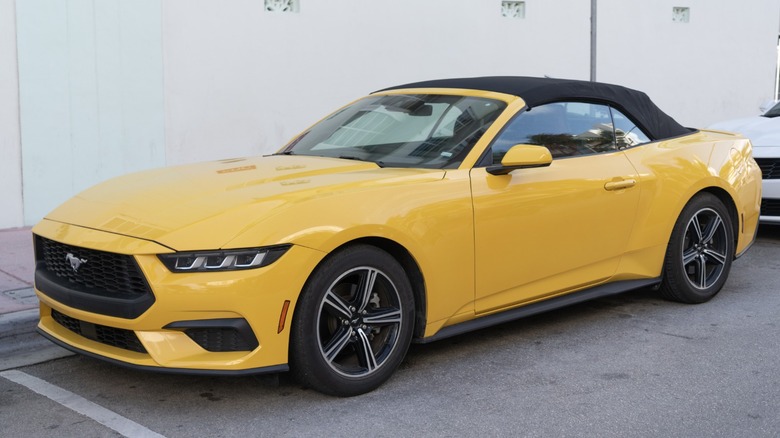
Nothing says "American sports car" quite like a Ford Mustang. These cars are so beloved that some of the older models, like the 1967 Ford Mustang Shelby GT500, are now worth a small fortune. Even the newer models carry the same legacy, just with more power, features, and a modern design.
If you're into performance cars and had gone your whole working life without buying one, it's a tempting purchase in retirement. You have the money, the car has been a lifelong dream of yours, and you no longer need a minivan to pick the kids up from school. In your mind, this is the perfect time. And you're right, retirement could indeed be the ideal time to splurge on a Mustang. However, you might also end up straining your finances and harming your retirement irreversibly if you don't think long and hard about it.
While many Mustang model years are relatively affordable to buy and maintain compared to other sports car brands, you'll still have to consider the true cost of ownership. Things like insurance, fuel efficiency, performance consumables, practicality, and safety are sometimes overlooked at first, only to bite really hard down the line. Therefore, it's important to mull over what the cons might be before making a decision, and here are some of the most significant ones.
Poor fuel economy can be a major drag on retirement savings
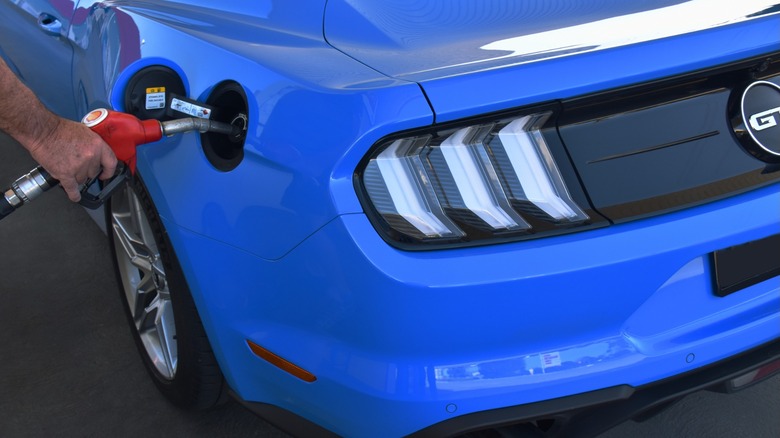
Ford Mustangs aren't exactly made with efficiency in mind; they come from a history of powerful fuel-guzzling muscle cars built for highway cruising. It's easy to underestimate just how much fuel they use until you calculate how much more money you'll be spending to fill up at a conservative time in your financial life.
For example, according to the U.S. Department of Energy, the 5.0-liter, eight-cylinder 2024 Ford Mustang GT has a combined miles-per-gallon (MPG) of 18. This isn't just an uncommon supercar version either; it's one with an MSRP that starts at $32,000. Assuming you pay $3 per gallon for gasoline, driving this Mustang would cost 16.7 cents per mile, which works out to $1,670 at 10,000 miles per year. Choosing this vehicle when other electric and hybrid cars are just as fun and cost a fraction in fuel costs is only justifiable if you retired rich, with significant savings, or you just really love the Mustang.
You can make a compromise by choosing an EcoBoost Mustang, which runs a more efficient turbocharged engine that still produces decent power and does 26 MPG combined. Apart from the fact that it doesn't feel like a Mustang to many enthusiasts, the catch is that you need more expensive high-octane (premium) fuel to get the optimal fuel economy. With premium fuel costing almost $1 extra per gallon on average, at 10,000 miles per year, you're still going to be spending in the $1,500 ballpark on gasoline yearly.
Insurance for sporty coupes is on the higher side
The traditional Ford Mustang has always been a two-door car, offered as either a coupe, fastback, or a convertible — though Ford now also uses the Mustang name on the four-door Mach-E electric crossover. That means that Ford Mustangs, for the most part, fall under the "sports car" category for the sake of insurance and are often priced above mainstream midsize sedans or even pickup trucks. According to aggregated quote data from Insurify, sports cars average about $3,086 per year in premiums for full coverage. Meanwhile, midsize sedans and pickup trucks cost roughly $2,519 and $2,202 per year to insure, respectively.
It's no surprise, because there's data to suggest that sports cars are riskier than other cars. Highway Loss Data Institute (HLDI) (the insurance-data arm affiliated with IIHS) shows that, for collision coverage, sports cars have higher-than-average claim severities and overall losses (overall losses reflect the frequency and costliness of claims).
That said, on Insurify's list of the cheapest car insurance quotes for sports cars, the Mustang has some of the lowest quotes. But even though it's relatively cheap to insure compared to other sports cars, the premiums are higher than for other vehicle types. Since many retirees are at an age when insurance costs begin to go up, sports-car premiums only inflate this expense further.
A Mustang can lock up cash in a car you barely use
If driving that Mustang is something that you think you'll do often down the line, think again; sports cars aren't designed around aging bodies or everyday convenience. Mustangs have low seating positions, long doors, tight rear access, limited cargo space, and relatively poor visibility — all of which can make routine errands much harder than they need to be. That's why the Ford Mustang remains one of the worst vehicles for retirees.
Driving a sports car may feel exciting during a test drive, but its limitations will slowly become annoying, and you may find yourself using the Mustang less, especially if you have another, more practical car. In retirement, your priorities should be financial freedom, comfort, and peace of mind, and a Mustang that's practically a weekend car is not the best way to achieve that. That's thousands of dollars sitting in a depreciating asset that's not meaningfully improving your day-to-day life. The same money could be earning you interest, covering healthcare costs, funding travel, or simply extending how long your retirement savings last.
Sports car maintenance costs can really rack up
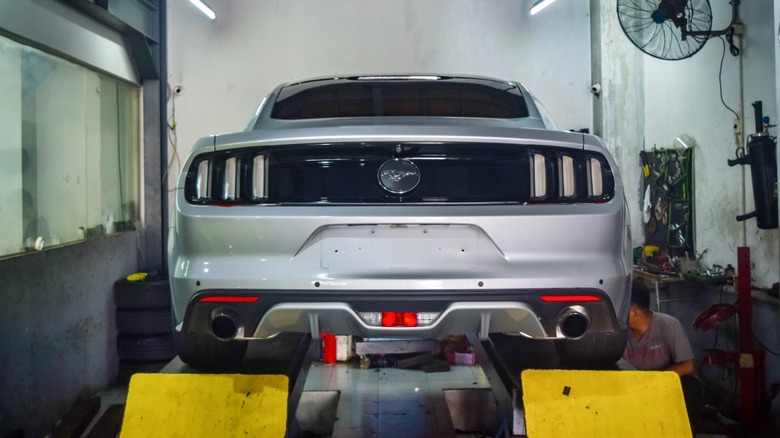
Even though a Ford Mustang is relatively affordable by sports-car standards, performance-oriented cars tend to cost more to maintain than their mass market counterparts. Edmunds' estimates show that a new 2025-year-model Mustang typically racks up $4,562 in maintenance and repair costs during its first five years of service. In 10 years, this figure rises to about $7,830, according to CarEdge, with around a one-in-five chance of a repair over $500. For context, a Toyota Camry will cost less than $5,000 to maintain in the same 10-year time span with a roughly one-in-ten chance of repairs over $500.
As a retiree on a fixed or semi-fixed income, these costs and unpredictability can be destabilizing in the long-term. While they vary depending on trim, routine expenses like brakes and tires often cost more for sporty cars, and a single out-of-warranty repair can easily run into the thousands. Now that you're not working, there's no paycheck to absorb those surprises — unplanned repairs will come directly out of your savings. That doesn't make a Mustang unaffordable by default, but it does mean ownership requires a larger cash buffer.
Higher risk of accidents and higher severity if they do happen

A Mustang isn't automatically a "deathtrap" by any means, but according to data and statistics, it's not the safest car, either. IIHS looked at fatalities per million registered-vehicle years using federal Fatality Analysis Reporting System (FARS) fatal-crash data. In its analysis of 2020-model vehicles (fatalities from 2018–2021), IIHS reported that six of the 21 vehicles with the highest driver death rates were muscle-car variants, including the Ford Mustang, which had a death rate of 97 per million vehicles. For context, the popular retiree-friendly Lexus RX350 had only 5 deaths per million registered vehicles, so you know the difference isn't simply because there are more Ford Mustangs on the road.
The FARS data only accounts for fatalities occurring within 30 days of a crash; the long-term consequences for older crash survivors are still a major issue. In an National Highway Traffic Safety Administration (NHTSA) Traffic Tech summary on older occupants' recovery following a car accident, injured individuals over the age of 65 reported worse physical outcomes about two years later than their younger counterparts.
That means even nonfatal crashes can lead to years of reduced physical function, and the negative financial and psychological impact of a slow recovery can outlast the car. In extreme cases, this could mean paying for home renovations to aid accessibility or making pricey forced lifestyle changes. And all of these will come after similarly expensive out-of-pocket medical bills and potential lawsuits.