

Elon's Big Nvidia Pivot Is A Gamble That Could Affect Both Companies
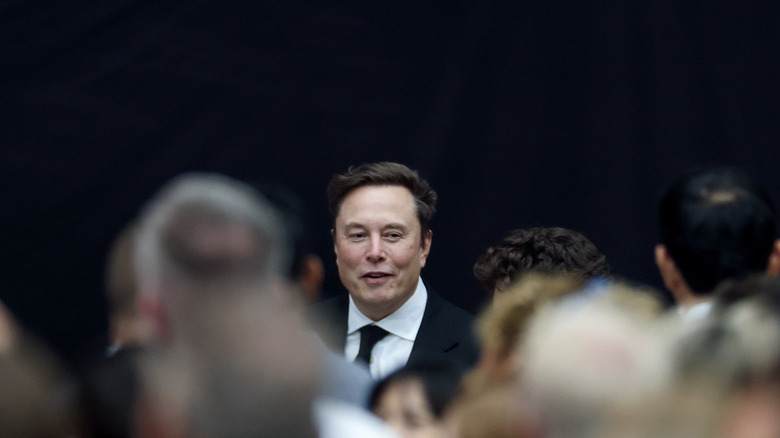
On January 17, 2026, Tesla's CEO Elon Musk announced, via X, that the electric vehicle manufacturer's long-awaited AI5 chip — which is predicted to be an instrumental component in the artificial intelligence (AI) powering the company's future autonomous vehicles (AVs) — was nearing completion. In fact, Tesla's Q4 2025 Update Deck predicts that the AI5 chip will be ready for mass production in 2027 and its follow-up, AI6, should be available the following year. Adding to this, Musk made another major announcement on the AI front: Tesla would once again be directing resources toward developing its previously scrapped Dojo 3 program, an AI computing system based in space.
These reveals came just weeks after the AI computing corporation, Nvidia, announced Alpamayo — a collection of open source AV-focused AI programs and resources. Tesla currently relies heavily on Nvidia's hardware to train its AI, and has for several years. In fact, Musk shared on X that Tesla is on track to have spent a cumulative $10 billion on Nvidia gear by the end of 2026. That's a hefty investment even for Musk, who makes over $2.2 million dollars per hour. The fact that Musk has decided to get back to work on Dojo 3, which was initially part of a program he shut down in August 2025, while simultaneously doubling down on other AI advancements suggests he may be trying to reduce his company's reliance on Nvidia technology. A decision that could have consequences for both companies.
Tesla and Nvidia may be forming a heated AV rivalry
Like many other Nvidia programs, Alpamayo is open source, meaning that Tesla (and virtually any other corporation) could use it to aid their own AI pursuits. However, given just how little time passed between the unveiling of Alpamayo and Musk's announcements about AI5 and Dojo 3 — it's likely that Musk intends to distance Tesla's operations from those of its competition.
While Tesla may no longer be Musk's most valuable asset, the AV technology it currently has on the market could be under serious pressure from Nvidia in the coming years. Tesla offers Full Self-Driving as an optional add-on to its current lineup of EVs, while a Mercedes-Benz CLA model with Nvidia's own Nvidia Drive AV program is slated to hit the U.S. market in 2026 — and has already been well received in Europe. Complicating the matter is that swaths of people have sold their Teslas in response to Musk's controversial behavior and more recent connections to the White House. If Nvidia continues to partner with established manufacturers to get its AV tech out into the world, Tesla may have a very powerful rival on its hands.