

5 Reasons A Retiree Regrets Buying A BMW Car
Retirement has always been a tricky time to manage finances. On the one hand, you might feel like it's the time to splurge on the excesses you didn't get to enjoy during your career, like a nice luxury car. On the other hand, it could be wiser to penny-pinch a little more so that you can live comfortably as long as possible.
There's no one simple choice, and neither of these two viewpoints is wrong; it all depends on the size of your nest egg and what your priorities are. The problem is that if you buy the wrong car, whether it's a splurge or what you thought was an economic move, you might end up with some deep regrets at a crucial time in your life.
Unfortunately, buying a BMW could be one of such regretful moves. It's a luxury car brand that's not exactly known to be cheap to buy, own, or maintain. However, it's worth noting that in the luxury car industry — especially recently — BMW is frequently listed among the best brands. In fact, Consumer Reports has named it among the most reliable luxury car brands. But the number of brands on the "exclusively luxury" list is short. And with the plethora of cheaper BMW alternatives that offer the same comforts, it's becoming a harder sell. Rapid depreciation, massive upfront costs, high maintenance costs, and pricey insurance are just some of the reasons you may regret buying a BMW in retirement.
BMWs require a large upfront cash commitment

The December 2025 Average Transaction Price (ATP) tables from Kelley Blue Book show that the typical BMW buyer paid $72,137 for their car. For context, according to that same report, that's $9,579 higher than the luxury car category average, $14,488 more than the entry-level luxury car average, and $21,811 higher than the overall market average for that month. It's also about the same as Mercedes-Benz's ATP, but higher than Audi's $65,983 and Lexus's $61,902. According to this data snippet, BMW sits on the high end of mainstream luxury car brands, often pricier than Lexus and Audi but cheaper than Land Rover and Porsche.
So, even before depreciation, maintenance, insurance premiums, or other money-sucking necessities, BMWs demand a large amount of cash upfront. And if you choose to finance it, you'll still need to bring meaningful cash to the table. For higher-priced luxury vehicles like BMW, lenders typically expect a larger percentage to manage risk — meaning a down payment of about 20%. On a $74,000 BMW, that translates to roughly $15,000 upfront before the monthly payments even begin.
Bankrate's weekly survey put the average 60-month new-car rate at 7.01% (January 2026), and Edmunds found the average annual percentage rate (APR) was 6.7% in the fourth quarter of 2025. At 7% APR for 60 months, financing a $74,000 BMW with 10% down ($66,600 loan) is about $1,319 per month and you'll pay roughly $12,500 in interest. Even with 20% down ($59,200 loan), it's about $1,173 per month and $11,150 in interest. If you're living on withdrawals, you're essentially locking in a four-figure fixed bill plus a five-figure interest drag.
Depreciation is usually really high for BMWs
While it's true that cars depreciate, viewing one as an asset can help your finances. Justin Yoshizawa, director of Product Management State told The St. Louis American that "... viewing your vehicle as a long-term asset just might change the way you purchase and maintain your cars. And it will probably save you money." The idea is to have a long-term productive asset that reduces costs and can still be sold for a reasonable price when you need money and don't want the car anymore. Luxury car brands like BMWs are generally unsuitable for this approach because of how much they depreciate.
An iSeeCars analysis revealed that the industry average five-year depreciation rate for cars in 2025 was 45.6%. In that same report, BMW's flagship 7 Series sedan ranked as the car with the second-highest depreciation on the list, losing a whopping 67.1% of its value in the first half-decade post-sale. Sixth on the list of high-depreciation cars is another popular BMW offering, the 5 Series hybrid, with a 64.7% depreciation — a $47,457 loss in value. The non-hybrid 5 Series follows in No. 13 spot, with 61.7% lost. The rate is similar for many other BMW offerings: the i4, for instance, can depreciate as much as 68.1% in its first five years, while the 3 Series can lose 51.4% of its value in the same period. That said, BMW SUVs typically hold value better. For example, the BMW X3 could be a good car for budget-conscious retirees if SUV-sized luxury is a major concern.
Maintenance and repair costs can hurt your portfolio
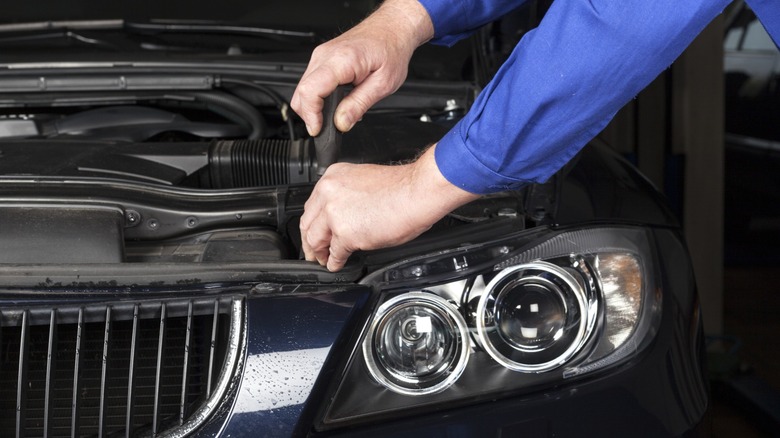
Maintenance and repairs on BMWs aren't typically cheap. These cars are exotic luxury vehicles with complicated and expensive components. That means sourcing parts for replacements is pricey, and the labor costs for professionals who understand the complicated engineering in these cars are also higher than normal.
Overall, BMW has an average score in reliability. RepairPal gives it two and a half stars out of five and estimates that the average annual repair cost for a BMW is $968. This includes scheduled maintenance and unscheduled repairs. In contrast, the average across all brands and models is about $652. That means you'd be spending over $300 more than the average car owner annually. Likewise, CarEdge estimates that BMW models average about $16,000 in maintenance and repairs over the first 10 years — roughly $4,000 more than the industry average for luxury brands. CarEdge also reports a 47.26% chance of a major repair (repairs over $500) in that same period.
As a retiree, meeting this maintenance bill would mean withdrawing more from your portfolio and leaving less funds to compound. This extra spending could compete directly with healthcare, housing, travel, and other important financial demands. Additionally, the 47.26% "major repair" probability matters a lot because such huge surprise costs can force you to sell investments at a bad time or hold more cash than you would have if you had gotten a more reliable car.
Insurance can be meaningfully higher

Luxury and performance vehicles typically have higher insurance premiums than their regular counterparts, but many people underestimate the difference. MarketWatch found that luxury vehicle owners pay 39% more than owners of regular cars. Meanwhile, a Bankrate report showed that on average, based on an analysis of 15 luxury car models (BMW M4 and X5 included), owners paid $1,223 more for full-coverage insurance premiums than they would have if they went with a mass-market competitor instead. The jump is particularly notable when comparing the BMW X5 with the Jeep Grand Cherokee, with premiums for the X5 costing over $2,000 more per year.
But research suggests that even among luxury cars, BMW's insurance cost isn't the most pocket friendly. While insurance rates vary depending on what type of BMW you own, your location, age, driving profile, and many other factors, CarEdge claims BMW insurance premiums average about $4,636 per year. According to the same report, that's $1,503 more than what you'd pay for other luxury brands given the same driver profile.
Premium fuel and car consumables raise costs
Many of the newer BMW engines are turbocharged, high-compression blocks built for power and efficiency. Using regular gasoline for such engines can cause knocks, harm the car's fuel economy, or even reduce the engine's life span. However, premium gas doesn't come cheap; the American Automobile Association's (AAA) national averages as of early 2026 show that regular gas costs around $2.8 per gallon, whereas premium costs $3.7-$3.8 per gallon — about $1 more.
Assuming you drive 10,000 miles a year in a BMW 330i, with a combined 31 MPG, you'll spend about $1,200 on fuel. Another car with the same MPG, running regular gasoline, would cost $300 less per year to fill up. Economy cars with even more fuel efficiency, like the Camry Hybrid (with 51 MPG combined), could cost you less than $600 a year in fuel if you drive the same 10,000 miles. In 10 years, that's anywhere from $3,000 to $6,000 more you'll spend on fuel as a BMW owner.
All of this is before adding the cost of performance consumables that typically come with BMWs, such as pricier run-flat tires, performance brake pads (on sportier models), expensive engine oil changes, and all the costly labor to fit them.