

Inside The Swiss Bunker That's Storing A Shocking Amount Of Money
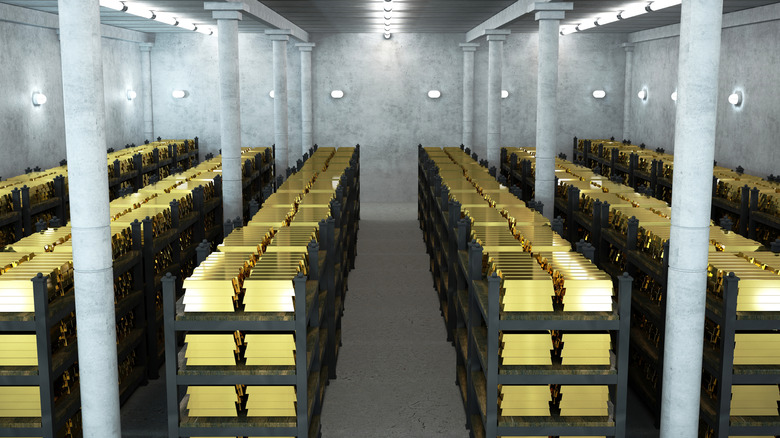
Tether, a blockchain financial services company led by CEO Paolo Ardoino, has stockpiled 140 tons of gold worth upwards of $24 billion and stored it in a former nuclear bomb shelter in Switzerland. The exact location of where Tether has its bunker-turned-vault has not been disclosed. So, it could be in any of the over 370,000 bunkers that proliferated throughout Switzerland back when the neutral nation's government mandated that developers include them as part of any new development 63 years ago.
Half of Tether's supply — more than 70 tons — was acquired in 2025, Bloomberg reported, outpacing many major financial institutions the world over. "This means Tether is the largest holder of gold outside central banks, and its holdings are roughly equal to smaller central banks such as Korea, Hungary, and Greece," Jefferies investment firm analysts Fahad Tariq and Andrew Moss observed (via Kitco).
And the country's not done yet: Tether continues to buy gold at a rate of one or two tons a week as of late January 2026, and Tariq and Moss doubt that will stop any time soon.
Americans can't access Tether's gold-backed cryptocurrency
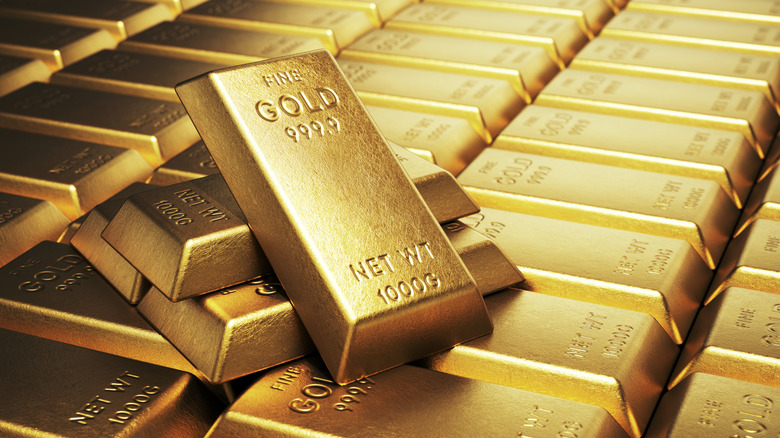
Tether has been collecting gold as part of its business plan of selling gold-backed stablecoins called XAUT. A form of cryptocurrency, the way stablecoins are supposed to work is their value is tied to a currency or commodity. So, a XAUT gold token is roughly equal to an ounce of gold, which is worth about $4,700 as of early February 2026. Tether also sells Scudo, tokens that are each worth 1/1000 of a XAUT token.
The Tether Gold website claims that each XAUT token represents direct ownership of actual gold within the company's Swiss vaults, minus a 0.25% transaction fee of the XAUT's value and other charges. As of February 2026, Tether's market cap sits at over $2.4 billion, and Ardoino told Bloomberg that his company may issue up to $10 billion worth of XAUT tokens by the end of 2026.
But unless Tether changes how it operates, most Americans won't be participating. That's because the GENIUS Act passed in July 2025 requires that any stablecoins sold in the U.S. must be backed by U.S. dollars or short-term Treasuries. Tether's terms of service also explicitly forbid citizens and residents in the U.S. from trading or owning XAUT tokens unless they're representing an approved corporation worth at least $10 million.
There's a method to Tether's massive gold accumulation
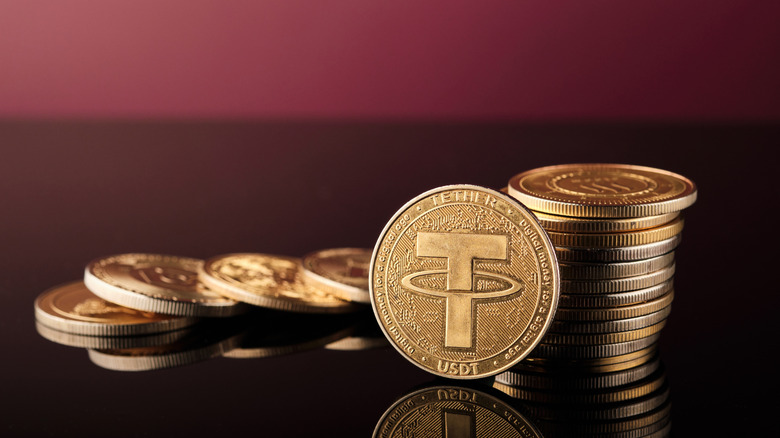
Like many other institutions and investors, Tether buys gold as a way to hedge against inflation. This may seem like a questionable strategy to some. After all, the bold value prediction for gold in 2026 was already surpassed when its price per ounce approached $5,600 on January 29, and even that monumental figure dropped nearly 10% just days later.
Still, the caveat that comes with buying gold is that it's hard to predict where its price will ultimately go in these economically turbulent times. While Tether has also issued $186 billion worth of its U.S. dollar stablecoin, USDT, into the global market, Ardoino told Bloomberg that he aspires for Tether to become a large enough force in the international gold trade to rival many of the institutions bolstering their own reserves of the precious metal. As he noted, "The way I see it, is that there are foreign countries that are buying a lot of gold, and we believe that these countries will soon launch tokenized [versions] of gold as a competitive currency to the U.S. dollar." Seeing as the value of the U.S. dollar fell by 9% in 2025, 2026 could be an opportune time for other nations to produce viable alternatives.