

Why JPMorgan Chase Shut Down Donald Trump's Bank Accounts
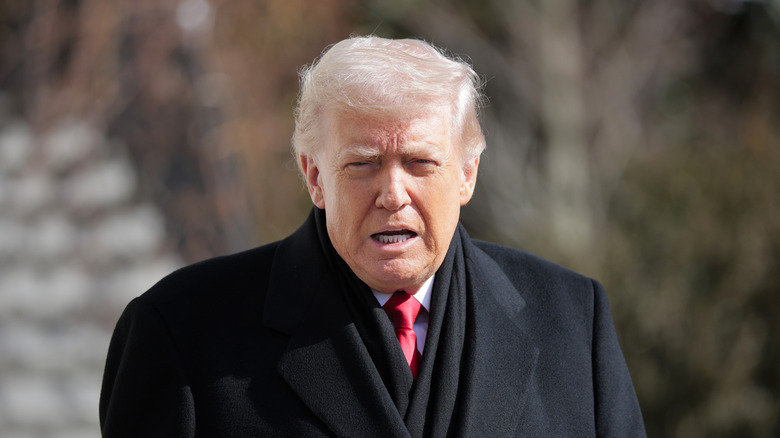
JPMorgan Chase (JPMC) joined multiple U.S. banks announcing in late January 2026 that it will match the federal government's one-time $1,000 deposits to new baby savings accounts. These "Trump accounts" could be worth hundreds of thousands one day if enough contributions are made, and this move may seem like an act of good faith on the bank's end. However, JPMC is not exactly in President Donald Trump's good graces as of late. On January 22, 2026, the firm became the president's latest legal target, accused of political discrimination for closing Trump's business accounts in April 2021. According to the $5 billion lawsuit filed in Florida's Miami-Dade County and obtained by the Washington Post, Trump claims that JPMC and its CEO, Jamie Dimon, benefited from being affiliated with him and his associates for decades but chose to close his accounts due to Trump's conservative leanings.
Perhaps unsurprisingly, JPMC has issued a response denying the accusations of prejudice, pointing instead to legal reasons for closing Trump's accounts. However, it is worth noting that Trump's filing details that JPMC notified Trump of his pending account closures on February 19, 2021. Although the Capitol Hill riot that took place on January 6, 2021, after Trump lost the presidency to Joe Biden is not mentioned anywhere in the complaint, multiple news organizations have pointed out the close timeline as a possible connection for the accusation. Joe Biden taking office is, however, suggested in the complaint as a reason for "unlawful" banking practices taking place.
JPMorgan Chase openly denies several of Trump's accusations
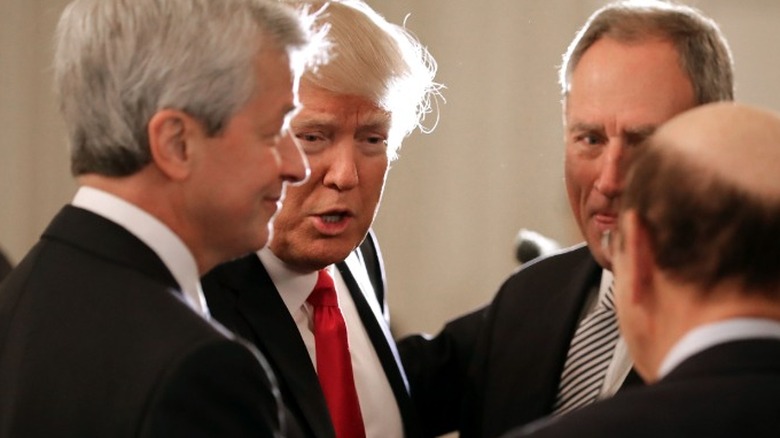
JPMorgan Chase released a public statement the same day Trump's lawsuit was filed, stating in part, "Our company does not close accounts for political or religious reasons. We do close accounts because they create legal or regulatory risk for the company." The finance giant also decried the lawsuit's validity, and concluded its short statement by highlighting that it's implored both Trump's administration and several of its predecessors to alter regulations to prevent situations such as this from occurring in the first place.
No specific details beyond that were provided as to why Trump's accounts were closed. However, that's not exactly a surprise. While many banking laws are designed to protect consumers and their transactions, others are set up to protect the banks themselves. In the United States, financial institutions do not have to provide customers with a reason for closing their accounts (particularly when illegal activity is suspected), nor do they even have to provide notice. And, despite being closely associated with Dimon in the 2010s, Trump's lawsuit filing also accuses the CEO's company of having a history of closing accounts belonging to other conservative figures. However, the only specific examples listed allegedly occurred in 2021 and 2022.
The reason for Trump's account closures may never be known
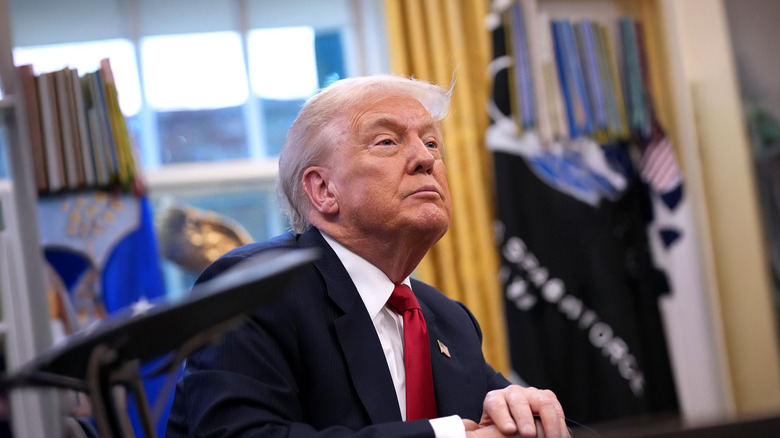
It's unknown when or if JPMC will be compelled to provide a more concrete reason for closing Trump's accounts. However, debanking is nothing new and can happen to customers on all levels of society. And although Trump's lawsuit timing may seem curious since the closures took place in 2021, the topic of debanking has been heating up. Politicians and researchers on many sides of the political spectrum have spoken up against the practice in the years leading up to this lawsuit. Nevertheless, the monitoring and reporting systems involved in debanking remain part of banks' efforts to combat criminal financial activity.
For Trump though, the issue appears increasingly personal. The President issued an executive order in August 2025 that said banks must reinstate clients whose accounts were unlawfully closed. Not only does it appear that his accounts with JPMC were never reinstated, but the rift between Trump and former financial ally Dimon may be growing despite Dimon promising contributions to the new Trump accounts. Dimon told CNN in November 2025 that JPMC would not be among the companies donating to Trump's new White House ballroom. This was followed up by comments in January 2026 criticizing both a new credit card plan proposed by Trump and the President's ongoing immigration enforcement activities.