

The One Service Boomers Paid More For In The 1970s Than They Do Now

We may receive a commission on purchases made from links.
Born between 1946 and 1964, the Baby Boomer generation tends to get a lot of flak for coming of age during a time when living costs were far more affordable than they are now. However, seeing as most Baby Boomers don't hit certain benchmarks of wealth, the contemporary economy isn't much friendlier to them than the average consumer. Furthermore, not everything decades ago was all peachy on the price front, and one item in particular was actually less attainable in the 1970s than it is today: airline tickets.
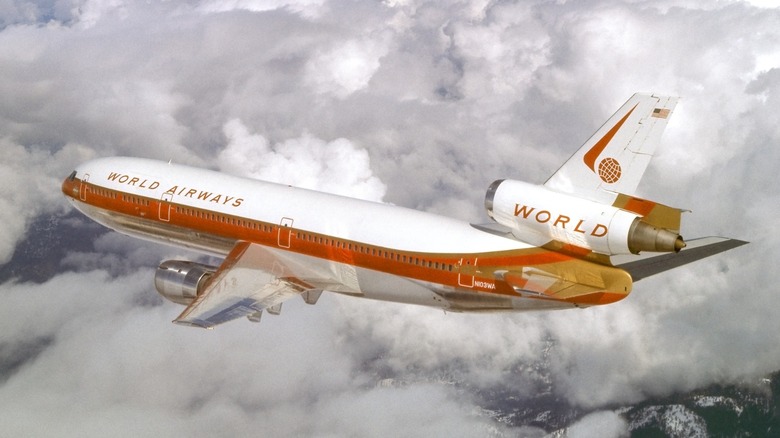
The 1950s, 1960s, and 1970s are often referred to as the golden age of airline travel, when commercial flight was seen as a luxury marked by spacious seating and full meals included in the ticket price. However, that experience came at quite a cost. Sure, complaining about seat prices feels as much a part of modern air travel as trudging through TSA security lines, but it seems 1970s travelers spent more when adjusted for inflation. In addition to a 2013 Atlantic article asserting that airfares dropped 50% in 30 years, real vintage airline receipts on eBay show one roundtrip from Newark to St. Louis cost $164.73 in October 1975, while another from Newark to Miami cost $209 in November 1978. According to the Bureau of Labor Statistics' (BLS) inflation calculator, those figures come out to $972.34 and $1,004.86 today, respectively. Expedia flights set for the same months in 2026 show most tickets are under $300 for both roundtrips.
Why airfares have become more affordable since the 1970s
The U.S. Inflation Calculator's analysis of BLS data likewise shows that ticket prices crept up at an average rate of 6.52% each year throughout the 1970s before beginning a gradual decline. As Airlines for America stated in March 2023, average domestic ticket prices actually fell a whopping 44% between 1979 and 2019. In 2024, the Wealth and Poverty Center also calculated that the hours of labor an average blue collar worker would have to do to afford a flight had fallen over 90% since 1970, suggesting that the same amount of time spent working that bought just one flight in 1970 could buy 10.8 flights in modern times. So, what happened?
There are definitely multiple factors that played a role, but the big one here is the Airline Deregulation Act. In the early 1970s, U.S. air travel was heavily regulated, with the federal Civil Aeronautics Board controlling fares as well as airline routes. The Airline Deregulation Act removed federal government control over airline fares, routes, and market entry in the United States. This meant that, from 1978 on, airlines were able to set their own prices and routes. This change resulted in more intensified competition, as well as the rise of low-cost carriers, which has helped strip away luxury barriers and transform flying into a common mode of transportation for much of the population. Even so, airlines still have plenty of other ways to trick you into paying higher fees.
Other factors affecting airline ticket costs over time
Though airline prices have fallen overall since the 1970s, modern times still aren't immune to skyrocketing fees. Looking at changes since 1964, U.S. Inflation Calculator data shows that airline tickets reached an all-time low in 2020, likely thanks to the COVID-19 pandemic causing a collapse in both domestic and international travel. Before long, the need to recoup these losses combined with general inflation to drive up prices across the economy, and airfares soared up 30.2% in 2022. The only year to see greater annual change in ticket prices than that was 1980, after which rates fell sharply.
Along with global events like the pandemic affecting airfares, the growing abundance of commercial flights since the 1970s has also helped make tickets more broadly affordable. Back in 1975, Airlines for America reported there were around 13,000 daily flights carried by U.S.-based airlines. The same organization stated in 2024 that the number of daily flights had grown to 27,000. With more flights to choose from, today's passengers can shop around more extensively for cheaper fares. So, while Baby Boomers are still the wealthiest generation and aren't likely to shed the "they had it better back in the day" stereotype anytime soon, the cost of flying is one area they can confidently say that's just not true.