

China's Wind Farms Generate More Money Than You Think
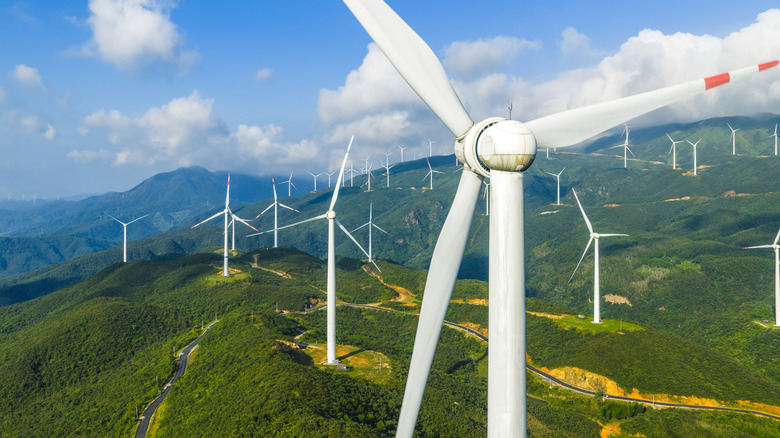
As the world moves towards reducing its reliance on fossil fuels and combating climate change, nations are looking to capitalize on renewable resources like solar and wind power. When it comes to the wind energy sector, China is dominating the landscape — leading in annual installations, manufacturing, as well as building on two decades' worth of streamlining a robust supply chain. By the end of 2024, China had installed a mind-boggling 521 Gigawatts of wind power capacity, according to data from China's National Energy Administration (via Climate Energy Finance). With constantly increasing installed capacity and a healthy influx of wind turbines, China is not only powering itself with wind, but it's also generating incredible amounts of revenue literally out of air. In 2024, China's wind power industry had an expected average revenue of $66.4 billion, per IBIS World.
The companies that operate the wind farms are selling electricity to grid companies at an enormous scale. For instance, the wind power segment of China Longyuan Power Company, one of the top developers in the country, generated 17.78 MWh of power in the first quarter of 2025, according to BCG Matrix. Windfarms in China are also leveraging turbine costs that are lower compared to those in Europe and the United States. And while the U.S. has wasted money on failed renewable energy projects in the past, and is now rolling back funding for clean energy generation, China's policies have given the industry a critical boost. With low initial costs of installation and government subsidies, Chinese wind farms become much more capable of producing electricity at lower costs, in turn driving the growth of similar projects.
Chinese wind power companies have benefited from the nation's favorable policies
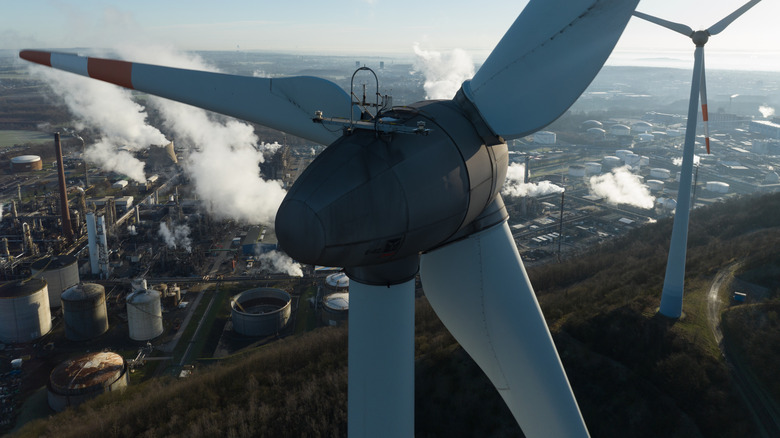
The Chinese wind energy sector has benefitted immensely from the nation's policies, which are driven by a goal to hit peak emissions by 2030. "Like in almost every country that has succeeded in scaling up renewable energy, the rise of China's wind industry simply would not have been possible without ample government support," Cosimo Ries, a renewable energy analyst at Trivium China, told CKGSB Knowledge. For a long time, wind power companies enjoyed subsidies from the government, but these got phased out by 2022. Considering that new technologies can, at times, also be a risky investment some people avoid, China had initially introduced feed-in tariffs for wind power production to attract investors and boost growth. Although these subsidies are no longer in place, local governments, such as the Guangdong province, continue to lend their support to developers.
While major energy companies are going bankrupt in the U.S. — and blaming the White House for it — wind power in China is set to reach $93.7 billion worth of revenue by 2029, per IBIS World. This phenomenal rise to the world-leader position in wind power production has happened in record time as well — in 1989, China only had three electricity-producing turbines in the entire country.
By betting on renewables, China has put itself in a world-dominant position, where it's manufacturing 80% of the world's turbines and setting up as many as 114 facilities worldwide, per Wood McKenzie. In fact, the export of wind power turbines and components is a flourishing industry in itself, with the nation exporting wind power components worth $3 billion to other countries within the first eight months of 2025, per Wind Power Monthly.
China is investing in the more profitable offshore wind farms
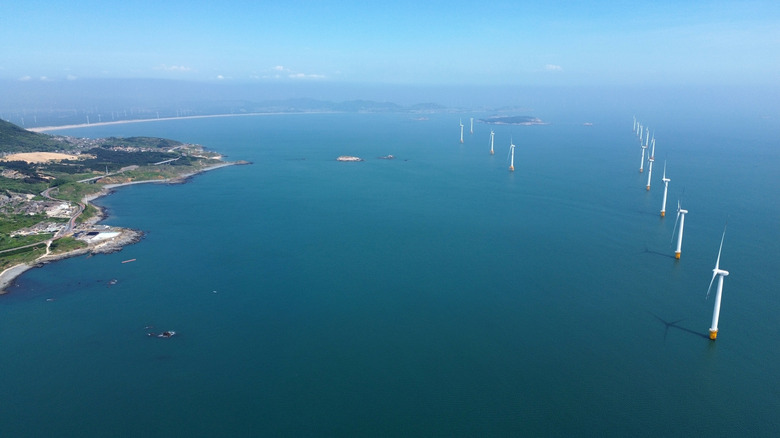
Offshore wind farms are far more efficient in producing electricity than their onshore counterparts because they take advantage of the high strength and consistency of winds in the ocean. China is flexing its power in this sector as well. The province of Guangdong alone is home to 15% of the world's offshore wind turbines, which are designed to withstand and even leverage the incredible power of cyclones in the South China Sea.
The economic impact of offshore farms in China is hard to estimate. That said, an E2 report on the economic benefits of offshore wind power generation in the United States found that around 5,000 jobs could be created in each coastal state where such farms would be installed. The report pegs the potential cumulative revenue at $3.6 billion. Nonetheless, for all the revenue the industry is generating, Chinese wind farms are also struggling with dwindling profitability, with factors like increasing competition and declining electricity prices, which beg the need for more innovations in future.