

Trump Wants A Credit Card Interest Rate Cap (But There's One Major Problem)

Credit card debt is exploding in the U.S. According to a recent report from the Federal Reserve Bank of New York, credit card balances grew to $1.23 trillion in the third quarter of 2025, a year-over-year increase of 5.75%. The inability of some consumers to pay off that debt was a factor in why FICO revealed America's average credit score has fallen considerably in the past three years.
Now, President Donald Trump has called for a one-year cap of 10% for credit card rates starting January 20, 2026, the one-year anniversary of his second inauguration. He declared in a Truth Social post, "We will no longer let the American public be 'ripped off' by Credit Card Companies that are charging interest rates of 20 to 30%." Trump even told reporters on Air Force One that any company's decision to violate the cap would be considered illegal.
Investors and financial experts have not reacted positively to the cap idea, or the threat. While JPMorgan Chase CFO Jeremy Barnum suggested to reporters that some banks may wind up taking legal action against this new regulation, multibillionaire hedge fund manager Bill Ackman predicted on X that the 10% cap could result in millions of credit card cancellations. He noted, "Consumers denied credit cards will be forced to turn to loan sharks whose rates and terms will be vastly worse for borrowers."
Financial experts warn the cap will only make things worse

A rate cut isn't unprecedented for the Trump Administration. On December 10, 2025, the Federal Reserve reduced the federal funds rate by .25%, and credit card rates did fall afterward: According to Bankrate, the average weekly credit card rate went from 19.87% for November 19, 2025, to 19.75% seven days after the reduction was announced. By January 7, 2026, the average weekly credit card rate was 19.65%. However, there's a big difference between a .22% reduction occurring over several weeks and the enormous reduction Trump posed in January, and the consequences could reflect that contrast.
A 10% cap would provide some financial relief for consumers mired in debt, but it will also prevent people with poor or mediocre credit scores from being able to secure a credit card or loan at all. As WalletHub CEO Odysseas Papadimitriou stated in an email to media outlets, "Millions of people will have to deal with reduced credit limits, account closures, shorter 0% [interest] promotional periods, and annual fee increases as a result. It's like if the government tried to set car insurance rates — millions of people would be without coverage." Papadimitriou also noted that, if such a policy were enacted, those who invest in credit card companies could also be impacted. He predicted, "Shares will likely be under a lot of pressure in the short term." If his words ring true, avoiding common credit card mistakes will be the last of many Americans' worries.
The cap's potential benefits have earned bipartisan support
Notably, not everyone is convinced that a cap would spark a credit apocalypse. Brian Shearer of the Vanderbilt Policy Accelerator told PBS that a 10% credit card cap would save consumers $100 billion, noting, "The few large banks that dominate the credit card market are making absolutely massive profits on consumers at all income levels." Shearer's Vanderbilt study on credit card caps revealed that a 10% cap would lower the monthly interest charged to the average American by $899. The research also contradicts other experts' predictions that there would be huge amounts of account closures, suggesting credit card companies don't rely as heavily on interest to make money as you might think. Instead, forces like interchange fees and various other charges to users generate a sizable chunk of their revenue.
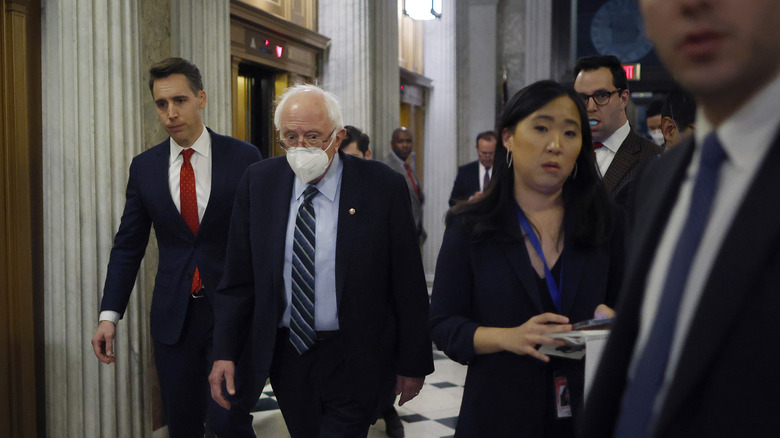
Additionally, Trump isn't the only politician proposing a 10% cap rate. In February 2025, Independent Senator Bernie Sanders of Vermont and Republican Senator Josh Hawley introduced bill S. 381 to the Senate, which also calls for a 10% credit card cap. Meanwhile, a 10% cap rate bill — H.R. 1944 — was also proposed in the U.S. House of Representatives by Democratic Representative Alexandria Ocasio-Cortez of New York and Republican Anna Paulina Luna of Florida in March 2025.