

The Real Reason Diesel Fuel Is Costing Americans More While Europe Pays Less
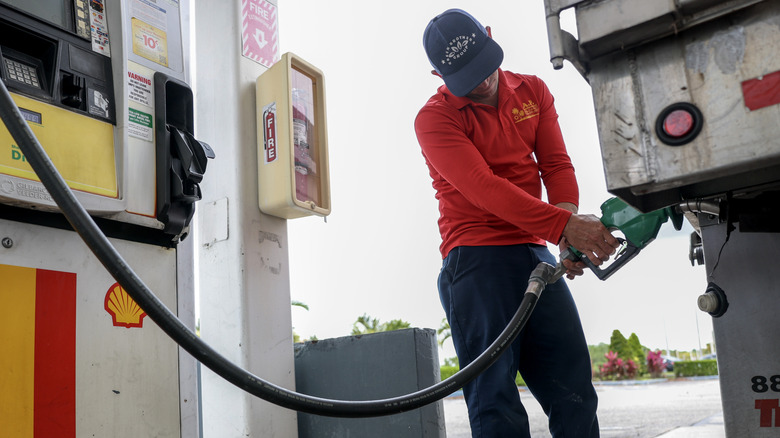
It's rare to pull into any U.S. gas station to find the price per gallon on the diesel pump anywhere near the price of regular gas. As of January 9, 2026, AAA reported that the average price of a gallon of diesel fuel in the U.S. was $3.52 — over 70 cents more than the price of regular gasoline. Meanwhile, in many European countries, the price of diesel fuel is somewhat lower than the price of gasoline. Even in countries where gasoline costs less, the gap between prices is smaller than it is in the U.S.
There are many factors impacting why U.S. prices are against the grain, with the simplest being taxation. While the U.S. imposes considerably higher taxes on diesel than it does on gasoline, much of Europe does the opposite. Plus, there are broader factors that can impact what controls the price of fuel in the U.S. For instance, more modern environmental regulations, both in America and internationally, have increased refinement costs while consumer shifts in the fuel market similarly affect diesel prices everywhere — especially in states with the highest gas prices.
Tax rates largely drive diesel price differences

The monetary difference between the excise tax requirements for gas and diesel is fairly similar between the U.S. and Europe, though the higher and lower ends of the comparison are flipped. While Europe's prices and taxes on fuel are generally higher than in the U.S., in many European countries the excise tax enforced on diesel, specifically, is considerably lower than the excise tax on gasoline.
According to Tax Foundation Europe, European diesel is taxed at $2.05 per gallon on average, while the average tax on gas is closer to $2.50. Plus, the European Union's (EU) minimum excise tax on diesel comes out to $1.47 per gallon, while the minimum for gas is $1.60. While those figures might make driving in Europe seem like a major money mistake when traveling, this is also a key reason why diesel is more affordable in Europe than it is domestically.
Meanwhile, the U.S. charges an 18.4-cent federal excise tax per gallon of gas, while the excise tax for a gallon of diesel is 24.4 cents. However, the Energy Information Administration (EIA) estimates that the average state diesel tax rate can be as high as 34.74 cents per gallon in the U.S. as of early 2024.
Differences in cost and demand are also at play

Throughout the 1990s and early 2000s, environmentally focused regulations on diesel refinement became considerably more strict in both the U.S. and in Europe. These legal shifts drastically increased diesel refinement costs which, in turn, raised the overall cost of the final product. Meanwhile, the early 2000s also marked the start of a near two-decade increase in U.S. fuel exports, meaning that much of the country's domestically produced diesel was being sent overseas around the same time it became more expensive to make. It stands to reason that these two forces working together contributed to make diesel harder to come by in the U.S. — thus raising its price.
Additionally, it's worth noting that consumers tend to use fuel differently in Europe than they do in the U.S. The Environmental Protection Agency (EPA) estimates that roughly 33% of American vehicles — on both land and sea — are powered by diesel. At the same time, electric vehicles (EVs) have become increasingly popular throughout Europe, with countries like Norway and Germany largely leading the charge in EV sales and registrations. According to Acea, less than 14% of new vehicles registered in Europe run on diesel, while 22.3% were EVs, as of 2023. While electric vehicles sales in the U.S. haven't exactly decreased in recent years, European consumers are clearly more willing to make the switch away from gasoline-powered vehicles. A switch that could potentially affect demand in Europe's diesel market — further affecting prices.