

9 Ways Retirees Can Turn A Second Home Into An Asset, Not A Money-Sucker
Owning a second home is a unique opportunity many retirees experience in their golden years. Following decades of dedicated work and diligent savings, seniors tend to be at the most financially stable point of their lives. According to Fidelity, the average net worth for U.S. households peaks between ages 65 and 74. Within this range, seniors have built an average of $1.79 million in total wealth. These riches tend to fall slightly for those 75 and older, with the average net worth hitting $1.62 million. Early retirees aren't far behind, maintaining an average wealth of $1.57 million between 55 and 64.
At these stages, seniors have accumulated enough savings to consider the possibility of owning a home, but wealth accumulation isn't the only decision point. Harvard University's Joint Center for Housing Studies reports that only 3.5% of the U.S. housing stock is suitable to accommodate those with mobility challenges, an increasingly common consideration for seasoned individuals. The overwhelming majority of homes don't fulfill the three recommended features for those with movement issues: stepless entrances, a single story, and wider-than-normal doors and walls. Thus, seniors often look into a second home to increase their quality of life, on top of their financial ability.
Regardless of the motivation, owning another property requires some financial savviness. Without proper preparation and planning, purchasing this asset could make you bleed money. The trick is to transform your next home into a cash-yielding investment instead of a liability. This way, your real estate purchase doesn't drain your nest egg, but works to reinforce it. Let's explore 10 ways you can turn a second home into an asset, not a money sucker.
Rent it out
One of the most straightforward and potentially lucrative ways to transform a second home into an asset is renting it out. If you still plan to spend time at the property throughout the year, you can rent it out to short-term guests. Long-term tenants may be the ideal option for seniors whose second home remains unused for most of the time. Both options have advantages and considerations, making the decisions dependent upon your personal preferences, financial needs, and living situation.
While there's no strict delineation, the City of Norfolk defines a short-term stay as any temporary booking lasting at least one night but not more than 30 nights — a widely accepted definition. These short-duration stays tend to generate more income than their long-term counterparts. The Journal of Housing Economics found that on Airbnb, one of the most widely used short-term rental platforms, the average rent for short-term properties is almost twice as much as long-term options. In addition to a potential for increased profits, short-term properties also help to lower the possibility of legal disputes with guests. Plus, property owners have more flexibility to visit the home whenever they desire.
On average, renting out to long-term tenants might yield lower profits compared to short-term visitors, but many seniors prefer the benefits of more permanent renters. You don't have to worry about actively managing a listing on Airbnb, VRBO, or Booking.com, with leases commonly lasting a year or longer. Furthermore, you're off the hook for routine cleaning, as tenants handle the more day-to-day responsibilities. Although lower on average, the income from long-term rentals tends to be more predictable, making it easier for retirees to manage their monthly expenses. Just make sure you're not buying a home to rent in one of the states with the lowest rent prices.
Buying and declaring residency in a low-tax state

When anyone adds a second home to their net worth, it's crucial to understand how the move affects their tax situation. Generally speaking, buying another property opens you up to more property and income taxes.
Since property tax exemptions are only offered for primary residences, you'll most likely be paying the full amount. Thus, buying a home in a state with lower property taxes can help reduce your overall costs. According to the Tax Foundation, the five states with the lowest property taxes are Hawaii, Alabama, Arizona, South Carolina, and Utah — all under 0.5% of the home's value. Keep in mind that the true cost of property taxes is only calculable when you know the home's value. Some residents in states like Hawaii with technically low property taxes still receive excessive annual surcharges due to the inflated real estate market. A total of 16 states, plus Washington, D.C., have property tax exemptions for seniors, too.
Leveraging the differences in income tax across the country is another way you can flip a second home from a liability into an asset. Buying a home in a state with no income tax opens up the possibility to declare residency in that state, eliminating a decent chunk of your annual tax burden. Currently, there are nine states with no income tax: Wyoming, Washington, Texas, Tennessee, South Dakota, New Hampshire, Nevada, Florida, and Alaska. Your second home's location in a state without income taxes also means you get to keep more of the profits from renting it out. States often require people to spend more than 183 days of the year within the state to prove residency, so make sure you can fulfill the residency requirements before buying a second home if you want those tax advantages.
Use fractional co-ownership

Have you ever heard one of those infomercials from lawyers promising to help seniors escape their money-sucking timeshares? To avoid the financial headache, new retirees should avoid this popular purchase at all costs. Celebrated financial expert Dave Ramsey describes timeshares as "legalized fraud," suggesting that 85% of people regret the decision.
Given these completely reasonable warnings, some seniors mistakenly assume that all forms of sharing a property are a scam. Enter fractional co-ownership. This increasingly popular investment structure allows retirees to gain the financial benefits of owning a second home without putting up the full investment. Similar to a timeshare, fractional co-ownerships allow you to stay at a property for a predetermined fraction of the year. The crucial distinction has to do with possession. With fractional co-ownership, retirees actually own a portion of the home's value, transforming a liability into an asset. When the property's value increases, so does your share of the overall price. Furthermore, some fractional co-ownership structures allow you to rent out the property during your part of the year.
In an interview with the Economic Times, Arkade Developers CMD, Amit Jain, claims that this type of shared real estate investment can return between 7% and 8% annually. Lofty claims that this real estate investment structure has returned 11.6% annually on average over the past 10 years, nearly double that of conventional real estate assets. It's important to note that offloading a fractional co-ownership can be more challenging and time-consuming than a standard property that you own outright. That's primarily due to the smaller pool of potential buyers and the general lack of familiarity with this type of investment.
Reduce estate taxes with a QPRT

Adding a second home to your net worth not only opens you up to additional property or income taxes. This additional property could also open you up to bequeathment-related taxes. However, retirees must also consider how an additional property could impact the taxes paid on inheritance. If you're planning to bequeath your properties to your posterity, you can help minimize the tax burden by setting up a Qualified Personal Residence Trust (QPRT). This legal tax structure allows property owners to shield their home's value against potential future tax implications sparked by estate taxes. When you set up this irrevocable trust, you're essentially giving up ownership of the home, removing it from your estate and into a trust. The QPRT allows you to live in the property for a predetermined period. When that time limit expires, the home's value is determined for tax purposes, not at market value, but at its assessed price at the point it was transferred to the QPRT.
Notwithstanding the tax advantages, a QPRT comes with some potential downsides. The initial property owner must live longer than the duration of the trust. If someone passes away before the trust term ends, the property's value falls under normal taxable conditions as part of the overall estate. Furthermore, seniors effectively hand over ownership of the property when the trust timeline runs out. Wrapping up a property into a QPRT may make it ineligible for certain property tax exclusions, potentially ramping up your property tax burden. Notably, federal estate taxes only kick in for transfers worth $15 million in 2026, up from $13.99 million in 2025. As a result, a QPRT may only be a worthwhile consideration for wealthy retirees subject to this oft-forgotten tax.
Take vacations to your second home

Ensuring your second home doesn't become a money-sucker isn't only about finding ways to make it profitable. You can also utilize the property to reduce costs in other areas, fulfilling the adage equating a penny saved to a penny earned. Instead of overspending on accommodation while traveling, take a trip to your second home. Seniors can save dramatically on vacation costs by cutting back on accommodation expenses.
Motley Fool Money estimates that 40% of a trip budget goes toward lodging. Realtor.com estimates the average domestic vacation in the U.S. costs about $2,000 per individual. That means a couple traveling within the country will spend about $800 on accommodation. Bear in mind that experts recommend that you don't spend more than 5% to 10% of your income on vacation. By using your second home as a destination, you eliminate one of the largest travel expenses. Better yet, you'll be building equity the whole time. And, when you're not traveling to the property, you can rent it out for an additional income stream.
Of course, you'll need to purchase a property in a place that you actually enjoy visiting. Still, this goal must be balanced with the need to find a location that's suitable for retirement. Generally, Florida is considered one of the best places to retire in the U.S., while being a popular domestic travel destination. Looking outside the country? There are several countries to retire outside of the U.S. that tick both boxes. Just make sure that you're eligible as a U.S. citizen to purchase property in the country, and that you can legally do everything you want with the investment, such as rent it out or sell it for a profit.
Build an accessory dwelling unit
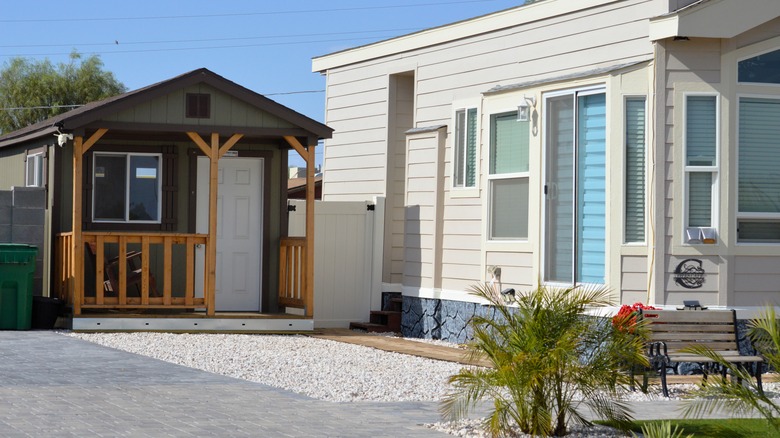
Another way to transform your second home from a cash drain into an asset with a reliable return is adding an accessory dwelling unit (ADU) — the technical term for a separate living space on the property of an existing home. Colloquially known as in-law suites, these units can provide an additional source of income for retirees who have maxed out rental units in their second home or who live on the property yet still desire rental income. Commonly, these add-on units are built after the construction of the primary unit, often developed from existing structures, such as basements, garages, or sheds. However, some homeowners build an entirely new structure on their property as an accessory apartment. Whether you're renovating an existing portion of your second home or building an entirely new structure, adding an ADU has some upfront costs that should weigh on the financial decision.
Angi puts the average cost of constructing an ADU at $180,000, although retirees could spend anywhere from $40,000 to $360,000. As you might imagine, building from the ground up will cost more than renovating. For instance, a basement conversion can be completed for $60,000, but it's tough to create a new detached structure for less than $110,000. Once the ADU is complete, however, you'll have reliable retirement income, which will be governed by the local rental market. For reference, Zillow puts the average rent in the U.S. is $1,995 per month, which means homeowners. In addition to generating another source of rental earnings, adding an ADU can boost the overall value of your second property. Angi estimates that every square foot added to a property boosts its value by up to $170. Put another way, an ADU can achieve a return on investment of 50% to 80%.
Claim tax deductions

Financially savvy second homebuyers know where to look for tax deductions. While owning another property means more tax liability, it may also mean an opportunity for a decreased tax burden. No matter the location of your second property, you may be able to write off some of those annual property and income taxes. These yearly surcharges fall under the state and local tax (SALT) deductions defined by the Internal Revenue Service (IRS). In 2026, these local taxes have a ceiling of $40,000 for couples and $20,000 for individuals. Put another way, a retired couple that rents out a second home can reduce their taxable income by up to $40,000 by deducting property and income tax levied at the state or municipal level. The same is true for individual retirees, yet the total amount is halved. Keep in mind that these potential deductions include property taxes, along with other SALT-related surcharges, from all properties. They're also dependent upon your income.
Retirees may be able to further minimize their taxable income by taking advantage of the home mortgage interest deduction. If you've taken out a mortgage on a primary or second home, the interest you pay on that loan might be deductible. On federal taxes, the IRS allows taxpayers to claim a deduction on up to $750,000 of mortgage debt. That limit is $375,000 for married couples that file separately. There's another commonly overlooked tax advantage awaiting retirees who own a second home. The IRS doesn't require property owners to report income made from renting out as long as it's within 14 days, offering a two-week window where retirees can make a lot and pay no taxes.
Leverage your second home's equity
Retirees who purchase another home can use their equity in the property to take out a loan. Homeowners can leverage one of many loan types to access quick infusions of cash when needed or desired. As with any type of borrowing, seniors should consider the long-term costs, taking into account the interest rates and repayment timeline. Some of the emergencies in retirement where tapping into your second home's equity might be worthwhile include emergency medical expenses or unforeseen debt accumulation. On the other hand, some retirees may choose to use their second property to help cover the costs of home renovation or to pay for a loved one's education. No matter your reasoning, it's advisable to think twice before getting a home equity loan. They're reliable and legitimate ways to access capital, but they don't come without risks.
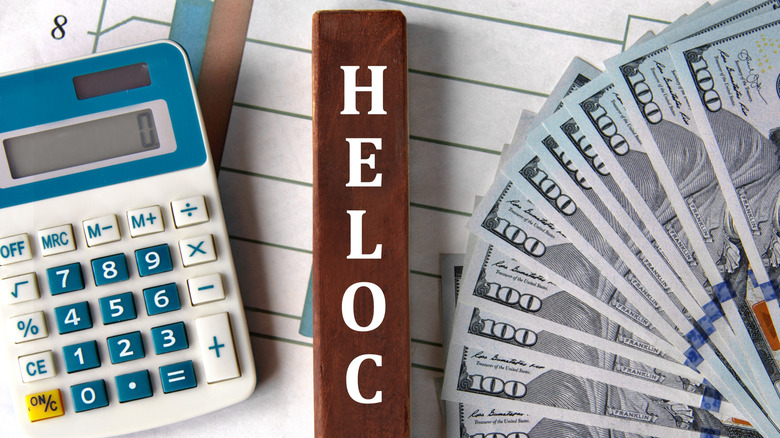
The Federal Trade Commission identifies two primary forms of home equity financing: home equity loans and home equity lines of credit (HELOCs). The former, commonly referred to as a second mortgage, usually comes with fixed interest costs and a set payment timeline. Home equity loans typically cap at 80% of a homeowner's equity, and the total amount borrowed is provided upfront. On the flipside, a HELOC acts like a credit card with your home as the collateral. Unfortunately, these home equity financing options come with variable interest rates, making it harder for homeowners to judge their payments. The good part is that you have greater control over how much you spend, since you're only charged for how much you take out.
Sell the property and invest the profits
The quickest way to turn a financially burdensome second home into an asset is to transfer the value from real estate to equity investments. Although real estate can be leveraged for financial returns in the ways we've already discussed, it requires retirees to continue investing time, energy, and money to maintain profitability. On the other hand, the stock market can potentially generate returns with a completely hands-off approach, once the principal amount is invested. You can even reinvest returns to maximize your profits. There's an opportunity cost to buying a second home that most people don't think about. Every dollar invested in a second home is money you could have in equities and the accompanying returns. That's not to say real estate cannot match or outpace the returns offered by stocks. Instead, it's acknowledging that some retirees would much prefer to have their capital in the market, instead of a home.
Let's look at how this might play out. Zillow estimates the average home in the U.S. is worth $359,241. Over the past 50 years, the S&P 500 — one of the most popular stock indices that tracks the top 500 performing companies — has yielded an average gain of nearly 12% annually. Taking the average value of an American home, a retiree could see an annual return of $43,108.92. That's not far from the median retirement income for a single person in the U.S., which is about $50,290. Within less than 12 years, seniors could add $500,000 to their nest egg by keeping this amount of money in the stock market. Again, this doesn't mean that a second home cannot be equally or more profitable; it's simply a matter of priorities and preferences.