

The Best Place To Live In The South, According To Consumer Affairs
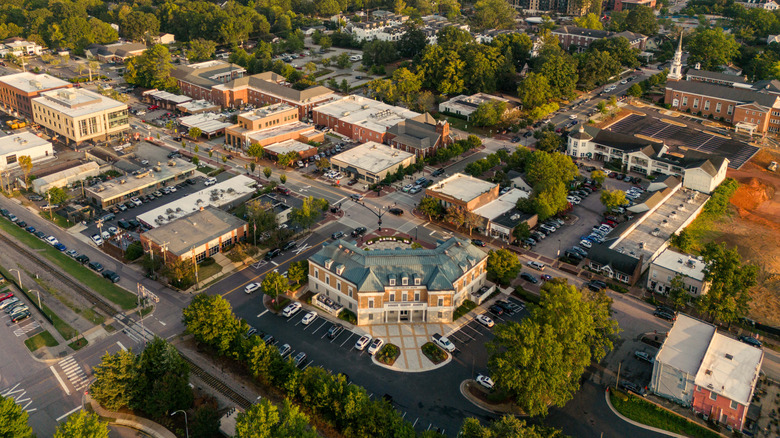
Located just 9 miles from North Carolina's state capital of Raleigh, Cary was named the best place to live in the South by Consumer Affairs. And while it's referred to as a town, Cary is the seventh-largest municipality by population in North Carolina, though that wasn't always the case. The number of its inhabitants exploded by 115% between 1990 and 2000, per Consumer Affairs. And with just over 182,000 people residing in Cary, its population is over 53 times larger than it was in 1960, when just 3,356 people lived there, per North Carolina Rabbit Hole.
According to Consumer Affairs, Cary is an attractive place to live due to its more than 200 miles of bikeable greenways and roads, its walkable downtown, and plentiful cultural programs. Data analytic website AreaVibes.com gives Cary an extraordinary livability score of 90 out of 100, notes that its crime rate is 41% lower than the statewide average and 34% lower than the national average, and gives an A+ grade for health and safety due to its multiple hospitals and doctors' offices. All these attributes make Cary an underrated place in North Carolina to retire. But where Cary, North Carolina really shines is its economy. In fact, it's part of the reason why Cary's population grew in the first place.
Cary has low unemployment, decent salaries, and thousands of businesses
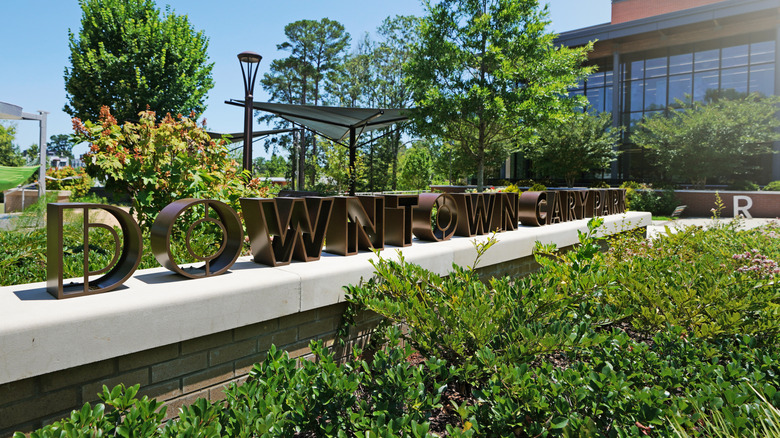
Cary's population and size started to swell in the 1960s, after the groundbreaking of Research Triangle Park (RTP) in nearby Durham, per North Carolina Rabbit Hole. Now measuring 7,000 acres and home to more than 300 companies, the RTP helped diversify North Carolina's economy and attract major corporations over the decades. It also inspired a lot of people from outside the South to move to Cary, which locals (jokingly) say stands for Containment Area for Relocated Yankees. Today, Raleigh-Cary is an economic hotspot in a state with one of the best economies in 2024 and 2025. As of September 2025, the metro's unemployment rate was 3.2%, according to the U.S. Bureau of Labor Statistics.
In Cary itself, 70.2% of inhabitants over the age of 25 have a bachelor's degree or higher, and the median household income is $129,399, per the latest U.S. Census Bureau statistics. Cary is home to the headquarters of software company SAS Institute, the regional headquarters of Swiss robotics company ABB, and 19 other companies that employ between 50 and 10,000 people, per Indeed.com. There were more than 4,400 actual businesses in Cary in 2022, per census figures. And, according to ZipRecruiter, Cary has job openings that pay between $44,500 and $154,500 a year, with most offering annual salaries from $75,000 to $115,000.
Living in Cary will cost you

When Consumer Affairs named Cary the best place to live in the South in February 2025, its staff reported that it was the eighth most affordable place in the South. This is no longer the case, especially when it comes to housing. According to Zillow, the average home in Cary, North Carolina was worth over $610,000 as of late 2025. That's higher than the national average ($359,000), the statewide average ($330,000), and the average in neighboring Raleigh ($427,000). The typical rental rate in Cary, as of January 6, 2026, was $2,100 a month, per Zillow Rentals. That's 5% higher than the national average and pricier than the statewide and Raleigh rental averages of $1,800 a month.
Factoring in other expenses like groceries, services, and utilities, Cary gets a D grade from AreaVibes for being 33% higher than the statewide average and 24% higher than the national average. In short, while Cary is a great location for those in the workforce, it isn't a place where a retiree can live on Social Security alone. But it is a better option for a retiree with a lot of savings than most beach towns in Hawaii.