

Finance Guru Jim Cramer Says 3 Assets Could Help You Retire Early
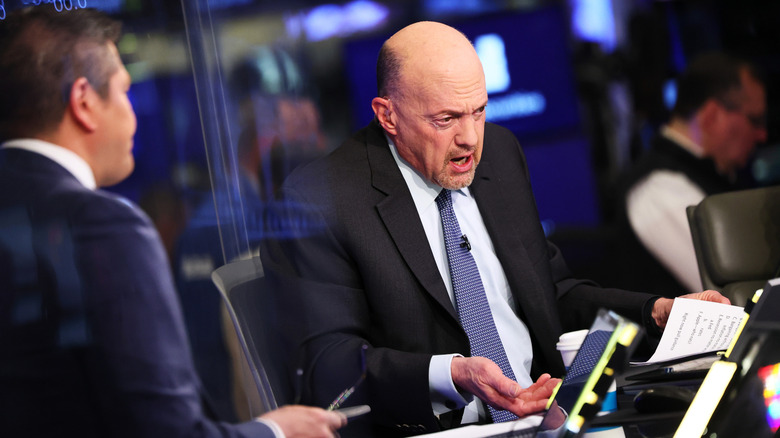
In September 2025, Jim Cramer, host of CNBC's "Mad Money," came out with a book of financial advice. Entitled "How to Make Money in Any Market," the book is meant to help readers rake in more cash than their workplace 401(k) or the average investor to achieve financial goals like early retirement regardless of the state of the economy. Speaking with CNBC, Cramer outlined three of the keys to obtaining above average returns and mitigating disaster, stating, "I want individual stocks, I want index funds and I want a little bit of gold or crypto. And that way I feel that you'll have the ability to be able to retire much earlier than other people."
Cramer has been a stock broker and hedge fund manager since the 1980s, when he did a three-year stint at Goldman Sachs before starting his own hedge fund, Cramer & Co. Cramer's offered plenty of good financial advice over the years, and GoBankingRates reports that between 1987 and 2000, his fund saw just one year of losses while the overall average return was 24%. In comparison, a good rate of return for your 401(k) is between 5% and 8%. In the years since starting his own fund, Cramer also co-founded TheStreet.com and has spent over two decades as a contributor to CNBC.
So, for those who want to try for a better return than what a $40,000 CD account can pay you in 2026, these are some of Cramer's central investing strategies.
Index funds can provide added safety from bad stock buys

An index is a numerical value based on the performance of a batch of assets like stocks or bonds, and an index fund is a mutual fund or exchange-traded fund (ETF) that attempts to mirror that performance. Focusing on index funds can be a solid investment strategy for beginners because they charge less money than actively managed firms and tend to be less risky. There are downsides to investing in index funds, such as limited control over your investments and the fact that they often yield considerably smaller returns compared to other assets. Cramer himself even wrote about being free from the "chains of middling returns" provided by index funds in his book, so the fact that he expressed to CNBC that a solid investment portfolio still "needs to have a hefty dose of index funds" underscores just how powerful of a tool they can be.
Cramer recommended that 45% or 50% of an investment portfolio be made up of index funds that mirror the performance of the S&P 500 or Nasdaq 100 to provide some "insurance against picking a few wrong stocks" that could suddenly plummet in value. As Cramer wrote, "You are going to make mistakes with some of your stocks." Making up a sizable portion of your portfolio with this more predictable type of asset can help ensure that those mistakes don't doom you altogether.
Individual stocks can compensate for underwhelming returns

In addition to highlighting the importance of diversifying your portfolio with index funds, Cramer also insisted that investors will need to put their money into individual stocks to yield more than mediocre returns. That's why Cramer suggested that an additional 45% of an investment portfolio should consist of five stocks that will provide growth over multiple decades. In his book, Cramer explained, "Buying and holding shares in best-of-breed companies can compound your money in spectacular fashion over time." The key word there is "holding," as Cramer also advised against planning to sell this portion of your portfolio if you can avoid it. As he told CNBC, "If it has a beginning and an end, I say don't own it, because I want owning. I don't want trading."
A younger investor might consider buying one or two short-term speculative stocks that can grow fast, but Cramer warned this will come with the risk of a big money loss. That's why even potential speculative investments should be researched thoroughly before making the plunge, and, once the buy is made, investors should track their picks regularly via quarterly earnings calls, Cramer said.
Above all, Cramer said investors should not buy questionable meme stocks like GameStop with the hope they'll gain so much value through internet hype that they can be sold to someone else at a high price. Such a strategy, Cramer opined, is "an easy road to disaster."
Gold and Bitcoin make solid hedges for a stock market crash.

The rest of an investment portfolio, between 5% and 10%, should be put in something that operates independently from the stock market, Cramer advised. That way, if there's a major stock market crash, you'll still have the value of this asset to provide some cushion. Cramer's favorite insurance hedge assets are gold and Bitcoin. "Unlike speculators who are buying gold or crypto and hoping it will make them rich, we are just using them to weather the storm," Cramer wrote in "How to Make Money in Any Market."
While there are caveats on when gold is worth buying due to price fluctuations, the rare earth element has been coveted for thousands of years. However, there is controversy about where cryptocurrencies get their value, with some critics insisting that the virtual assets are worse than a Ponzi scheme.
But Bitcoin advocates point out that, while there have been big price depreciations, its value has generally headed upward. The reason for this is that, unlike fiat currency, only 21 million Bitcoin can ever be created, and nearly 20 million have already been mined. VanEck, a multibillion-dollar hedge fund that owns significant amounts of Bitcoin, has even advocated that the federal government create a Bitcoin reserve to pay off the United States' $37 trillion of debt.