

Fast Food Chains That Are Slowly Disappearing Across America
It was once fairly common for fast food chains to emerge from seemingly nowhere, only to become household names over the years. Many of these brands become easily recognizable across multiple generations, and some go on to achieve global recognition. But even steadfast chains with thousands of franchise locations across the United States can feel the effects of economic shifts and changing dining trends. As things take a turn for the worse, locations can disappear and a once-popular chain can become a distant memory before many even realize what happened.
For the fast food brands that have since found themselves in this position, business focuses can shift away from growth and more toward taking the right steps to keep the chain from going completely under. But in the current economic climate, that process is only getting more difficult to undertake. According to a survey by Lending Tree, at least 78% of Americans consider fast food a luxury, and over 30% of people surveyed by Ipsos admit they've cut back on eating out.
Unfortunately for struggling chains, the restaurants with the widest reaches will likely be the ones Americans continue gravitating toward, and the gap between success and failure could continue to grow. This leaves the smaller players no choice but to cut costs and close down underperforming locations. These are eight once-beloved brands that have started to disappear from the U.S.
TGI Fridays
TGI Fridays credits itself not only with introducing the Loaded Potato Skin to the world, but for being the first place to offer a happy hour where young singles could meet for drinks. The brand had grown in popularity since the very first bar opened in 1965 in Manhattan, New York, eventually expanding into multiple states. At its peak in 2008, TGI Fridays had over 600 locations and was earning $2 billion annually. But then, in the 2010s, things began to move in a troubling direction.
TGI Fridays soon found itself struggling to stick out from other chain restaurants in its niche. While the brand successfully moved some of its signature dishes into supermarket freezers, the restaurant's ability to get customers to spend money started dwindling as the early 2000s came to a close. From 2014 through 2017, ownership changed hands multiple times, and CEOs have also come and gone repeatedly in the past decade. By 2024, CNN reports the company was down to 270 restaurants, and it filed for Chapter 11 bankruptcy that same year. In a press release, the company cited complications resulting from the COVID-19 pandemic as well as other financial hiccups for informing this decision. While there are still TGI Fridays locations scattered throughout much of the country, as of late 2025, there are only 79 in total.
A&W
Depending on where you live in the United States, it's entirely possible you only ever associated A&W with its iconic root beer soda and never even realized that the beverage was itself the byproduct of what is actually the very first fast food chain in U.S. history. Founder Roy W. Allen opened his first root beer stand in Lodi, California, in June 1919. He later partnered with employee Frank Wright — who put the "W" in A&W — and the brand was born. Through the decades, A&W expanded not just across America, but globally, opening restaurants in Canada and parts of Asia. Though this innovative brand would be credited with creating the bacon cheeseburger and world's largest root beer float, it just couldn't keep up with the competition as times changed.
According to the Chicago Tribune, A&W maxed out at over 2,400 locations in 1974. By the end of the 1980s, the brand was struggling as it fell behind rising stars like McDonald's, Burger King, and Wendy's — all of which continue to dominate the burger industry decades later. A&W could not keep up, and began to close down locations across the United States. The brand shrunk to the point that some people don't even realize it's still in business. Although A&W has not closed down for good, it's no longer operating at quite the capacity that it once was. It's currently down to about 400 locations spread across 37 states.
Quiznos
Many millennials no doubt remember Quizos' viral Spongmonkeys ad from the early 2000s. It spoke the bizarre language of early social media and helped the brand tap into a young adult customer base with its own sense of humor. But well before that, this fast food chain set itself apart from the competition by offering toasted subs years ahead of the likes of Subway, and for providing unique menu items to its customers. Restaurant Business Online reports that Quiznos managed to expand to around 5,000 locations by 2006, but it was all downhill from there. By 2010, that number was nearly cut in half.
Throughout the 2010s, Quiznos faced multiple lawsuits by dissatisfied franchise owners, who complained about questionable business practices. It also didn't help that the chain was arguably at its peak just ahead of the Great Recession that left Americans with less money to spend on fast food. The combination of scandal and lost customers caused Quiznos to lose pace as Subway gained significant ground thanks to its iconic $5 Footlong campaign.
Quiznos would ultimately file for bankruptcy in 2014. Though the independently owned franchises — which made up the majority of the chain at the time — weren't directly impacted by this decision, the writing was on the wall. As the years passed, more and more chain locations closed their doors. As of December 2024, there are about 148 Quiznos still operating in the United States and 183 locations in international markets.
Ruby Tuesday
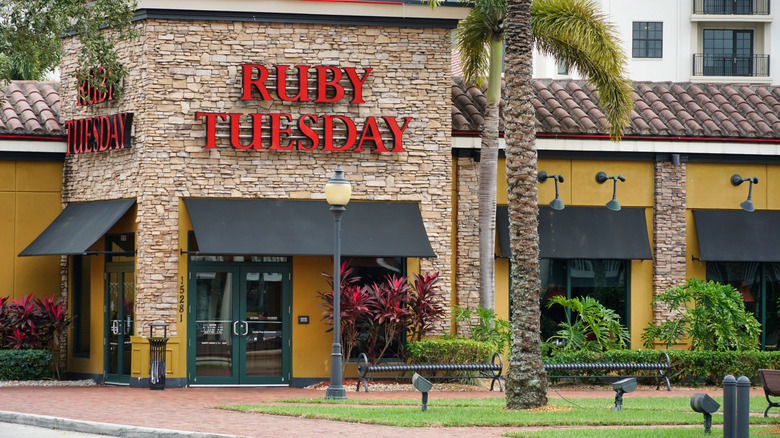
Ruby Tuesday used to be among the most popular sit-in restaurant chains in the United States. The very first location opened in Knoxville, Tennessee, in 1972. The brand was able to successfully expand thanks to the popularity of its Endless Garden Bar and the affordable nature of its menu. It reached the peak of its success in 2009, when the chain had around 900 active restaurants. Unfortunately, Ruby Tuesday's golden age coincided with the incoming recession and major shifts across the fast food industry. Some brands like McDonald's successfully adapted through the creation of a Dollar Menu strategy, but like many other chains, Ruby Tuesday's decline began in earnest as the chain struggled to navigate those changing times.
Rather than offer more affordable fare, Ruby Tuesday opted to get rid of its popular salad bar and shifted to a more luxurious caliber of menu items that both failed to impress the intended demographic and alienated existing customers. The result was a massive decline in foot traffic and sales, which ultimately led to a wave of chain closures. Ruby Tuesday eventually found itself at least $100 million in debt, and by 2020, the once-beloved restaurant was on the verge of bankruptcy. It ultimately filed for Chapter 11 in 2020, and the company has continued to struggle in the years since. As of 2025, there are only about 200 Ruby Tuesday locations still in operation.
Denny's
In 2025 alone, Denny's will reportedly have shut down over 150 locations, a sign of just how far the once-popular chain of diners has fallen. Denny's, which first opened in 1953, built its reputation on letting customers sit in and order delicious burgers at all hours, something that set it apart from other fast food and restaurant chains that closed their seating areas to diners earlier in the evening. The brand went public in the late 1960s, and continued to innovate its menu and steadily grow into the 1980s. Though the chain has undeniably remained culturally relevant in the decades since, recent developments show the company's success may have reached a plateau.
As of June 2025, the Denny's website reports there are 1,558 active locations worldwide — the vast majority of which are franchises. And while there aren't many companies on this list with over 1,000 open restaurants, that number has likely dwindled in recent months and the brand has had to make some tough strategic moves. In November 2025, the company announced it was acquired by a trio of investment entities for $620 million. Between this sale and the recent series of closures, Denny's may wind up heading in a positive direction again. However, success in the current economic climate will likely require a more intricate strategy than simply inventing another fancy breakfast plate or offering 24-hour service.
Boston Market
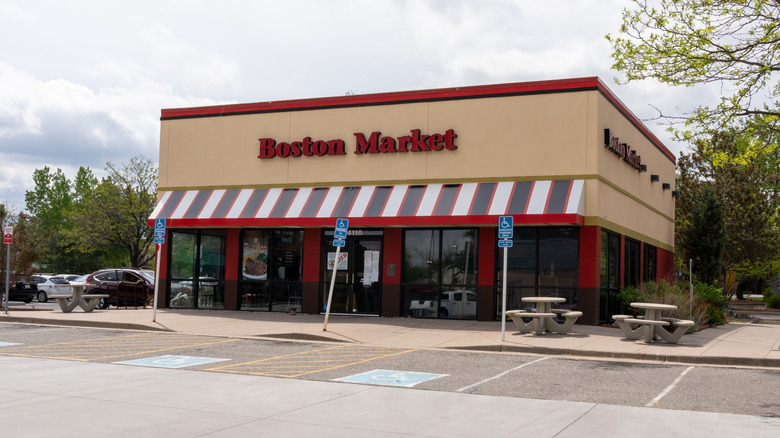
The near erasure of the Boston Market chain might be one of the most harrowing instances of a brand vanishing from the American consumer landscape since the downfall of Blockbuster Video. In the 1990s, Boston Market reportedly had roughly 1,200 restaurants thanks to a successful nationwide expansion. However, it was around that time that the company also started running into trouble, first filing for Chapter 11 bankruptcy in 1999. By late 2022, Restaurant Business reports the chain was down to around 300 locations, with more and more shutting their doors in the years that followed.
Despite Boston Market's best efforts to re-expand and reinvigorate customer interest, none of its menu changes or short-term gimmicks caught on. What the public did become aware of was a series of forced closures in New Jersey due to workers' rights violations. Moreover, Boston Market was sued in 2024 for over $11 million in unpaid bills, further exacerbating its financial woes.
In 2024, Restaurant Business claimed there were as few as 16 locations still operating, though Boston Market's website suggests there could be at least a few dozen scattered throughout the Northeast. Regardless of the exact number, the company is so clearly depleted that many Americans would be forgiven for assuming it was already out of business.
Taco Bueno
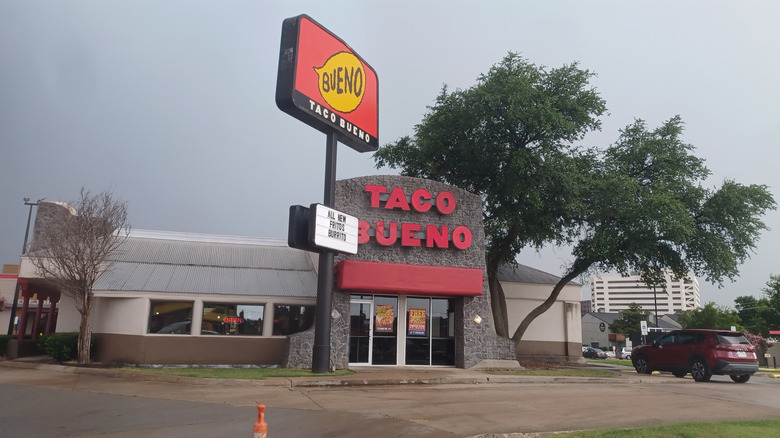
When it comes to Mexican or Tex-Mex fast food chains, Taco Bell and Chipotle are most likely the first companies that spring to mind. However, in 2016, a Market Force study sent shockwaves through the industry when Taco Bueno bested several larger companies to be named America's favorite Mexican fast food chain (via Business Insider). At the time, the Texas-based chain had successfully grown to 175 locations across seven states.
Unfortunately, this recognition and level of growth would ultimately represent the top of the mountain for Taco Bueno. Despite its potential, the company filed for Chapter 11 bankruptcy protection in November 2018. As Restaurant Business reports, the surprising move came after a period of heavy rainfall in Texas directly resulted in a 20% decline in sales. Weighed down by $130 million worth of debt, Taco Bueno was quickly sold to Sun Holdings. The overall goal was to pursue a level of restructuring that would ease the company's financial burden to the point that it could continue to operate in some form.
Taco Bueno doesn't seem headed for immediate closure, but it has gotten smaller. As of December 2025, the Taco Bueno website lists 128 locations in the United States. Unless it's able to successfully implement plans to re-grow its brand, the chain may continue to disappear from the minds of the very Americans who boosted it above far more established Mexican fast food chains in 2016.
Steak 'n Shake
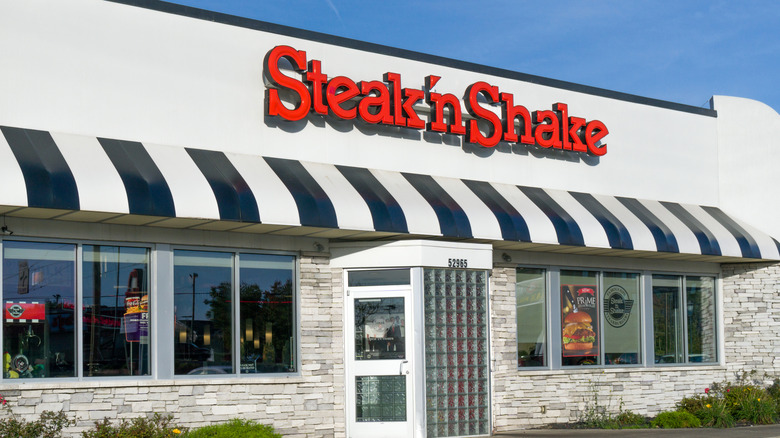
As its name suggests, Steak 'n Shake is a fast food chain best known for its unique steak burgers, routinely paired with homemade milkshakes. First founded on the iconic Route 66 in 1934, Steak 'n Shake soon became associated with a retro, 1950s aesthetic. While other burger chains insisted on changing over the years, Steak 'n Shake distinguished itself as a place where you could practically step back in time while enjoying delicious fast food. This approach contributed to the company's national popularity, allowing it to expand nationwide. By 2018, QSR Magazine reports there were 626 Steak 'n Shake locations across the United States, representing the brand's peak.
Steak 'n Shake first ran into serious trouble during the COVID-19 lockdown of 2020. The quarantine era was hard on many fast food and restaurant chains, but the loss of revenue led to the chain's first notable series of closures. By 2024, Steak 'n Shake had closed roughly 200 restaurants. This is yet another case where the company isn't exactly straining to survive. In fact, it's one of the few entries on this list that's actually managed to skirt bankruptcy completely. Even so, turning its fortunes around completely will be an uphill battle, and only time will tell if Steak 'n Shake will ever come close to returning to its former glory.