

Hospital Costs Medicare Won't Cover For Seniors

Retirees may know that Medicare doesn't cover inpatient hospital costs forever, as Medicare Part A covers the first 60 days of the cost for the time in the hospital after you meet your deductible. Starting on day 61, beneficiaries must pay a daily coinsurance amount. For very long hospital stays, patients may eventually be responsible for all costs.
However, paying attention to the number of days Medicare will pay your hospital costs provides only part of the picture for seniors. It's also important to understand that Medicare does not cover certain hospital service costs, even during the first 60 days of inpatient care. Such services go beyond what Part A approves.
These types of hospitalization and health care costs can surprise retirees, as understanding what Medicare does and doesn't cover can be extremely confusing. A recent eHealth survey shows that 75% of beneficiaries feel confused about choosing the right Medicare plan. Learning more about what Part A doesn't cover may clear up some of the confusion related to hospitalization costs and Medicare coverage. The most common inpatient hospital services that Medicare does not cover include private rooms and private-duty nursing. However, you could also receive unreimbursed charges for unusual situations, such as a television or phone that must be added to the room, personal care items that the hospital charges extra for, and even the first three pints of blood received in a transfusion.
Medicare Part A usually doesn't cover private rooms

One of the most expensive items you may have during a hospital stay that Medicare Part A doesn't cover is a private room. The private room is defined as one that the Medicare recipient does not share with another patient, while a semi-private room usually has at least two beds for patients, separated by a curtain or partition. The amount you'll pay depends on the hospital and its individual rates, but private rooms are more expensive than semi-private rooms. If a patient chooses a private room, they will need to pay the difference in cost between the semi-private and private room.
Medicare offers a few exceptions to the private room rule. If you are admitted to the hospital and no semi-private rooms are available, you will not be charged for the private room. Additionally, some hospitals may only offer private rooms, and you would not have an extra charge in this case. Your doctor could also deem that having a private room is a medical necessity for you. Medicare defines medical necessity as care that's "reasonable and necessary" for diagnosis or treatment, based on evidence. This designation may occur if the patient has a communicable disease that might place a second patient in the room in jeopardy of contracting it. Additionally, a patient might need a private room because the doctor believes isolation enhances the chances of a full recovery.
A private nurse for inpatient hospital care is not covered

If you choose to hire a private-duty nurse (PDN) to help you with care while you're in the hospital, Medicare will not cover the cost of this skilled professional's one-on-one work. Some patients who use a private-duty nurse at home may want to continue that care during a hospital stay. Medicare does not cover 24-hour nursing care inside your home, and it will not cover this expense in the hospital, either.
A private-duty nurse is a trained or licensed professional attendant hired to help with care. Frequently, these people are registered nurses or licensed practical nurses. This professional would provide one-on-one care, usually for someone who has a medical problem that requires having a caregiver available continuously. Hiring a PDN at your home is more common than having one at a hospital. They can provide the focused care you need to remain healthier and avoid having to go to the hospital as often.
This type of focused, personalized care is not part of normal hospital services, though, as PDNs are not on staff. Instead, hospitals provide nurses who take care of multiple patients during their shifts, with the nurse-to-patient ratio depending on the type of care provided and the level of illness of the patients.
If a TV or phone in a room has an extra cost, you'll pay it
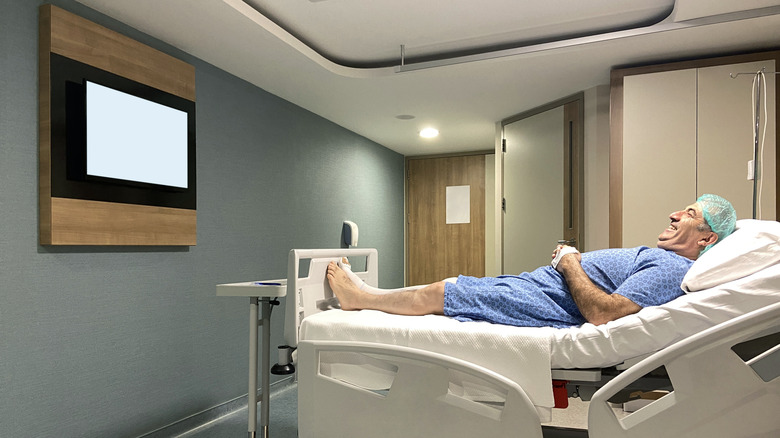
Although most hospital rooms have a television in them to provide distractions and to keep boredom at bay for patients, not all types of rooms carry TVs, including some associated with mental illness care or intensive care. Older hospital rooms might not have space for TVs. Rooms where infection control must be at the highest level might skip televisions and remote controls. A room made for multiple people also might not include a TV because it would generate unwanted noise.
Some hospitals include televisions in every room, but the facility occasionally adds the charge of using the television to the bill. If a hospital charges extra for television use, or if the patient requests a TV for a room that doesn't have one and receives a charge, Medicare Part A will not cover the cost
Hospitals have long used landlines for trusted communications, including having these wired telephones in the patient rooms that patients can often use for free. However, if the hospital charges you for using the landline phone in the room, charges for long-distance calls, or bills you for having a telephone added to a hospital room that doesn't normally have one, Medicare Part A doesn't reimburse its costs.
Medicare doesn't cover extra charges for personal items

When going to the hospital for inpatient care, you might leave the house in a hurry because of an emergency situation. You also might not know how long you'll be staying. In these situations, it's common for people to fail to anticipate some of the personal care items that they need to bring. If you need personal care items during a hospital stay and the hospital charges for them, Medicare Part A won't cover these costs.
Depending on your health situation, some of the personal care items you might want during a hospital stay include razors, slipper socks, shampoo, toothpaste, a toothbrush, lip balm, deodorant, and hand lotion. If you receive some of these items from the hospital during your stay, it might list them as supplies instead of splitting out each item's cost, which can make it tough to understand why Medicare won't cover them. Some hospitals charge for all personal care items, while others don't.
If you're worried about having to pay for these items, you should ask family members to bring anything you forgot. If you know you'll be going to the hospital in a few days, take the time to pack a bag that contains all the personal items you think you might need.
Sometimes, Medicare won't reimburse the cost of blood

Although there are many Medicare mistakes that retirees should take steps to avoid, some add-on costs during an inpatient hospital stay that Medicare Part A won't reimburse are partially beyond your control. If you need a blood transfusion during your inpatient hospital stay, Medicare Part A will usually cover the cost of the transfusion. However, if the hospital purchases the blood and creates a charge for it on your hospital bill, Medicare Part A might not cover the cost for the first three pints you receive.
If the hospital has enough of your blood type on hand and doesn't have to purchase it, it might not charge you. In that case, because there's no extra charge on the hospital bill, there's no worry about Medicare Part A's coverage.
Patients can sometimes avoid this charge by replacing the blood through donation, either personally or through a family member. You can donate blood before you have an inpatient procedure done at a hospital or afterward. As long as someone donates and replaces the three pints of blood needed, Medicare will not charge an additional fee. If you are receiving plasma instead of whole blood for your procedure, the charge is usually waived.